
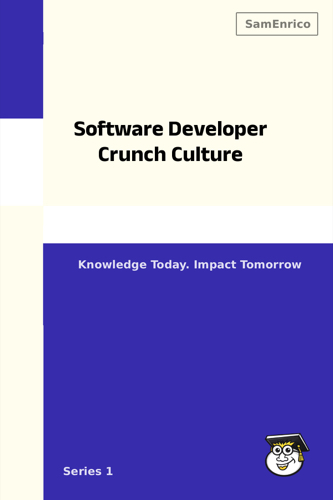
Software Developer Crunch Culture eBook
Resists death march deadlines and late nights.
Resists death march deadlines and late nights.
Formats
Free sample
Chapter 1: The 2:1 Impossibility...--The morning of April 15th started like any other for Sarah Chen. She poured her coffee, scanned her calendar, and clicked into the first Slack thread of the day. By 9:14 AM, her heart was already racing."Hey team, great news!" wrote Mark, the Vice President of Product. "We've aligned with leadership and are accelerating the Q3 feature to end of this month. I know it's aggressive, but I have full confidence in this group.
Let's show them what we're made of."Sarah stared at the message. The Q3 feature was a six-month project. They had four developers. The current sprint was already overbooked. Today was April 15th.
The end of this month was fifteen days away.She typed a careful response: "Mark, just to clarify—are you asking us to deliver the analytics dashboard by April 30th? We estimated that at 24 person-weeks of work for our current team size."His reply came within ninety seconds: "I'm not asking. I'm telling. No excuses. We have investor promises to keep."That Thursday became the first of many 80-hour weeks.
Sarah slept under her desk twice. She cried in the bathroom once—on day nine, when she realized her daughter's school play had happened without her. She delivered the feature on April 30th, a broken mess of technical debt held together with conditional statements and hope. The system crashed that weekend. The on-call rotation spent seventy-two hours debugging code that should never have been written.Her reward?
A tepid "thanks" in a company-wide email, a $50 gift card to a coffee chain she didn't drink from, and a new deadline: the next feature, even more impossible, due in three weeks.Sarah quit six months later. She spent two months recovering from burnout before she could look at an IDE without nausea. Her replacement—let's call him David—lasted four months. The person after him lasted six weeks. The project eventually shipped eighteen months late, over budget by 400%, and the company lost its investor funding anyway.This story is not unusual.
It is not extreme. It is, by the standards of the software industry, utterly normal. And that is the problem.What This Book Is (And What It Is Not)This is not a book about "resilience." It is not a collection of mindfulness exercises to help you tolerate the intolerable. It is not a guide to "managing your stress" while your employer systematically dismantles your health, your relationships, and your capacity for joy. Those books exist.
They have their place. But they miss the fundamental point: the problem is not that you are too weak to handle the pressure. The problem is that the pressure should not exist in the first place.This book is a survival manual and a strategic playbook for software developers who are tired of being told that 60-hour weeks are "just how the industry works." It draws from the collective wisdom of foundational texts—Edward Yourdon's Death March, Tracy Kidder's The Soul of a New Machine, Jason Schreier's Blood, Sweat, and Pixels, and modern analyses of tech burnout—but it does something those books do not. It moves beyond diagnosis into action. While most literature teaches you how to survive a death march, this book teaches you how to prevent, resist, and escape them.The core argument is simple and, to many, controversial: the "hero" programmer who works 80-hour weeks is not an asset.
She is a liability. Every hour beyond forty-five hours per week produces negative value—not just diminishing returns, but actual damage. Bugs multiply. Technical debt compounds. The "hero" creates more work for everyone else while burning herself out.
True professional excellence comes from sustainable velocity, data-driven negotiation, and setting firm ethical boundaries.The Developer Who Never Sleeps Let me tell you about Alex. Not the real name, but a composite of dozens of engineers I have interviewed over the past five years.Alex graduated from a top computer science program with honors. He joined a well-funded startup in San Francisco, excited to build things that mattered. Within three months, he was working 60-hour weeks. Within six months, 80-hour weeks.
Within a year, he had his first panic attack during a code review—not because the feedback was harsh, but because his body simply gave out."It was like my brain short-circuited," Alex told me. "I was looking at a pull request that changed three lines of code. I couldn't understand it. I couldn't read it. I started crying at my desk at 2 AM and I didn't even know why."Alex took two weeks off.
His manager called him every day. He came back to a backlog of 200 unread emails and a Slack channel where his name had been mentioned thirty-seven times. Within a month, he was back to 80-hour weeks. Within six months, he quit.Here is what Alex learned, too late to save that job: the industry has normalized what should be considered abuse. There is no other profession where working twice the standard hours is celebrated as "dedication." No other profession where sleeping under your desk is a badge of honor.
No other profession where the people who destroy their health are promoted while the people who set boundaries are called "not team players."Defining the Death March Edward Yourdon, in his seminal book Death March, defined the concept with brutal clarity. A death march is not merely a difficult project. It is a project whose parameters exceed the known limits of physics, resources, or human endurance by a factor of at least 2:1.Let me repeat that: at least 2:1.If a project realistically requires 200 person-weeks of work, and you have four people and six weeks, that is a death march. The math does not work. It cannot work.
No amount of heroism, no number of late nights, no quantity of caffeine will make the math work. The only question is how many people will be sacrificed before the project inevitably collapses or is saved by factors outside anyone's control.Yourdon identified five diagnostic indicators of a death march. I have seen each of them in every toxic workplace I have ever studied.Indicator One: Impossible Deadlines The first indicator is the most obvious: deadlines that bear no relationship to engineering reality. These deadlines are almost always set by calendars rather than by work. "We must ship before Christmas." "The conference is in May, so we need it by April." "The investors are visiting in two weeks, so we need a demo by then."The calendar-driven deadline is the enemy of rational planning.
It assumes that the universe will bend to the will of the executive who chose a date. The universe, unfortunately, does not care about your investor pitch.Here is a litmus test: if the deadline requires 200 person-weeks of work and you have four people and six weeks, it is a death march. There is no negotiation. There is no "working smarter." The math is the math.Indicator Two: Inadequate Resources The second indicator is the complement of the first: too few people, broken tools, no QA, no documentation, or—most commonly—all of the above. The "resource triangle" of people, time, and scope is the fundamental constraint of all project management.…
This is the end of the free sample. Get the eBook to keep going. Buy now
About this book
Details
- Author
- Hanna Herminia
- Publisher
- SamEnrico
- Language
- English
- Genre
- Non-Fiction, Self-Help, Tech
- Released
- 2026-06-06
- Pages (approx.)
- 130
- Available as
- eBook, Audiobook

Read better in the ZLOADR app
Your eBooks on your phone or tablet. Sign in with your SamEnrico account and start reading.
More by Hanna Herminia
 Team Creative Feedback CircleHanna Herminia$11.99
 Workplace Stress for ImmigrantsHanna Herminia$11.99
 Carson DDT CrusadeHanna Herminia$11.99
 Warm Outreach Validation GuideHanna Herminia$11.99
 Habit JournalHanna Herminia$11.99
 Terrorism Attack Dream WorkHanna Herminia$11.99
 Bipolar Support Group Facilitation GuideHanna Herminia$11.99
 Vietnamese Green IncentivesHanna Herminia$11.99
 The Silent Banquet: A Royal Feast of BetrayalHanna Herminia$11.99
 Beneath the Glass: The Unseen Metropolis of Venice's Forgotten FoundationsHanna Herminia$11.99
 The Silent Betrayal: How a Whistleblower Exposed the World’s Largest Corporate Cover-UpHanna Herminia$11.99
 MLA Works Cited Page GuideHanna Herminia$12.99
You may also like
 Technology Anger TriggersJustus Hank$11.99
 Incognito Mode AccountabilityFaber Kayleen$11.99
 Work Addiction in Tech IndustryKroll Nu$11.99
 TM App and Timer GuideTownes Wei$11.99
 Outsourcing for Tech StartupsDevries Janette$11.99
 The Software Engineer Crunch ModeCarrington Cassidy$11.99
 The Breath Counting App SupplementDonnell Lavelle$11.99
 Anger for Software EngineersRatcliff Claris$11.99
 Food Addiction Recovery for Software EngineersLusk Deirdre$11.99
 Remote Work VPN GuideBlaine Melisa$11.99
 Technology for Caregivers GuideOtis Norine$11.99Technology for Caregivers GuideOtis Norine$11.99