
Non-FictionInformativeEducational
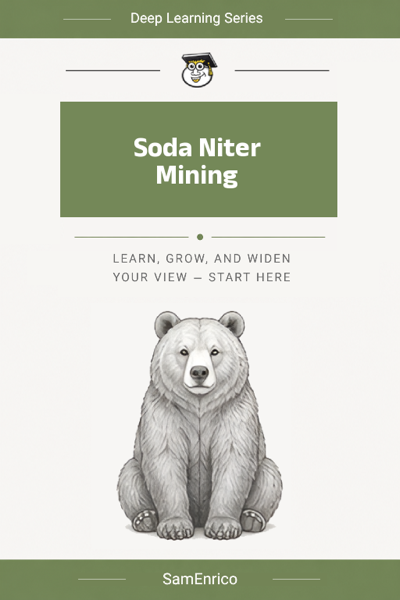
Soda Niter Mining eBook
A Coursebook on Soda Niter Mining
A Coursebook on Soda Niter Mining
Formats
Free sample
Chapter 1: The Buried Fortune--The ground beneath the Atacama Desert does not look like treasure. It looks like cracked, sun-baked earth the color of rust and bone, stretching endlessly toward mountains that pierce a sky so blue it seems almost artificial. For centuries, the indigenous peoples of the Atacama crossed this land—the driest non-polar desert on Earth—and they knew certain patches of soil tasted strange. Bitter. Sharp.
They used it sparingly, as a curiosity, a seasoning, perhaps a primitive preservative for meat. They did not know that they were standing on a substance that would reshape the global economy, trigger a war between three nations, fund the construction of the London Underground, and eventually find its way onto the breakfast plates of millions of people every single morning.Today, that substance has a quiet, almost boring name: sodium nitrate. But in the nineteenth century, it was called "white gold," and men killed for it.This is not a book about chemistry, though chemistry will fill these pages. It is not a book about mining, though you will learn every step of how this mineral is pulled from the earth. This is a book about hidden connections—the invisible threads that tie a desert in South America to a bacon sandwich in New York, a solar power plant in Morocco, and a glass skyscraper in Dubai.
It is about a mineral that most people have never heard of, yet without it, modern life as we know it would look very different.The White Gold Rush That History Forgot In the 1830s, a French mineralogist named Alfred Désiré Clément traveled to the Atacama Desert, which at the time was part of Peru (what is now northern Chile). He was not looking for treasure. He was studying geology, mapping rock formations, doing the kind of quiet scientific work that rarely makes headlines. But when he analyzed samples of the local soil—a strange, whitish crust the locals called "caliche"—he discovered something extraordinary.The caliche contained extraordinarily high concentrations of sodium nitrate.The implications were staggering. In early nineteenth-century Europe and North America, farmers faced a chronic crisis: their soil was exhausted.
For centuries, they had grown crops on the same fields without understanding the chemistry of nitrogen depletion. Crop yields were falling, and populations were rising. The one reliable source of nitrogen fertilizer at the time was guano—the accumulated excrement of seabirds, primarily from islands off the coast of Peru. Guano worked wonders, but it was finite, messy, and increasingly expensive. The British Empire had already fought a "Guano War" in the 1860s, and the US Congress had passed the Guano Islands Act of 1856, allowing American citizens to claim any unoccupied island containing guano anywhere in the world.
The hunger for nitrogen was that intense.Now, Clément had found something potentially even better: mountains of nitrate, stretching for hundreds of kilometers, often lying just beneath a thin layer of gravel. It was not as concentrated as guano, but there was far more of it. And unlike guano, which required tedious manual collection from bird-covered cliffs, this white gold could be mined with picks and shovels and eventually steam shovels and explosives.The word spread slowly at first. A few Chilean entrepreneurs began digging small pits, hauling caliche to makeshift processing stations where they boiled it in iron pans to extract the nitrate. The product was crude, but it worked.
When European farmers tested Chilean nitrate on their wheat fields, yields jumped by thirty to fifty percent. Word spread like wildfire through the agricultural journals of England, France, and Germany.Then, in the 1870s, everything exploded.The Nitrate Boom, which lasted from approximately 1870 to 1930, transformed the Atacama Desert into one of the most economically valuable pieces of real estate on Earth. But there is a critical historical correction that most accounts miss: the boom did not end simply because the Great Depression starved demand. It ended because synthetic nitrate had already begun to eat the market years earlier. The German chemists Fritz Haber and Carl Bosch developed their process for synthesizing ammonia from atmospheric nitrogen in 1909, and by 1913, the first industrial Haber-Bosch plant was operating in Germany.
By the 1920s, synthetic nitrates were already displacing Chilean product in European fertilizer markets. The Great Depression was the knockout punch, but the fight had been going on for nearly two decades before that.Understanding this overlap matters because it reveals a pattern that echoes through the entire history of industrial minerals: no natural monopoly lasts forever. Technology always catches up. And when it does, the landscapes—and the people—left behind often pay a terrible price.The War of the Pacific: Blood for Saltpeter To understand the modern soda niter industry, you must understand the War of the Pacific (1879–1884). This conflict is largely forgotten outside of South America, but its consequences shape the region to this day.
The war began as a dispute over nitrate taxes, escalated into a full-scale territorial invasion, and ended with Bolivia losing its entire coastline—a loss the country has never accepted.Here is the simplified version: At the time, the Atacama Desert was contested territory. Bolivia controlled the inland areas, Chile controlled the coast to the south, and Peru controlled the northern desert. The richest nitrate deposits lay in what was then Peruvian territory, near the towns of Iquique and Antofagasta. Chilean mining companies, backed by British capital, were operating in those Peruvian and Bolivian territories, extracting nitrate and shipping it through Chilean ports. When Bolivia attempted to raise taxes on one of those Chilean companies (a violation of a prior treaty), Chile protested.
When Bolivia refused to back down, Chile sent a naval force.The war lasted five years. Chile's better-equipped navy destroyed the Peruvian fleet in a series of dramatic naval battles, including the famous engagement between the Peruvian ironclad Huáscar and the Chilean fleet. On land, Chilean forces advanced north through the desert, taking Iquique, Arica, and finally Lima, the Peruvian capital. When the guns fell silent, Chile had seized approximately 200,000 square kilometers of territory—everything from the southern border of Peru to the northern boundary of Bolivia. Bolivia was left completely landlocked, a condition it has protested ever since.The human cost was enormous.
Perhaps thirty thousand soldiers died, most from disease and exposure rather than combat. The economic cost was also staggering: Peru and Bolivia lost their nitrate wealth, while Chile suddenly controlled the world's only commercial source of natural sodium nitrate. For nearly half a century, Chile had a global monopoly.But here is the detail that nitrate history books often omit: that monopoly was never entirely Chilean. The mines were owned, managed, and financed largely by British corporations. The Nitrate Railways Company, the Bank of London, and a shadowy British financier named John Thomas North—the so-called "Nitrate King"—pulled the strings from London boardrooms.
North never set foot in a mine. He bought nitrate certificates, leveraged them, and built a vertical monopoly so tight that he could set global fertilizer prices from his drawing room. Chilean miners worked the caliche, but the profits flowed across the Atlantic.This pattern—resource extraction by foreign capital—would repeat itself across…
This is the end of the free sample. Get the eBook to keep going. Buy now
About this book
Details
- Author
- Meacham Shanel
- Publisher
- SamEnrico
- Language
- English
- Genre
- Non-Fiction, Informative, Educational
- Released
- 2026-05-09
- Pages (approx.)
- 144
- Available as
- eBook, Audiobook

Read better in the ZLOADR app
Your eBooks on your phone or tablet. Sign in with your SamEnrico account and start reading.
More by Meacham Shanel
 Iroquois Maple Syrup EmpireMeacham Shanel$11.99
 Marriott Status ComparisonMeacham Shanel$11.99
 The Arthritis NSAID GuideMeacham Shanel$11.99
 The Bedtime Self Talk RewiringMeacham Shanel$11.99
 Assertiveness for SalesMeacham Shanel$11.99
 The Plague Doctors of Venice: Medicine and Mystery in the Age of ShadowsMeacham Shanel$11.99
 DCAA Compliance MinorityMeacham Shanel$12.99
 Credit Score Rate Impact GuideMeacham Shanel$12.99
 Understanding Short Stature Robin Sequence Cleft Mandible Hand Anomalies ClubfootMeacham Shanel$17.99
 How to Start a Dressing and Dying of Furskins and Hides With The Hair On Business (Beginners Guide)Meacham Shanel$11.99
You may also like
 Hong Kong Handover 1997Dunn Johnnie$11.99
 Zumba For Postnatal Recovery CourseNeal Christian$11.99
 Zumba for BeginnersLadner Nikia$11.99
 YouTube Comment Mining GuideHumes Pandora$12.99
 Worry Box MeditationCarlin Rudy$11.99
 Workplace Stress MeditationNguyen Lynn$11.99
 Workplace Stress and Sleep RepairHawley Ivory$11.99
 Workplace Perfectionism CureDelaney Jeffry$11.99
 Workplace Injustice Anger GuideWallen Isabelle$11.99
 Work Addiction and Burnout LinkGreenwood Ester$11.99
 Women in Yoga and WellnessBeattie Galina$11.99
 Women in Stand Up ComedyChun Evangeline$11.99