
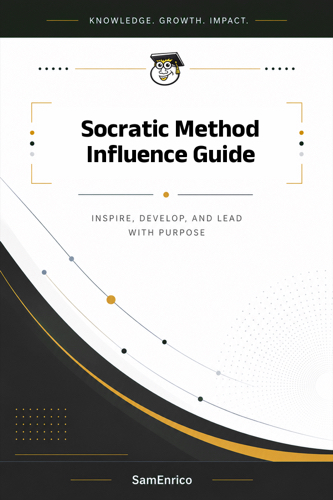
Non-FictionSelf-HelpSocraticQuestions
Socratic Method Influence Guide eBook
Use questioning to guide others to your desired co
by Mcewen Meta
Use questioning to guide others to your desired conclusions.
Formats
Free sample
Chapter 1: The Truth Trap--–- The conference room was silent except for the hum of the projector. Maria, a senior marketing director with fourteen years of experience, had just finished her presentation. She had prepared for weeks—forty-seven slides, eighteen data sources, three independent case studies, and a financial model that any CFO would admire. Her conclusion was clear: the company should reallocate 15% of the print budget to digital advertising. The evidence was, in her words, "irrefutable."Her boss, David, leaned back in his chair.
He had been with the company for twenty-two years. He believed in print. He believed in what had always worked. He looked at Maria and said, "I appreciate the research, but I think you're wrong. Print still drives our core demographic.
The data doesn't tell the whole story."Maria did what any rational person would do. She presented more evidence. She walked through the data again, slower this time, highlighting the key metrics. She showed the return on investment comparisons. She explained the methodology.
She was factually correct on every single point.David's jaw tightened. "We're not changing the budget," he said. "End of discussion."Maria left the room defeated. She had been right. She had the facts.
And she had lost.Three weeks later, Maria was having coffee with a colleague from the sales team. The colleague listened to the story and then asked a simple question: "What if you hadn't shown him any data at all? What if you had just asked him questions?"Maria blinked. "What do you mean?"The colleague smiled. "What if you had asked him, 'How do you measure the success of our current print budget?' And then, 'What would need to change for you to consider a different allocation?' And then, 'If we could prove that digital reaches the same demographic at half the cost, would you want to see that data?'"Maria realized something that would change the way she led conversations for the rest of her career.
She had been trying to push her conclusion through the front door. She should have invited David to walk through the side door—the door of his own reasoning.This book is about that side door.The Backfire Effect: Why Being Right Makes You Wrong The problem Maria encountered is not a failure of evidence. It is a feature of the human brain. In 2006, researchers Brendan Nyhan and Jason Reifler conducted a landmark study that would upend the assumption that facts persuade. They presented participants with a fictional news article about a weapons inspection report.
Some participants were told that the report found weapons of mass destruction. Others were told the report found no such weapons. Then, the researchers presented corrective information—the truth that no weapons had been found.What happened next was astonishing. Among participants who initially believed weapons were present and who held strong political views supporting that belief, the corrective information did not change their minds. It did the opposite.
They became more convinced that weapons existed. Their original belief had been challenged, their identity had been threatened, and they doubled down.This is the Backfire Effect. When you present someone with evidence that contradicts their existing belief, you trigger a threat response. The brain does not process the evidence neutrally. It processes it as an attack.
The more evidence you provide, the more entrenched the other person becomes.Consider a simple experiment you can run yourself. Find someone who holds a strong opinion about a local issue—traffic, school policy, a sports team. Present them with a fact that contradicts their position. Watch what happens. Do they say, "Oh, I didn't know that.
I've changed my mind"? Almost never. Instead, they will explain why the fact is wrong, or misleading, or incomplete. Or they will change the subject. Or they will attack your source.
Or they will get quiet and resentful.None of these responses mean the person is stupid or irrational. They mean the person is human. The Backfire Effect is not a flaw in reasoning. It is a defense mechanism. The brain's primary job is not to find truth.
Its primary job is to protect the self. When you tell someone they are wrong, you are not just challenging an idea. You are challenging their competence, their judgment, and their identity.The implications for influence are profound. If presenting evidence is the least effective way to change someone's mind—and often backfires—then the traditional model of persuasion is backwards. The traditional model says: gather evidence, build a case, present it clearly, and win the argument.
This model works in a courtroom, where a judge is paid to be objective. It works in a scientific paper, where peer reviewers are trained to follow evidence. It does not work in a conference room, a kitchen table, a car ride, or a text message.Maria was playing by the rules of a courtroom. She should have been playing by the rules of a conversation.The Illusion of Control: Why Telling Creates Resistance There is a second psychological mechanism at work, even more powerful than the Backfire Effect. It is called reactance.
When people feel that their freedom to choose is being threatened, they experience an aversive emotional response, and they act to restore that freedom—often by doing the opposite of what they are being told.Imagine a parent telling a teenager, "You cannot go to that party." What does the teenager feel? Not compliance. A burning desire to go to the party. The parent's control triggers reactance. Now imagine the same parent asking, "What are your plans for Saturday night?
And what would make you feel safe if you went out?" The dynamic changes immediately. The parent is no longer the enemy. The parent is a collaborator.This is the Illusion of Control. When you tell people what to think or do, you create the illusion that you are in control. But that illusion is expensive.
It costs you their buy-in, their creativity, and their willingness to cooperate. The moment you tell someone the answer, you remove their autonomy. And when you remove autonomy, you remove ownership.Let us define ownership precisely. Psychological ownership is the feeling that an idea, decision, or outcome belongs to me. It is mine.
I created it. I am responsible for it. When people feel ownership, they will defend the idea, work harder to implement it, and feel pride in its success. When people do not feel ownership, they will comply at best and sabotage at worst.The fastest way to kill ownership is to tell someone the answer. The fastest way to build ownership is to ask questions that lead them to discover the answer themselves.Consider two managers.
Manager A says, "We need to cut costs by 10%. Here are the three areas to cut." Manager B asks, "What do you see as our biggest cost drivers? And if we needed to reduce spending by 10%, where would you start?" Manager A gets compliance with resentment. Manager B gets engagement and ideas—often better ideas than the manager had in the first place.This is not manipulation. It is respect.
You are treating the other person as a thinking agent, not a machine to be programmed. You are honoring their…
This is the end of the free sample. Get the eBook to keep going. Buy now
About this book
Details
- Author
- Mcewen Meta
- Publisher
- SamEnrico
- Language
- English
- Genre
- Non-Fiction, Self-Help, Socratic, Questions
- Released
- 2026-06-09
- Pages (approx.)
- 137
- Available as
- eBook, Audiobook

Read better in the ZLOADR app
Your eBooks on your phone or tablet. Sign in with your SamEnrico account and start reading.
More by Mcewen Meta
 MBSR Daily Life Integration GuideMcewen Meta$11.99
 Earle's Deepest Point VisitMcewen Meta$11.99
 Workplace Stress and Eating GuideMcewen Meta$11.99
 The RLS Travel Survival HandbookMcewen Meta$11.99
 Kamikaze and Khan: The Mongol Storm That FailedMcewen Meta$11.99
 Space PlannerMcewen Meta$11.99
 Talent Mobility Technology GuideMcewen Meta$12.99
 Investor Rejection Resilience PlanMcewen Meta$12.99
 Understanding Keratoconus Posticus CircumscriptusMcewen Meta$17.99
 How to Start a Bus Station Operation Business (Beginners Guide)Mcewen Meta$11.99
You may also like
 Hong Kong Handover 1997Dunn Johnnie$11.99
 Zumba For Postnatal Recovery CourseNeal Christian$11.99
 Zumba for BeginnersLadner Nikia$11.99
 YouTube Comment Mining GuideHumes Pandora$12.99
 Worry Box MeditationCarlin Rudy$11.99
 Workplace Stress MeditationNguyen Lynn$11.99
 Workplace Stress and Sleep RepairHawley Ivory$11.99
 Workplace Perfectionism CureDelaney Jeffry$11.99
 Workplace Injustice Anger GuideWallen Isabelle$11.99
 Work Addiction and Burnout LinkGreenwood Ester$11.99
 Women in Yoga and WellnessBeattie Galina$11.99
 Women in Stand Up ComedyChun Evangeline$11.99