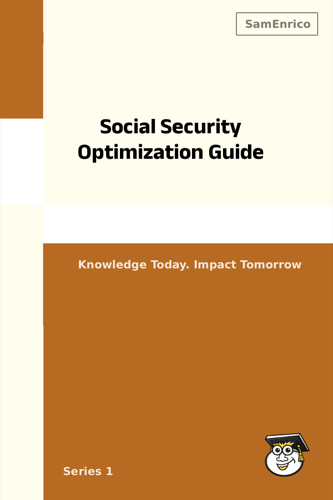
Social Security Optimization Guide eBook
Teaches claiming strategies to maximize lifetime b
by Hulsey Maria
Teaches claiming strategies to maximize lifetime benefits.
Formats
Free sample
Chapter 1: The $3.4 Trillion Mistake--Most Americans believe they know when to claim Social Security. They have a number in mind—62, 66, 67, or perhaps 70—and they have a reason, usually something like “I want to get my money before I die” or “I calculated my break-even age.” That kind of thinking, as reasonable as it sounds, has cost American households an estimated $3.4 trillion in lost lifetime benefits over the past two decades. Not because the system is broken, but because the most common claiming strategies are mathematically backward.This chapter will dismantle the single most dangerous myth in retirement planning: that break-even analysis is a useful tool for deciding when to claim Social Security. In its place, we will introduce a new framework—one that treats Social Security not as an investment to be optimized for “total dollars received,” but as a form of longevity insurance that protects you against the only financial risk you cannot outrun: living longer than expected.By the end of this chapter, you will understand why the conventional wisdom is wrong, why the real value of Social Security has nothing to do with break-even points, and why a seemingly “late” claiming age of 70 is actually the most powerful financial move for the vast majority of American households. You will also learn the single most important concept in this entire book: the household maximization principle, which shifts the goal from maximizing your individual benefit to maximizing the lifetime security of the last surviving spouse.The $3.4 Trillion Statistic Let us start with the number that gives this chapter its title.
According to research conducted by economists at the Social Security Administration and later validated by independent analysts at the Center for Retirement Research at Boston College, American households collectively forfeit between $3.4 trillion and $4.2 trillion in lifetime benefits due to suboptimal claiming decisions. That is trillion with a T. To put this number in perspective, it exceeds the total value of all student loan debt in the United States. It exceeds the annual federal budget for Medicare. It is roughly equivalent to the entire market capitalization of Amazon, Google, and Apple combined in 2019.Where does this money go?
It does not go to the government. It simply never materializes for the households that earned it. When a worker claims benefits at 62 instead of 70, the Social Security Administration pays that worker less money every month for the rest of their life. The system was designed to be “actuarially neutral,” meaning that the average person with average life expectancy should receive roughly the same total lifetime benefits regardless of claiming age. But average people do not exist.
And the assumptions baked into actuarial neutrality—particularly about life expectancy, marital status, and investment alternatives—break down completely for real households.Consider this: a 62-year-old woman in good health has a life expectancy of 86 years. Her husband, also healthy, has a life expectancy of 83 years. But here is the critical detail that most people miss: the odds that at least one of them will live to age 90 are over 50 percent. And the odds that one of them will live to 95 are nearly 30 percent. When you optimize for the “average” lifespan, you are ignoring the very real possibility of living decades longer than average.
And if you live longer than average, claiming early is a catastrophic financial mistake.This is the $3.4 trillion blind spot. Americans are making claiming decisions based on the fear of dying young, when the far more financially dangerous outcome is living long. The remainder of this chapter will explain why.Why Break-Even Analysis Is a Trap Break-even analysis is seductive because it feels like math. You calculate the age at which the total dollars received from waiting surpass the total dollars received from claiming early. For example, take a worker with a Full Retirement Age (FRA) of 67 and a Primary Insurance Amount (PIA) of $2,000 per month.
If they claim at 62, their benefit is permanently reduced by 30 percent to $1,400 per month. If they wait until 70, their benefit increases by 24 percent to $2,480 per month. The break-even age—the point at which the total cumulative benefits of the late claimer overtake the early claimer—is approximately 78 to 80 years old.The natural conclusion seems obvious: if you think you will live past 80, wait; if you think you will die before 80, claim early. This is the logic that drives millions of claiming decisions. It is also dangerously wrong for three reasons.First, break-even analysis treats Social Security as if it were a lump sum investment with a fixed return.
It is not. Social Security is a stream of inflation-adjusted income that continues for as long as you live. The value of that stream is not simply the sum of its payments; it is the insurance value of knowing that your income will never run out. A 62-year-old who claims early receives $1,400 per month. A 70-year-old who waits receives $2,480 per month.
If both live to 95, the early claimer will have received $554,400 total, while the late claimer will have received $744,000 total—a difference of nearly $200,000. But the real difference is not just the total dollars; it is the monthly purchasing power. At age 85, when healthcare costs rise and portfolio returns may have faltered, the late claimer has an extra $1,080 every single month. That is the difference between affording in-home care and entering a Medicaid facility.Second, break-even analysis ignores the survivor benefit entirely. For married couples, the lower-earning spouse’s benefit disappears when that spouse dies.
The surviving spouse keeps only the higher benefit. Therefore, the household’s effective lifespan is not the average of two lives; it is the life expectancy of the longer-living spouse. When you optimize for the couple rather than the individual, the break-even age shifts dramatically. For a married couple where the high earner waits until 70, the “household break-even” is often in the mid-80s, but the survivor benefit continues for the rest of the widow’s life. If she lives to 95, the late-claiming high earner generates hundreds of thousands of dollars more in survivor benefits than an early-claiming high earner would have.Third, break-even analysis assumes that the money you take early would otherwise sit idle.
In practice, the decision is not “claim at 62 and spend” versus “claim at 70 and spend.” It is “claim at 62 and spend from Social Security, preserving your investment portfolio” versus “delay until 70, spend from your portfolio during the gap years, and then receive a much larger guaranteed income stream for life.” This is where sequence-of-returns risk enters the picture. A market downturn in your early sixties can devastate a portfolio that you are drawing down for living expenses. A guaranteed Social Security benefit that grows at 8 percent per year (plus inflation adjustments) is mathematically superior to drawing from a volatile stock market.The Longevity Insurance Framework The correct way to think about Social Security is as longevity insurance. You pay into the system through payroll taxes for your entire career. In exchange, you receive a guaranteed, inflation-adjusted monthly payment for the rest of your life.
The “premium” you pay for this insurance is the forgone benefits between ages 62 and 70. The “payout” you receive is a permanently higher monthly benefit starting at age 70.Viewed through this lens…
This is the end of the free sample. Get the eBook to keep going. Buy now
About this book
Details
- Author
- Hulsey Maria
- Publisher
- SamEnrico
- Language
- English
- Genre
- Non-Fiction, Health & Wellness, Social Security
- Released
- 2026-06-05
- Pages (approx.)
- 152
- Available as
- eBook, Audiobook

Read better in the ZLOADR app
Your eBooks on your phone or tablet. Sign in with your SamEnrico account and start reading.
More by Hulsey Maria
 PCOS Weight Loss StrategyHulsey Maria$11.99
 Eyebrow Movement InterpretationHulsey Maria$11.99
 Laci Peterson Case Juror InterviewsHulsey Maria$11.99
 The Last Light of the Abyss: The Titanic’s Deep-Sea SecretsHulsey Maria$11.99
 Understanding ParuresisHulsey Maria$17.99
 How to Start a Hobby in YoYoHulsey Maria$11.99
 Dot Eu Registration RequirementsHulsey Maria$12.99
 Apple Patent Portfolio Analysis GuideHulsey Maria$12.99
 Kubernetes Cluster OperationsHulsey Maria$11.99