
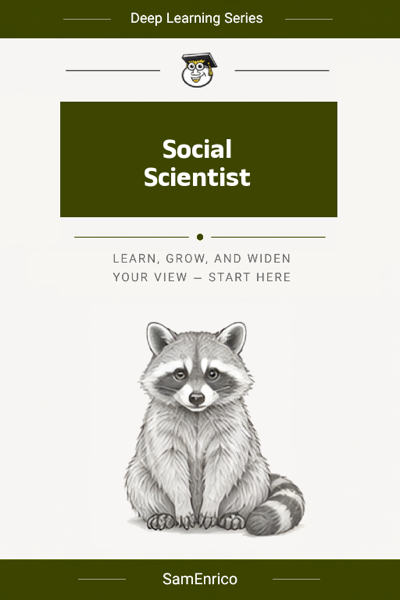
Non-FictionInformativeEducational
Social Scientist eBook
A Coursebook on Social Scientist
A Coursebook on Social Scientist
Formats
Free sample
Chapter 1: The Trash Audit--– You think you know what kind of person you are. You think your opinions about poverty, crime, love, and politics are based on careful observation and rational thought. You think that if something were true, you would have noticed it by now. You are almost certainly wrong about all of these things, and this book is going to prove it to you using your own garbage.Not metaphorically. Literally.
Your actual trash.Before you close this book and walk away, consider this: every single day, you make dozens of claims about the world. “My boss doesn’t like me.” “That politician is corrupt.” “People are basically good.” “Social media is making us depressed.” These feel like facts because they live inside your head. But a social scientist looks at the same thought and asks one brutal question that separates professionals from amateurs: What would count as evidence against this?If you cannot answer that question, you do not have an opinion. You have a prejudice wearing a costume.This chapter is going to dismantle the way you normally think and replace it with something more useful. You will learn to spot the three mental traps that snare every human brain.
You will discover the engine that drives all social science—a simple loop called the Research Circle. And then you will take out the trash. By the end of these pages, you will have conducted your first piece of original social science research without leaving your kitchen. It will be messy, humbling, and unforgettable. Let us begin.The Confidence Trick In 1981, a psychologist named David Dunning watched the news and became obsessed with a question.
A man had robbed two Pittsburgh banks in broad daylight without wearing a mask. When police arrested him later that night, he seemed genuinely confused. “But I wore the juice,” he told officers. He believed that rubbing lemon juice on his face made him invisible to security cameras. Lemon juice can be used as invisible ink, he explained.
It only works if you heat it, but he had skipped that step.Dunning could not stop thinking about this man. Not because the robbery was clever—it was spectacularly stupid—but because the man’s confidence was so wildly disconnected from his competence. He did not know what he did not know. That insight led Dunning and his graduate student Justin Kruger to design a series of experiments that would become famous as the Dunning-Kruger effect. They found that the least competent people are the most confident, because the same cognitive machinery that allows you to be good at something is the machinery that allows you to recognize expertise in others.
If you are bad at logic, you also cannot recognize when someone else is being logical. You are trapped inside your own incompetence.Social scientists have a name for the broader pattern: naive realism. It is the feeling that you see the world as it actually is, and anyone who disagrees must be ignorant, stupid, or evil. Journalists call it the “false consensus effect.” Your grandmother probably called it “being stubborn.” Whatever you name it, it is the single greatest obstacle to thinking like a social scientist.Here is the uncomfortable truth: you are the lemon juice robber. Not in every domain, of course.
You are probably quite competent at your job or your hobby. But in any area where your beliefs are strong and your evidence is weak—and that describes most of what you believe about society—you are walking around with invisible juice on your face wondering why no one takes you seriously.The Three Errors You Make Before Breakfast Social scientists have catalogued dozens of cognitive biases, but almost all of them are variations of three fundamental errors. Learn to spot these three, and you have already learned more than most people will ever know about how their own minds fail them.Error Number One: Overgeneralization You see one thing and assume it is everything. Your friend’s cousin lost money in the stock market, so investing is a scam. Your neighbor’s daughter got pregnant as a teenager, so “kids these days have no morals.” You tried one meditation app and felt nothing, so mindfulness is garbage.Overgeneralization is efficient.
Your brain evolved to learn from single experiences because in the ancestral environment, one encounter with a saber-toothed tiger was enough to establish a pattern. But modern social life is not the savanna. Single cases prove nothing. Social science requires systematic observation—looking at many cases, not just the one that made you angry or scared.Here is the test: the next time you catch yourself saying “everyone,” “no one,” “always,” or “never,” stop. You are probably overgeneralizing.
Ask yourself: how many cases have I actually observed? What would count as a counterexample? If you cannot name a number, you do not have data. You have an anecdote wearing a statistic’s clothes.Error Number Two: Selective Observation You see what you want to see and ignore the rest. A driver cuts you off, and you think “people are terrible drivers.” You do not notice the three hundred drivers who followed the rules because they did not trigger your attention.
You read one headline about a violent crime and feel afraid, but you miss the data showing crime has been falling for decades.Selective observation is not laziness. It is physics. Your brain receives eleven million bits of sensory information every second but can only process about forty bits consciously. You cannot help but filter. The problem is that your filter is not neutral.
It is biased toward what confirms your existing beliefs—a phenomenon psychologists call confirmation bias.The most dangerous version of selective observation happens in relationships. You think your partner never listens to you, so you notice every time they glance at their phone while you are talking. You ignore the twenty times earlier that day when they listened carefully. By dinner, you have built a fortress of evidence for your grievance, and every brick is a cherry-picked moment.Social science does not ask you to stop filtering. That is impossible.
It asks you to systematize your observation so your filter does not lie to you. That means writing things down before you know what they mean. That means counting. That means looking for disconfirming evidence on purpose.Error Number Three: Illogical Reasoning You take a single observation and leap to a conclusion that does not follow. This is the “exception proves the rule” fallacy, the “post hoc ergo propter hoc” (after this, therefore because of this) error, and the false dilemma all rolled into one.Here is a classic example: “I wore my lucky socks, and my team won.
The socks caused the victory.” No. Two things happened at the same time. That does not mean one caused the other. Ice cream sales and drowning rates both go up in summer. Ice cream does not cause drowning.
Heat does. But your brain loves stories, and “lucky socks cause wins” is a better story than “random chance and thousands of unobserved variables.”Illogical reasoning is especially dangerous in arguments about causality. Does spanking cause…
This is the end of the free sample. Get the eBook to keep going. Buy now
About this book
Details
- Author
- Burden Dannie
- Publisher
- SamEnrico
- Language
- English
- Genre
- Non-Fiction, Informative, Educational
- Released
- 2026-05-04
- Pages (approx.)
- 138
- Available as
- eBook, Audiobook

Read better in the ZLOADR app
Your eBooks on your phone or tablet. Sign in with your SamEnrico account and start reading.
More by Burden Dannie
 Baby Sleep Environment GuideBurden Dannie$11.99
 Networking Mindset ShiftBurden Dannie$11.99
 Parental Food Insecurity GuideBurden Dannie$11.99
 Renoir Humanist TouchBurden Dannie$11.99
 The Senior Pet Loss Self Worth GuideBurden Dannie$11.99
 The Golden Compass: Magellan’s Odyssey and the Birth of Global TradeBurden Dannie$11.99
 How to Start a Pea and Pie Vendor Business (Beginners Guide)Burden Dannie$11.99
 Promotion Business Case Common MistakesBurden Dannie$12.99
 World Bank Monitoring and Evaluation GuideBurden Dannie$12.99
 Understanding Mental Retardation Short Stature Heart and Skeletal AnomaliesBurden Dannie$17.99
You may also like
 Hong Kong Handover 1997Dunn Johnnie$11.99
 Zumba For Postnatal Recovery CourseNeal Christian$11.99
 Zumba for BeginnersLadner Nikia$11.99
 YouTube Comment Mining GuideHumes Pandora$12.99
 Worry Box MeditationCarlin Rudy$11.99
 Workplace Stress MeditationNguyen Lynn$11.99
 Workplace Stress and Sleep RepairHawley Ivory$11.99
 Workplace Perfectionism CureDelaney Jeffry$11.99
 Workplace Injustice Anger GuideWallen Isabelle$11.99
 Work Addiction and Burnout LinkGreenwood Ester$11.99
 Women in Yoga and WellnessBeattie Galina$11.99
 Women in Stand Up ComedyChun Evangeline$11.99