
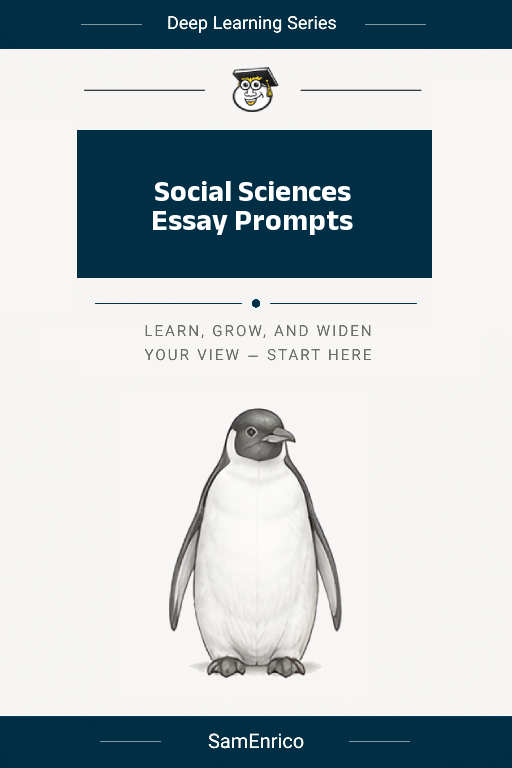
Social Sciences Essay Prompts
Analyze human behavior and social structures using
Analyze human behavior and social structures using GPT prompts that generate hypotheses, data interpretations, and theoretical applications.
Formats
About this book
Free sample
Chapter 1: The Logic Engine...--–- The first time Maria typed a raw interview transcript into GPT and asked it to “find patterns in social trust,” she expected magic. Instead, she got a beautifully written paragraph that was completely wrong. It cited a “study” that didn’t exist, invented a quote from a participant who never spoke, and concluded that “rural communities universally distrust outsiders”—a claim her own data directly contradicted. She closed the browser, frustrated, and told herself AI wasn’t ready for serious social science.Three months later, Maria defended her master’s thesis on social trust in post-disaster communities. In her acknowledgments, she thanked GPT-4 as a “methodological collaborator.” What changed?
Not the technology. Maria changed. She stopped treating GPT as a search engine or an oracle and started using it as what it actually is: a logic engine for qualitative and symbolic reasoning about human behavior.This chapter is for every researcher who has felt that same initial disappointment. You have likely heard that large language models (LLMs) can “revolutionize” social science, but when you tried using one, you got plausible-sounding nonsense. That is not because the tool is useless.
It is because you were using it wrong. Most social scientists fall into one of two traps: they treat GPT like Google (fact retrieval) or like a crystal ball (truth-teller). Both approaches fail. The correct path—the one this entire book will teach—is to treat GPT as a structured reasoning partner that can help you think more systematically about human behavior, social structures, and the messy data we collect to understand them.This chapter establishes the foundational mindset for AI-assisted social science. You will learn what GPT can and cannot do, why the replication crisis makes structured prompting essential, and how to position GPT as a collaborator rather than a shortcut.
By the end, you will understand why Maria succeeded on her second attempt: she learned to speak the language of prompts, to verify outputs against her own expertise, and to treat AI not as an answer machine but as a thinking tool.The Synthetic…
This is the end of the free sample. Get the eBook to keep going. Buy now
Contents
- Chapter 1
- Chapter 2
- Chapter 3
- Chapter 4
- Chapter 5
- Chapter 6
- Chapter 7
- Chapter 8
- Chapter 9
- Chapter 10
- Chapter 11
- Chapter 12
Details
- Author
- Kitchen Wilhelmina
- Publisher
- SamEnrico
- Language
- English
- Genre
- essays, Student's Shortcut
- Released
- 2026-05-29
- Pages (approx.)
- 160
- Available as
- eBook, Audiobook

Read better in the ZLOADR app
Your eBooks on your phone or tablet. Sign in with your SamEnrico account and start reading.
More by Kitchen Wilhelmina
 Book Subscription Box ChurnKitchen Wilhelmina$11.99
 Luke Bryan Country PartyKitchen Wilhelmina$11.99
 Senior Working Memory MaintenanceKitchen Wilhelmina$11.99
 Model Minority Myth BurdensKitchen Wilhelmina$11.99
 The Social Stress CoupleKitchen Wilhelmina$11.99
 Rosalynn Carter First LadyKitchen Wilhelmina$11.99
 North Korea Underground TherapyKitchen Wilhelmina$11.99
 Detox And Withdrawal PsychosisKitchen Wilhelmina$11.99
 The Silent Witness: Europe's First Witness Protection Betrayal (1930s)Kitchen Wilhelmina$11.99
 The Great Coffee Heist: How Starbucks Brewed a Global EmpireKitchen Wilhelmina$11.99
 How to Produce SidingKitchen Wilhelmina$11.99
 How to Produce a Four-slideKitchen Wilhelmina$11.99
You may also like
 YouTube Video Essay DepthLeon Lala$11.99
 TOEFL Independent Essay GuideMintz Alex$11.99
 Music Theory Essay GuideWilkinson Maisha$11.99
 Expository Essay AI PromptsApplegate Dalia$11.99
 Exam Essay MemorizationMcgovern Johna$11.99
 Compare Contrast Essay PromptsOntiveros Marx$11.99
 College Application Essay GuideSisson Aimee$11.99College Application Essay GuideSisson Aimee$11.99
 The 100 Word Essay ChallengeAli Luciana$11.99
 Journalism Essay PromptsThatcher Williemae$11.99
 Finance Essay PromptsShrader Lamont$11.99
 Cause Effect Essay GPT GuideBland Jacelyn$11.99