
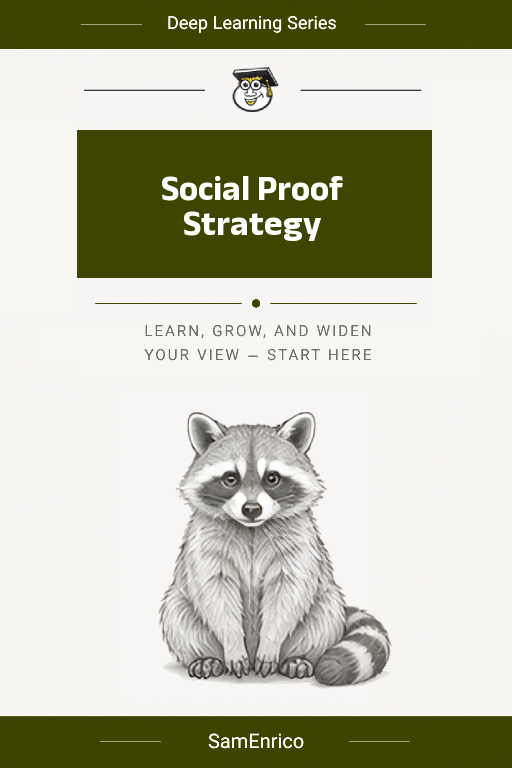
Non-FictionFirst 30 DaysSocial Proof
Social Proof Strategy eBook
Plan testimonials, case studies, and media mention
Plan testimonials, case studies, and media mentions you need for credibility on one page.
Formats
Free sample
Chapter 1: The Trust Crash--The moment your customer lands on your website, their brain has already made a decision about you.Not in five seconds. Not in three seconds. In the first 50 milliseconds. That is how long it takes for the human brain to form an aesthetic and credibility judgment about a digital experience. A blink takes 300 milliseconds.
By the time your visitor blinks, they have already judged you six times over.And here is what they are looking for: evidence that other people like them have trusted you and survived.Welcome to the post-trust economy. Every single day, your potential customers are bombarded with over 10,000 commercial messages. Billboards. Banners. Cold emails.
Linked In requests. Retargeting ads that follow them across the internet like a haunted ex. Podcast sponsorships. You Tube pre-rolls. The noise is not just loud anymore.
It is physically unbearable.And the human brain has adapted beautifully.We now possess what neuroscientists call "ad blindness" – a sophisticated filtering mechanism that deletes branded messaging from conscious awareness before it even registers. Your million-dollar advertising campaign? It lands in the same mental trash folder as the spam email from a Nigerian prince and the pop-up offering free i Phones.But something else has risen in its place. Something more powerful than any billboard, any Super Bowl commercial, any celebrity endorsement.Social proof.The Trust Crash of 2025Let me paint you a picture that might feel uncomfortably familiar.In 2015, a well-placed banner ad still worked. A polished "About Us" page still impressed.
A cold email sequence still booked meetings. Brands stood on mountaintops and shouted their greatness into the megaphone of mass media, and enough people believed them to keep the engine running.By 2020, the cracks had appeared. Ad blockers surged. Email open rates plummeted. The phrase "I'll just Google it" became the automatic response to any unsolicited brand message.
Consumers had discovered a secret weapon: each other.By 2025, the crash was complete.Consider these numbers slowly, because they should terrify you if you are still investing in traditional "brand broadcasting":92% of consumers now trust recommendations from peers over any form of branded content. Not "some" consumers. Not "most" consumers. Ninety-two percent. That is not a preference.
That is a near-universal rejection of brand authority in favor of crowd authority.70% of consumers will actively seek out reviews before making a purchase, even if they are standing in a physical store holding the product in their hands. They trust a stranger on the internet more than their own eyes.And here is the killer: 84% of people trust online reviews as much as a personal recommendation from a friend. Think about what that means. Your customer trusts a faceless, nameless person who left three sentences on Google Maps two years ago as much as they trust their own mother's opinion.The era of brand-centric marketing is not dying. It is dead.
We just haven't held the funeral yet.The Myth of the Rational Buyer Here is where most business owners make a catastrophic error.They believe their customers make decisions like judges in a courtroom: weighing evidence, comparing features, calculating ROI, and rendering a rational verdict.This is beautiful fiction. And it is completely wrong.The reality, drawn from decades of behavioral science (including the foundational work of Daniel Kahneman, Amos Tversky, and Robert Cialdini), is that human beings make decisions emotionally and then justify them rationally. Your brain's limbic system – the ancient, emotional core – decides "I want this" or "I trust this" within seconds. Then your neocortex – the rational, calculating part – scrambles to build a logical bridge to that emotional destination.This means that when a potential customer lands on your website, they are not reading your carefully crafted headlines. They are scanning for social proof.
They are looking for the digital equivalent of a crowded restaurant.Because here is the evolutionary truth that advertising agencies hate: humans are herd animals.For 300,000 years, our survival depended on following the crowd. If your tribe members ran, you ran. If they ate a berry and survived, you ate that berry. If they trusted a person and prospered, you trusted that person. The individual who ignored social proof and blazed their own trail?
They were eaten by predators, poisoned by unknown plants, or exiled from the group.You are descended from the followers, not the pioneers.And that ancient wiring has not changed just because you now shop on Amazon instead of hunting on the savanna.The Four Lies Your Customers Are Told Every Day Before we go further, we need to understand the battlefield. Your customer is not an empty vessel waiting for your message. They are a fortress, heavily defended by layers of skepticism built from years of disappointment.Every day, they are told four lies by the traditional marketing machine:Lie #1: "We are the best." Every brand says this. Every single one. The plumber, the Saa S startup, the luxury hotel, the freelance graphic designer.
"Best" has become a linguistic shrug. It carries no weight, no specificity, no credibility. When you claim to be the best, your customer's brain automatically translates it to "We have no actual evidence, so we will use a meaningless superlative."Lie #2: "We care about you." No, you don't. You care about their money. And that is fine – business is an exchange of value for currency.
But pretending otherwise insults your customer's intelligence. When a brand says "We care about you like family," the customer thinks "You would not charge your grandmother $49 per month for software."Lie #3: "Our product is revolutionary." The word "revolutionary" appears in over 80% of technology press releases. If every product is revolutionary, no product is revolutionary. Your customer has seen "game-changing," "disruptive," and "paradigm-shifting" so many times that these words now trigger the opposite response: skepticism.Lie #4: "Trust us." This is the most dangerous lie of all, because it is so often implied rather than stated. Every ad, every landing page, every cold email whispers "Trust us" without providing any reason to do so.
And your customer has learned, through painful experience, that "trust us" is usually followed by "we lost your data," "we buried the cancellation fee in the terms," or "we raised prices after you were locked in."Against this backdrop of deception fatigue, what actually works?The Uncomfortable Truth About Advertising's Death I am going to tell you something that might cost me speaking invitations from marketing conferences.Most advertising is a tax on businesses that have not yet realized they are invisible.The average click-through rate of a display ad across all formats and placements? 0.05%. Not five percent. Five one-hundredths of one percent. That means for every 10,000 times your banner ad appears on someone's screen, five people click it.
And of those five, most will bounce within seconds.The average open rate for cold emails across all industries? Around 25% if you are exceptional. But the average reply rate? Less than 1%. You are sending thousands of emails to get a handful of conversations.The average organic reach of a branded Facebook post?
Without paid amplification, you are lucky to reach 2% of your page's followers. You built an audience of 10,000 people, and Facebook shows your content to 200 of them.This…
This is the end of the free sample. Get the eBook to keep going. Buy now
About this book
Details
- Author
- Hutchins Eliz
- Publisher
- SamEnrico
- Language
- English
- Genre
- Non-Fiction, First 30 Days, Social Proof
- Released
- 2026-06-01
- Pages (approx.)
- 126
- Available as
- eBook, Audiobook

Read better in the ZLOADR app
Your eBooks on your phone or tablet. Sign in with your SamEnrico account and start reading.
More by Hutchins Eliz
 Eating Differences RelationshipHutchins Eliz$11.99
 The Personal Brand Hope GuideHutchins Eliz$11.99
 Kurt Cobain Nevermind StoryHutchins Eliz$11.99
 Time Blocking for SalespeopleHutchins Eliz$11.99
 Senate Parliamentarian DecodedHutchins Eliz$11.99
 Time Boxing Technique GuideHutchins Eliz$11.99
 Meeting Role Time KeeperHutchins Eliz$11.99
 Scripting for MotivationHutchins Eliz$11.99
 Themistocles: The Strategist Who Defied XerxesHutchins Eliz$11.99
 The Battle of Lake Poyang: The Naval Duel That Saved the Ming Dynasty (1363)Hutchins Eliz$11.99
 How to Produce PlumsHutchins Eliz$11.99
 How to Produce Dock StepsHutchins Eliz$11.99
You may also like
 Hong Kong Handover 1997Dunn Johnnie$11.99
 Zumba For Postnatal Recovery CourseNeal Christian$11.99
 Zumba for BeginnersLadner Nikia$11.99
 YouTube Comment Mining GuideHumes Pandora$12.99
 Worry Box MeditationCarlin Rudy$11.99
 Workplace Stress MeditationNguyen Lynn$11.99
 Workplace Stress and Sleep RepairHawley Ivory$11.99
 Workplace Perfectionism CureDelaney Jeffry$11.99
 Workplace Injustice Anger GuideWallen Isabelle$11.99
 Work Addiction and Burnout LinkGreenwood Ester$11.99
 Women in Yoga and WellnessBeattie Galina$11.99
 Women in Stand Up ComedyChun Evangeline$11.99