
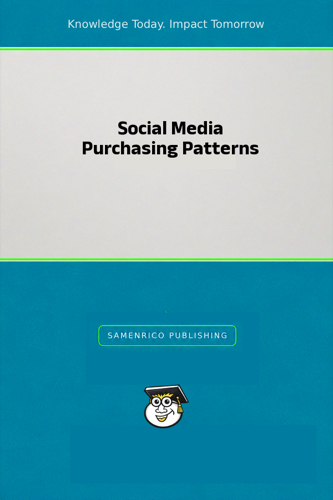
Non-FictionConsumer Mind ReportSocial Commerce
Social Media Purchasing Patterns eBook
Compares Boomer Facebook recommendations versus Ge
by Viera Edward
Compares Boomer Facebook recommendations versus Gen Z TikTok shop impulse buys.
Formats
Free sample
Chapter 1: The Great Divide--–- On a Tuesday afternoon in suburban Ohio, two people sat in the same living room, stared at the same Wi-Fi connection, and made two wildly different purchasing decisions. One took forty-seven minutes and opened fourteen browser tabs. The other took nine seconds and never left the app. Both were convinced they had made the smartest choice of their day. Both were right.
And both were completely invisible to each other's version of the internet.This is not a story about technology. This is a story about trust, about time, and about the strange way that generational memory shapes how we decide what is worth our money. The woman who spent forty-seven minutes researching a $35 kitchen gadget was not being indecisive or old-fashioned. She was being thorough in the way her generation learned was necessary. The teenager who spent nine seconds buying a $12 phone case was not being reckless or impulsive.
He was being efficient in the way his generation learned was expected. Neither recognized the other's behavior as rational. Neither understood the invisible forces that guided their click.And that is precisely why most social media marketing fails.The Myth of the Universal Consumer For the past decade, the marketing industry has operated on a seductive but fundamentally broken assumption: that people on social media are essentially the same. Sure, the industry acknowledged demographic differences in Power Point slides—age brackets, income levels, geographic clusters—but the actual strategies remained remarkably uniform. Post engaging content.
Run targeted ads. Optimize for click-through rates. A/B test your headlines. The platform changed, but the playbook did not.This assumption worked reasonably well from approximately 2010 to 2018. During those years, social media was still young enough that early adopters spanned generations.
Boomers joined Facebook to see photos of grandchildren. Millennials joined Instagram to curate aspirational lives. Gen Z was still mostly children, influencing household purchases indirectly but not yet making their own. There was overlap. There was patience.
There was a shared sense that social media was a new thing everyone was figuring out together.That era is over. It ended more abruptly than most marketers realize.The evidence is everywhere if you know where to look. In the past five years, the behavioral divergence between generations on social media has accelerated faster than at any point since the invention of the smartphone. Boomers and Gen X now spend more time on Facebook than any other platform—not because they love Mark Zuckerberg, but because Facebook still functions like a digital town square where their actual friends and family gather. Gen Z spends more time on Tik Tok than any other platform—not because they love Chinese algorithms, but because Tik Tok functions like an endless personalized TV channel that requires no social maintenance whatsoever.These are not preferences.
They are entirely different relationships to what social media is for.The Two Definitions of "Social"To understand why purchasing patterns have diverged so dramatically, we must first understand what the word "social" means to each generation. This sounds trivial. It is not.For Boomers and older Gen X, "social" means connection to known individuals. The social graph matters. When a Boomer sees a recommendation on Facebook, the question they unconsciously ask is not "Is this product good?" but rather "Does the person sharing this have good judgment?" The trust flows through the relationship.
A recommendation from a high school friend carries weight not because of the product's merits but because of the history of the friendship. If Cheryl from accounting says a vacuum cleaner changed her life, the Boomer thinks: Cheryl has clean carpets. I have seen Cheryl's carpets. I trust Cheryl's carpets. The logic is transitive and personal.For Gen Z, "social" means connection to collective culture.
The social graph is almost irrelevant. When a Gen Z user sees a product on Tik Tok, the question they unconsciously ask is not "Who is recommending this?" but rather "How many other people are engaging with this?" The trust flows through the aggregate. A product that has been saved by 80,000 people and has 3,000 comments carries weight not because of any individual endorsement but because of the sheer weight of numbers. If 80,000 strangers have engaged, the Gen Z user thinks: this must be worth paying attention to. The logic is emergent and impersonal.Both are forms of social proof.
Both are rational. They are just rational about different things.This distinction explains a great deal of otherwise confusing behavior. When a Boomer sees a Tik Tok video with 2 million views, they often feel skepticism: Who are these people? Why should I care what strangers think? When a Gen Z user sees a Facebook recommendation from a friend's aunt, they often feel irrelevance: Why would I trust someone my mom's age?
Neither is wrong. They are simply calibrated to different signals.The Hidden Variable: Generational Memory Beneath these behavioral differences lies a deeper force that marketers almost never discuss: generational memory. Every generation grows up with a specific set of economic and technological conditions that shape their default assumptions about how the world works. Those assumptions become invisible—they feel like common sense, not history—and they influence every purchasing decision.Boomers came of age during an era of limited information. If you wanted to buy a product before the internet, you had three sources: friends who already owned it, the salesperson at the store, and the manufacturer's brochure.
All three were biased. All three had limited reach. As a result, Boomers learned that purchasing required effort. You had to drive to multiple stores. You had to ask around.
You had to trust your own judgment because there was no crowd to outsource to. This was not a personality trait. It was a survival skill in an information-scarce environment.Gen Z came of age during an era of infinite information. If they want to buy a product today, they have millions of sources: user-generated videos, comment sections, aggregate ratings, unboxing streams, discourse threads, and algorithmic recommendations. Most of these sources are also biased, but the bias is distributed.
As a result, Gen Z learned that purchasing requires almost no effort. The crowd has already done the work. The algorithm has already filtered the noise. You can trust the aggregate because the aggregate has survived the scrutiny of millions. This is not laziness.
It is efficiency in an information-saturated environment.These are not character flaws. They are adaptive responses to radically different worlds.The middle generations—Millennials—grew up during the transition. They remember life before the internet but not vividly. They remember dial-up but not fondly. They learned to research online but also to distrust what they found.
This is why Millennials sit at the intersection of every purchasing pattern in this book. They are the straddlers, the translators, the ones who can understand both Boomer skepticism and Gen Z speed without fully belonging to either.The Data That Confuses Everyone Let us examine a statistic that appears in countless marketing reports and is almost always misinterpreted: 52 percent of Millennials who use Facebook have made a purchase on the platform, and 52 percent of Gen Z who use Tik Tok have made…
This is the end of the free sample. Get the eBook to keep going. Buy now
About this book
Details
- Author
- Viera Edward
- Publisher
- SamEnrico
- Language
- English
- Genre
- Non-Fiction, Consumer Mind Report, Social Commerce
- Released
- 2026-06-08
- Pages (approx.)
- 133
- Available as
- eBook, Audiobook

Read better in the ZLOADR app
Your eBooks on your phone or tablet. Sign in with your SamEnrico account and start reading.
More by Viera Edward
 Gacy Forensic Autopsy ReportsViera Edward$11.99
 Bhagwan Laundry ServiceViera Edward$11.99
 Reciprocity Persuasion PlaybookViera Edward$11.99
 Dubai Student Model UNViera Edward$11.99
 Caffeine Clock Effects GuideViera Edward$11.99
 Psyllium Fiber GuideViera Edward$11.99
 Hypomania Recognition GuideViera Edward$11.99
 The Cairo Plague Doctor: A Victorian Medical ConspiracyViera Edward$11.99
 Nefertiti's Lost Voice: The Silent Queen of AmarnaViera Edward$11.99
 How to Produce Fiberglass GasketViera Edward$11.99
 A Collector's Handbook to the Citroën Citroen 10 Légère (Light 12)Viera Edward$11.99
 Australian Offshore Skills AssessmentViera Edward$12.99
You may also like
 Hong Kong Handover 1997Dunn Johnnie$11.99
 Zumba For Postnatal Recovery CourseNeal Christian$11.99
 Zumba for BeginnersLadner Nikia$11.99
 YouTube Comment Mining GuideHumes Pandora$12.99
 Worry Box MeditationCarlin Rudy$11.99
 Workplace Stress MeditationNguyen Lynn$11.99
 Workplace Stress and Sleep RepairHawley Ivory$11.99
 Workplace Perfectionism CureDelaney Jeffry$11.99
 Workplace Injustice Anger GuideWallen Isabelle$11.99
 Work Addiction and Burnout LinkGreenwood Ester$11.99
 Women in Yoga and WellnessBeattie Galina$11.99
 Women in Stand Up ComedyChun Evangeline$11.99