
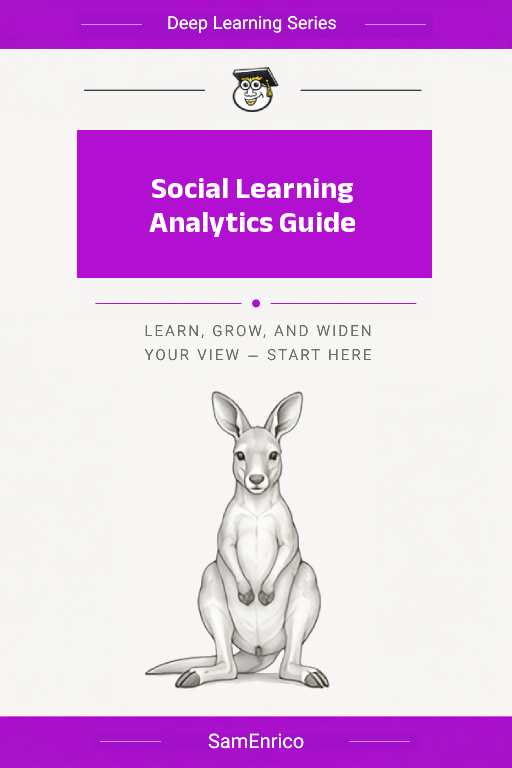
Non-FictionForecast & OutlookSocial Analytics
Social Learning Analytics Guide
Discover network analysis of student collaboration
by Haney Scotty
Discover network analysis of student collaboration patterns to identify leaders and at-risk learners.
Formats
About this book
Free sample
Chapter 1: The Invisible Classroom--–- The email arrived at 11:47 PM on a Tuesday. Maria, a third-year biology teacher at a large suburban high school, had just finished grading forty-two lab reports. Her eyes hurt. Her coffee was cold. And she had just stamped a C- on a paper written by a student named Jasmine—a quiet girl who sat in the back, never raised her hand, and had missed three homework assignments.Maria felt a small pang of guilt.
Jasmine wasn't a behavior problem. She wasn't failing. She was just… invisible. And that C- felt fair, based on the rubric. Lab report structure?
Incomplete. Data analysis? Shallow. Citations? Missing.What Maria did not know—could not know from the grade book alone—was that Jasmine had been the only person in her lab group who could explain the difference between correlation and causation.
She had been the one who stopped her partner from fabricating data. She had been the quiet voice that said, "Wait, that doesn't make sense," saving the entire group from a catastrophic error.None of that appeared in the rubric. None of that appeared in the grade. And here is the uncomfortable truth this chapter will force you to confront: Your grade book is lying to you. Not maliciously.
Not because you are a bad teacher. But because grades were never designed to measure what actually matters most in a learning community.The 50-Percent Problem For decades, educational assessment has operated under a quietly heroic assumption: that the work we grade—tests, essays, problem sets, lab reports—captures the majority of what students learn in our classrooms. This assumption is demonstrably false. And the evidence has been accumulating for years, hiding in plain sight in the research literature of learning sciences, social psychology, and network theory.Consider a landmark study conducted by researchers at the University of Michigan, which followed 1,200 students across fourteen different courses—from introductory physics to advanced seminar-style humanities. Researchers tracked two parallel streams of data: first, traditional academic performance (homework, quizzes, exams, final grades); second, peer-to-peer interaction patterns (who asked whom for help, who studied together, who…
This is the end of the free sample. Get the eBook to keep going. Buy now
Contents
- Chapter 1
- Chapter 2
- Chapter 3
- Chapter 4
- Chapter 5
- Chapter 6
- Chapter 7
- Chapter 8
- Chapter 9
- Chapter 10
- Chapter 11
- Chapter 12
Details
- Author
- Haney Scotty
- Publisher
- SamEnrico
- Language
- English
- Genre
- Non-Fiction, Forecast & Outlook, Social Analytics
- Released
- 2026-05-30
- Pages (approx.)
- 152
- Available as
- eBook, Audiobook

Read better in the ZLOADR app
Your eBooks on your phone or tablet. Sign in with your SamEnrico account and start reading.
More by Haney Scotty
 Humor In Email MarketingHaney Scotty$11.99
 Instagram Highlight Reel GuideHaney Scotty$11.99
 Thai Solar Rooftop IncentivesHaney Scotty$11.99
 Criticism Sensitive Self EsteemHaney Scotty$11.99
 The Secret Tapes of the Velvet Revolution: Prague’s Whispered UprisingHaney Scotty$11.99
 Silk & Steel: The Unseen Trade Wars of the Han DynastyHaney Scotty$11.99
 Understanding IchthyophobiaHaney Scotty$17.99
 Inventory OutfitterHaney Scotty$11.99
 Unrelated Business Income Tax PrimerHaney Scotty$12.99
 How to Start a Primary Battery Manufacturing BusinessHaney Scotty$11.99
You may also like
 Hong Kong Handover 1997Dunn Johnnie$11.99
 Zumba For Postnatal Recovery CourseNeal Christian$11.99
 Zumba for BeginnersLadner Nikia$11.99
 YouTube Comment Mining GuideHumes Pandora$12.99
 Worry Box MeditationCarlin Rudy$11.99
 Workplace Stress MeditationNguyen Lynn$11.99
 Workplace Stress and Sleep RepairHawley Ivory$11.99
 Workplace Perfectionism CureDelaney Jeffry$11.99
 Workplace Injustice Anger GuideWallen Isabelle$11.99
 Work Addiction and Burnout LinkGreenwood Ester$11.99
 Women in Yoga and WellnessBeattie Galina$11.99
 Women in Stand Up ComedyChun Evangeline$11.99