
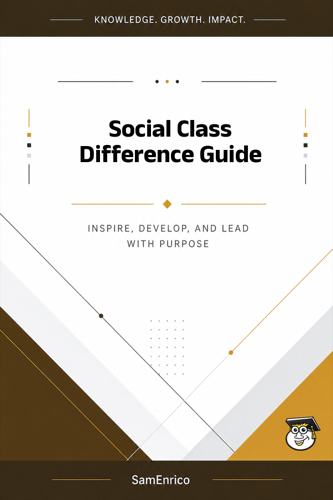
Social Class Difference Guide eBook
Navigate different backgrounds without feeling inf
by Sisk Dona
Navigate different backgrounds without feeling inferior or superior.
Formats
Free sample
Chapter 1: The Iceberg Lies...--Most people who have ever felt out of place have been told the same lie in a hundred different forms. “Just be yourself.” “Money doesn’t matter.” “We’re all equal here.” “Class is about how much you earn.” These phrases are not merely unhelpful—they are actively deceptive. They are the cultural equivalent of telling someone lost in a foreign country that all languages are essentially the same. Technically true in the most abstract sense. Practically useless when you need to find a bathroom, order food, or explain why you’re crying in your car after a work dinner.If you have picked up this book, you already know something that most people spend their entire lives trying to ignore.
You have felt the floor drop out from under you in a conversation where everyone else seemed to know the rules except you. You have said the wrong thing at a family dinner—either too fancy for your relatives or too crude for your colleagues. You have been called “articulate” as if that were a surprise, or “humble” as if that were a choice. You have watched someone’s face freeze when you mentioned something perfectly normal from your childhood—a camping trip, a food stamp card, a summer abroad, a second job at fourteen. And in that frozen moment, you learned the first real lesson about social class: it is not about money.
It is about shame.This chapter dismantles the most common and destructive assumption about class: that it is primarily about income or wealth. Using the Iceberg Model, we will explore the ninety percent of class that remains invisible to the naked eye—the hidden curriculum of norms, values, emotional reflexes, and unconscious rules that shape everything from how you argue with a partner to how you fill out a government form. We will introduce the five-category class model that will serve as the backbone of this book. And we will reframe class not as a ladder of value (where some people are “higher” and others “lower”) but as a set of different operating systems—each with its own internal logic, its own survival strategies, and its own hidden costs.By the end of this chapter, you will never again believe that class is “just about money.” More importantly, you will begin to see your own class history not as a source of shame or pride, but as a piece of data—useful information for navigating a world that pretends class doesn’t exist while punishing you constantly for not understanding its secret rules.The Iceberg Model: Why Your Salary Tells Almost Nothing Imagine an iceberg floating in cold, dark water. The tip—the ten percent visible above the surface—is what most people mean when they say “social class.” Income.
Wealth. Job title. The car you drive. The neighborhood you live in. These are the signals that American culture has trained us to scan for within the first thirty seconds of meeting someone.
“What do you do?” is the most common icebreaker in the English language for a reason. We have been taught that the answer to that question tells us everything we need to know about a person’s class, their intelligence, their worth, and their future.But the iceberg’s tip is the least interesting and least informative part of the whole structure. The real mass—the ninety percent that can sink ships—lies underwater, invisible to the casual observer. This hidden mass consists of the unspoken rules, the automatic reactions, the values you didn’t know you had until they were violated. These are the things that actually determine whether you will feel comfortable or miserable in a given room, whether you will be promoted or passed over, whether your relationships across class lines will deepen or explode.Let us surface some of that hidden mass.
Here is what lives below the waterline of the class iceberg.Time Orientation How far into the future do you habitually plan? The answer is not a personality trait. It is a class signal trained into you from birth. Children in households with economic stability learn to plan for retirement, for college applications two years away, for summer vacations booked six months in advance. They learn that time is a resource to be invested, saved, and leveraged.
Children in households with economic scarcity learn to plan until Friday—because there is no guarantee of groceries beyond that. They learn that long-term planning is a luxury for people who have control over their own schedules. When a middle-class manager asks a working-class employee, “Where do you see yourself in five years?” and receives a blank stare in return, the manager sees a lack of ambition. The employee sees a ridiculous question from someone who has never had their electricity shut off.Risk Tolerance The ability to take risks—to invest in the stock market, to quit a job for a better opportunity, to move across the country for a dream—is not a measure of courage. It is a measure of cushion.
Growing up with scarcity primes your brain’s amygdala (the threat-detection center) for rapid response. You learn that one wrong move can mean eviction, hunger, or disaster. So you become conservative. You take the safe job. You keep money in cash under the mattress.
You avoid credit cards. Growing up with abundance primes your prefrontal cortex (the planning and exploration center) for delayed gratification. You learn that risks sometimes fail, but failure rarely means catastrophe. So you explore. You invest.
You take the unpaid internship that might lead somewhere. Neither profile is more virtuous. They are different nervous systems optimized for different environments.Humor What makes you laugh is not a matter of taste. It is a matter of class training. Irony, sarcasm, and abstract wordplay are signals of the Credentialed Middle Class and above—people who have the cognitive surplus to play with meaning because they are not worried about survival.
Slapstick, physical comedy, and direct punchlines are signals of the Stable Working Class and Precariat—people who value clarity, shared experience, and the release of tension through laughter that doesn’t require a dictionary. This is why a joke that kills in a corporate boardroom will die in a union hall, and vice versa. It is not that one group is funnier. It is that they are speaking different emotional languages.Conflict Style How do you fight? Do you raise your voice?
Do you go silent? Do you use abstract principles (“You violated my boundaries”) or concrete complaints (“You left your boots in the hallway again”)? These styles are class signals. The Credentialed Middle Class tends toward therapeutic conflict language—talking about feelings, using “I statements,” avoiding overt aggression. The Stable Working Class tends toward direct confrontation—raised voices, swearing, then immediate forgiveness.
The Precariat often avoids conflict entirely because the stakes (eviction, firing, violence) are too high to risk escalation. When these styles collide, each side sees the other as either “cold and manipulative” or “violent and out of control.” In reality, both are following the rules they were taught.Class as a Nervous System: The Biology of Scarcity…
This is the end of the free sample. Get the eBook to keep going. Buy now
About this book
Details
- Author
- Sisk Dona
- Publisher
- SamEnrico
- Language
- English
- Genre
- Non-Fiction, Self-Help, Class, Background
- Released
- 2026-06-11
- Pages (approx.)
- 142
- Available as
- eBook, Audiobook

Read better in the ZLOADR app
Your eBooks on your phone or tablet. Sign in with your SamEnrico account and start reading.
More by Sisk Dona
 King's Childhood HomeSisk Dona$11.99
 Cape Town SADC ExpansionSisk Dona$11.99
 The Co Parenting Communication GuideSisk Dona$11.99
 The Bone Collector of Whitechapel: Unmasking Jack the Ripper’s Forensic LegacySisk Dona$11.99
 Value Proposition One Page GuideSisk Dona$12.99
 Canadian PR After Graduation GuideSisk Dona$12.99
 Understanding Pseudovaginal Perineoscrotal HypospadiasSisk Dona$17.99
 How to Become a Spring Inspector ISisk Dona$11.99