
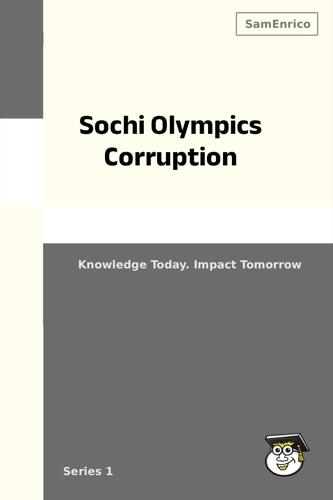
Sochi Olympics Corruption eBook
Diversion of Olympic construction funds to crimina
by Steele Nancy
Diversion of Olympic construction funds to criminal networks.
Formats
Free sample
Chapter 1: The Fifty-One Billion Dollar Question...--The most expensive sporting event in human history did not take place in a global capital like Tokyo, London, or Beijing. It did not require the construction of a new Olympic stadium in a major metropolitan area with existing infrastructure. It was not held in a country with a robust history of hosting international competitions, transparent procurement systems, or independent auditing mechanisms. Instead, the single most costly Games ever staged unfolded in a subtropical resort town of just three hundred forty thousand people, nestled between the Caucasus Mountains and the Black Sea—a location chosen not for its logistical convenience, not for its existing venues, and certainly not for its temperate winter climate, but for reasons far more revealing about the nature of the regime that built it.The Sochi 2014 Winter Olympics cost fifty-one billion dollars.To fully grasp what this number means, consider the following comparisons. The combined cost of every previous Winter Olympics—from Chamonix in 1924 to Vancouver in 2010—totals approximately forty-eight billion dollars when adjusted for inflation.
Sochi alone cost more than all of its predecessors combined. The 2008 Beijing Summer Olympics, a spectacular display of state power that involved constructing dozens of massive venues across China's capital, cost approximately forty billion dollars. Sochi, a Winter Games with fewer than half the events and a fraction of the spectators, cost eleven billion dollars more. The 2012 London Olympics, staged in one of the world's most expensive cities with rigorous labor and environmental standards, cost roughly fifteen billion dollars. Sochi cost more than three Londons.This chapter poses the central question that drives this entire book: how did a single sporting event in a small Russian resort town cost more than the GDP of half the world's nations?
The answer is not found in engineering challenges, inflation, or the normal cost overruns associated with large-scale construction. Those factors played a role, certainly, but they cannot explain a four-hundred-percent budget escalation that transformed an eleven-billion-dollar estimate into a fifty-one-billion-dollar reality. The answer, this book argues, lies in understanding the Sochi Olympics not as a sporting event that unfortunately experienced corruption, but as a deliberate mechanism designed to divert state funds to a network of cronies, security elites, and criminal organizations. The Games were not merely corrupted by the system; they were the system, operating exactly as intended.The Illusion of Transformation To understand the gap between official narrative and operational reality, one must first understand what the Kremlin promised and what it delivered. The official story, carefully cultivated by President Vladimir Putin's press apparatus, presented Sochi as the triumphant return of a resurgent Russia to the world stage.
The narrative arc was compelling: a nation humiliated by the collapse of the Soviet Union, battered by the economic chaos of the nineteen-nineties, and determined to reclaim its status as a global power. What better symbol of renewal than the Olympics, staged in a city that would be completely transformed from a sleepy Soviet-era resort into a gleaming, modern showpiece?Putin himself championed the project with personal intensity rarely seen in his public appearances. He visited construction sites dozens of times, posed for photographs with workers, and personally intervened to resolve bottlenecks. For the Russian president, Sochi was not merely a sporting event but a legacy project—a physical manifestation of his promise to restore Russian greatness. The official budget was presented as a patriotic investment in the nation's future.
The new roads, rail lines, airports, hotels, and venues would serve the region for generations. The Games would announce to the world that Russia had arrived.Visitors who arrived for the Games in February 2014 saw exactly what the Kremlin wanted them to see. The venues were indeed spectacular. The Fisht Olympic Stadium, with its sweeping translucent roof, looked like something from a science fiction film. The Bolshoy Ice Dome glowed like a giant frozen egg against the night sky.
The coastal cluster of venues, connected by new highways and a rail line that ran directly from the airport, gave the impression of a city that had been utterly remade in less than seven years. The mountain cluster, accessible via a new highway that cut through the Caucasus foothills, offered world-class facilities for skiing, bobsled, and snowboarding. International visitors marveled at the transformation. Journalists filed stories about Putin's personal triumph. The opening ceremony, with its spectacular choreography and special effects, drew praise from around the world.But behind this glittering facade lay a very different reality.
The transformation was real, but it was selective. The billions of dollars poured into Sochi created a kind of Potemkin village—a beautiful surface behind which the old Russia remained, and in many ways worsened. The venues that dazzled visitors in February 2014 would, within months, become some of the most expensive white elephants in Olympic history. The worker dormitories that housed the laborers who built this dream were abandoned and rotting before the closing ceremony. The promised economic boom never materialized for ordinary Sochi residents, many of whom were displaced from their homes to make room for Olympic infrastructure.
And the money that flowed through Sochi did not stay in Sochi. It traveled via shell companies to Cyprus, to Latvia, to Switzerland, and from there to luxury real estate in London, villas in Tuscany, and artwork purchased through anonymous shell companies in New York auction houses.The diversion was so massive, so systematic, that it functioned as an alternative economic system. The fifty-one billion dollars was not "spent" in any conventional sense. It was transferred—from state coffers to private accounts, from the Russian people to a small circle of insiders, from public infrastructure to private luxury. The construction was real enough to produce a usable product—the Games had to happen, after all—but the overruns, the inflated contracts, the no-bid deals, and the offshore accounts were not bugs in the system.
They were the system.Defining the Terms of Theft Before proceeding further, it is necessary to clarify what this book means by certain key terms. The subtitle refers to "criminal networks," but this phrase requires careful definition to avoid conflating distinct phenomena.The first category is what this book calls kleptocratic networks. These are state officials and their connected oligarchs who use legal loopholes, state corporations, and their access to political power to extract value from public projects. The Rotenberg brothers—Arkady and Boris, childhood judo partners of Vladimir Putin—are the archetypal example. They did not steal money by breaking into vaults or threatening bank managers.
They secured no-bid contracts from state corporations, overbilled for construction materials and labor, and laundered the proceeds through offshore accounts. The criminality was not in the method—which was largely legal on its face—but in the underlying reality that the contracts were awarded not on merit but on personal connection, and that the inflated costs were paid by the state. This is kleptocracy: governance by theft, conducted under color of law.The second category is criminal syndicates, traditional organized crime groups. These actors were primarily involved in the exploitation of migrant labor, which Chapter Seven examines in detail. They ran extortion rackets on construction sites, smuggled workers across borders, confiscated passports, withheld wages, and…
This is the end of the free sample. Get the eBook to keep going. Buy now
About this book
Details
- Author
- Steele Nancy
- Publisher
- SamEnrico
- Language
- English
- Genre
- Non-Fiction, True Crime
- Released
- 2026-06-09
- Pages (approx.)
- 133
- Available as
- eBook, Audiobook

Read better in the ZLOADR app
Your eBooks on your phone or tablet. Sign in with your SamEnrico account and start reading.
More by Steele Nancy
 Fire Symbolism in Jungian DreamsSteele Nancy$11.99
 Anger And Perfectionism GuideSteele Nancy$11.99
 Senior Fall Prevention EsteemSteele Nancy$11.99
 Nursing Anger ManagementSteele Nancy$11.99
 The Holding Cost CalculatorSteele Nancy$11.99
 TM Research BenefitsSteele Nancy$11.99
 Overcoming Procrastination for ScientistsSteele Nancy$11.99
 The Lion Economists: How African Scholars Tamed the Gold of the SavannahSteele Nancy$11.99
 The Trial of the Beast: The Impeachment of a Serial Killer in the Media SpotlightSteele Nancy$11.99
 The Photographer's Guide to Satellite ImagerySteele Nancy$11.99
 How to Start a Hobby in Bungee JumpingSteele Nancy$11.99
 Upgrade Nudges After Value MomentsSteele Nancy$12.99
You may also like
 Hong Kong Handover 1997Dunn Johnnie$11.99
 Zumba For Postnatal Recovery CourseNeal Christian$11.99
 Zumba for BeginnersLadner Nikia$11.99
 YouTube Comment Mining GuideHumes Pandora$12.99
 Worry Box MeditationCarlin Rudy$11.99
 Workplace Stress MeditationNguyen Lynn$11.99
 Workplace Stress and Sleep RepairHawley Ivory$11.99
 Workplace Perfectionism CureDelaney Jeffry$11.99
 Workplace Injustice Anger GuideWallen Isabelle$11.99
 Work Addiction and Burnout LinkGreenwood Ester$11.99
 Women in Yoga and WellnessBeattie Galina$11.99
 Women in Stand Up ComedyChun Evangeline$11.99