
Non-FictionSelf-HelpSocial Support
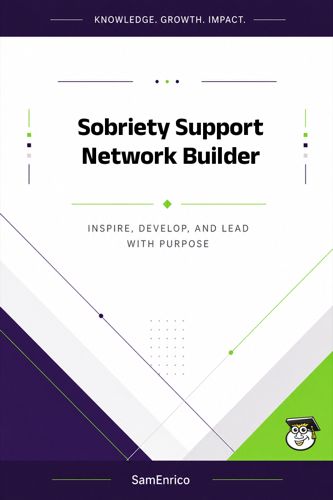
Sobriety Support Network Builder eBook
Create a personal recovery team including sponsors
Create a personal recovery team including sponsors, therapists, sober friends, and family allies.
Formats
Free sample
Chapter 1: The Loneliness Trap--–- The lie arrived wrapped in virtue. No one told me directly, of course. It seeped in through cultural osmosis, through movies where the hero locks himself in a cabin and emerges sober, through well-meaning friends who said "you just need more willpower," through the quiet shame that whispered real strength means doing this alone.I believed it for years. Every time I tried to quit drinking—and I tried dozens of times—I would retreat inward. I would delete my social media, avoid my friends (who all drank anyway), skip parties, and huddle in my apartment like a wounded animal.
I told myself I was being disciplined. I was "focusing on myself." I was "taking a break from the world to get my head straight."Every single time, I relapsed within ninety days.Not because I didn't want to stop. Not because I didn't try. But because isolation—the very thing I thought was protecting me—was actually the engine of my addiction.This chapter dismantles the most dangerous myth in recovery: that quitting is a test of individual willpower, and that asking for help is a sign of weakness. Drawing from the loneliness documented in modern memoirs like The Sober Diaries and the community-focused research in Recovery Allies, we will see that isolation is not just a symptom of addiction but its primary fuel.
You will learn why the "white knuckle" approach statistically leads to relapse within ninety days, and why building a recovery team is not optional—it is biological.By the end of this chapter, you will complete the Isolation Inventory, create your own Isolation Emergency Plan, and understand the full definition of Recovery Capital—the internal and external resources you need to stay sober. You will also meet the four pillars of support that this entire book is built upon, though we will only introduce them here. Most importantly, you will make a decision: Do I keep trying to do this alone, or do I start building my team?Let me tell you the story that convinced me.The Bathroom Floor I had been sober for forty-seven days. That number is seared into my memory. Forty-seven days of white-knuckling, of avoiding bars, of lying to my friends about why I couldn't come to dinner, of pacing my apartment at 10 PM with a craving that felt like a physical hand around my throat.On the forty-seventh night, I sat on my bathroom floor at 11 PM.
My phone was in my hand. I had not had a drink in over six weeks. By any objective measure, I was "succeeding."But I was dying to drink. Not metaphorically. The craving was so intense that I could taste it, could feel the phantom warmth of whiskey spreading through my chest, could hear the voice in my head that said "Just one.
You've proven you can stop. One won't hurt."I opened my phone. I scrolled through my contacts. Two hundred and forty-four names.Not one I could call.Not my mom—she would cry, and I couldn't handle her tears on top of my own shame. Not my old drinking buddies—they would invite me out, and I would say yes.
Not my ex-boyfriend—he was the reason I drank in the first place. Not my coworkers—they didn't know I had a problem. Not my therapist—wait, I didn't have one. Not a sponsor—I had never been to a meeting.I had two hundred and forty-four people in my phone, and not a single one of them knew the full truth about my drinking. Not a single one was in recovery themselves.
Not a single one had ever received a call from me saying "I'm struggling right now. Can you sit with me?"That night, I did not relapse. But I came closer than any craving ever brought me. The problem was not my willpower. The problem was my address book.I had built a life that looked full—friends, a job, a social calendar—but every relationship was built on a foundation of lies.
I had hidden bottles, lied about how much I drank, laughed off blackouts as "funny stories," and presented a version of myself that was in control. No one knew the truth because I had never told them. And because no one knew the truth, no one could help.That night, I realized something that changed everything: Isolation is not being alone. Isolation is having no one who truly knows you.The Myth of the Lone Warrior Let me name the lie explicitly: Recovery is an inside job.You have heard this phrase. It appears in memes, in self-help books, in the whispered advice of people who have never struggled with addiction.
The idea is that you must first fix yourself, find your inner strength, develop your willpower, and then you can rejoin the world as a sober person.This is backwards.The research is clear. A landmark study published in the Journal of Substance Abuse Treatment followed 1,200 people in recovery for five years. The single strongest predictor of long-term sobriety was not age, not income, not even the severity of the addiction. It was social support—the number of people in the recovering person's life who knew about their addiction and actively supported their recovery.Another study from the National Institute on Alcohol Abuse and Alcoholism found that people who attended mutual-help groups (like AA or SMART Recovery) had significantly higher rates of abstinence at one year compared to those who tried to quit alone. The effect was so strong that the researchers concluded: "Attempting to recover without social support is clinically inadvisable."Why?
Because addiction hijacks the brain's reward system. Alcohol and drugs flood the brain with dopamine, creating a powerful association between substance use and relief. Over time, the brain rewires itself: triggers (stress, loneliness, boredom, social situations) become automated cues to drink. Willpower is the conscious mind fighting against an unconscious system that has been optimized over thousands of repetitions. The conscious mind always loses.But here is what the research also shows: the same brain that rewires for addiction can rewire for connection.
When you build relationships with people who support your sobriety, your brain begins to associate those people with safety, relief, and reward. Over time, the urge to reach for a phone (to call a sober friend) can become as automatic as the urge to reach for a bottle.This is the social immune system. A body needs white blood cells to fight infection. A recovering person needs external accountability to fight addiction. You cannot white-knuckle your way through a bacterial infection, and you cannot white-knuckle your way through a substance use disorder.The Statistics That Should Scare You (And Set You Free)Let me give you the numbers.
They are not pretty, but they are honest.Ninety days. The average relapse rate for people attempting to quit alcohol without any formal support system is approximately 80% within the first ninety days. That means eight out of ten people who try to "just stop" on their own will be drinking again within three months.One year. For those who make it past ninety days…
This is the end of the free sample. Get the eBook to keep going. Buy now
About this book
Details
- Author
- Mccaskill Argentina
- Publisher
- SamEnrico
- Language
- English
- Genre
- Non-Fiction, Self-Help, Social Support
- Released
- 2026-06-10
- Pages (approx.)
- 137
- Available as
- eBook, Audiobook

Read better in the ZLOADR app
Your eBooks on your phone or tablet. Sign in with your SamEnrico account and start reading.
More by Mccaskill Argentina
 Witnessing Domestic ViolenceMccaskill Argentina$11.99
 Mindfulness Workbook for NewcomersMccaskill Argentina$11.99
 Eisenhower Matrix for Nonprofit LeadersMccaskill Argentina$11.99
 Rental Property Net Operating IncomeMccaskill Argentina$11.99
 TikTok Comparison RecoveryMccaskill Argentina$11.99
 Pomodoro For Pomodoro FatigueMccaskill Argentina$11.99
 Byron Katie InquiryMccaskill Argentina$11.99
 The Last Circus of the Moonlit SaharaMccaskill Argentina$11.99
 The Divine Fire: Mozart's Musical RevolutionMccaskill Argentina$11.99
 Mastering The Art of Limalama (Samoa)Mccaskill Argentina$11.99
 Error Handling in Bank APIsMccaskill Argentina$12.99
 Chinese Supplier Minimum Profit ProtectionMccaskill Argentina$12.99
You may also like
 Hong Kong Handover 1997Dunn Johnnie$11.99
 Zumba For Postnatal Recovery CourseNeal Christian$11.99
 Zumba for BeginnersLadner Nikia$11.99
 YouTube Comment Mining GuideHumes Pandora$12.99
 Worry Box MeditationCarlin Rudy$11.99
 Workplace Stress MeditationNguyen Lynn$11.99
 Workplace Stress and Sleep RepairHawley Ivory$11.99
 Workplace Perfectionism CureDelaney Jeffry$11.99
 Workplace Injustice Anger GuideWallen Isabelle$11.99
 Work Addiction and Burnout LinkGreenwood Ester$11.99
 Women in Yoga and WellnessBeattie Galina$11.99
 Women in Stand Up ComedyChun Evangeline$11.99