
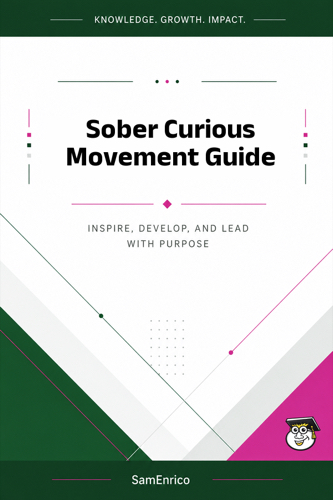
Non-FictionSelf-HelpSober Curiosity
Sober Curious Movement Guide eBook
Introduces alcohol reduction and exploration of so
Introduces alcohol reduction and exploration of sobriety without requiring rock bottom.
Formats
Free sample
Chapter 1: The Autopilot Lie--–- You are about to read something that will make you uncomfortable. Not because it is threatening or cruel, but because it will show you a version of your own life that you have been actively trained not to see.Let us begin with a simple experiment. Think about the last time you said the words “I am not drinking tonight.” Where were you? Who were you with? And most importantly, what happened next?For most people, those five words land like a small bomb in the middle of a conversation.
The person who hears them almost always asks a follow-up question: “Oh, why? Are you okay?” “Are you pregnant?” “Are you doing some kind of cleanse?” “How long are you doing that for?” The assumption embedded in every single one of those questions is the same: There must be a reason. A justification. An excuse. Because not drinking is not the default.Now run the opposite experiment.
Think about the last time you said “I am having a drink tonight.” Did anyone ask why? Did anyone demand a medical explanation? Did anyone assume something was wrong with you? Of course not. You could say those words at ten o’clock on a Tuesday morning and most people would not blink.
Having a drink requires no justification. Not having a drink requires a defense.That asymmetry is the first clue that something is wrong with the story we have all been sold.The Water That Does Not Know It Is Wet Imagine you are a fish. You have lived your entire life in a body of water. You have never known anything else. One day, another fish swims past you and says, “How is the water today?” And you look at them with genuine confusion and ask, “What is water?”This old parable captures the single greatest obstacle to changing your relationship with alcohol: you cannot question what you cannot see.
Alcohol is so deeply embedded in the architecture of modern life that it has become invisible. It is not a substance you consume. It is the atmosphere you breathe.Consider the sheer reach of alcohol’s cultural footprint. There is the work happy hour where deals are made over beer. The first date that is almost always “drinks.” The wedding toast.
The funeral reception. The birthday dinner where the waiter asks, “What can I get you to drink?” before they ask what you want to eat. The airplane, the train, the concert, the sporting event, the book club, the yoga class that ends with wine, the running club that ends with beer, the parent meet-up that ends with rosé. There is no secular ritual, no life transition, no ordinary Tuesday that has not been colonized by alcohol.The result is that most people never make a conscious choice to drink. They simply default to drinking because that is what everyone else is doing, because that is what the environment suggests, because that is what they have always done.
This is what we call autopilot drinking. And autopilot is the opposite of choice.The Thursday Anticipation Let us walk through a week in the life of an autopilot drinker. Not an “alcoholic” by any clinical definition. Not someone who has lost a job or a marriage or a license. Just someone who drinks like a normal person.
Which is to say, someone who drinks like everyone else.Thursday arrives. You have made it through most of the week. The fatigue is real. The stress has accumulated. And somewhere in the back of your mind, a quiet voice whispers, Almost there.
Friday is the finish line. Friday is the reward. Friday is the night when you will finally get to relax. By Thursday afternoon, you are already anticipating the first sip. That anticipation feels good.
It feels like hope. It feels like you have earned something.Friday night comes. You pour the first drink. The glass is cold. The liquid catches the light.
And for about twenty minutes, you feel exactly what you were hoping to feel: relaxed, warm, relieved. The edges of the week soften. The voice in your head quiets. You exhale. This is what you needed.
This is what you deserved. You pour another.Saturday morning arrives like a thief. You wake up sometime between 3 AM and 5 AM—the precise window when alcohol metabolizes and the brain rebounds with a surge of stress hormones. Your heart is racing. Your mouth is dry.
Your mind is already spiraling through everything you said, everything you texted, everything you posted. You lie there in the dark, waiting for sleep to return, but it does not. Eventually, you give up. You check your phone. You scroll.
You feel the low-grade shame settle into your chest like a familiar tenant.You sleep late. You wake up groggy. The morning is gone. The day feels truncated, smaller than it should be. You tell yourself you will not drink tonight.
You tell yourself you needed the break. You tell yourself everyone does this. By noon, the headache fades. By 2 PM, you are functional. By 5 PM, the thought crosses your mind: Maybe just one tonight.
To take the edge off.Sunday is a reset. You clean the house. You answer emails. You meal prep. You promise yourself that next week will be different.
You will drink less. You will not drink on weeknights. You will be more disciplined. You mean it. You believe it.
By Sunday night, you feel virtuous. You have earned the good week ahead.Monday comes. Tuesday comes. Wednesday comes. You do not drink.
You feel proud. You feel in control.And then Thursday arrives. And the cycle begins again.This is not a story of addiction. This is a story of normalcy. This is the weekly rhythm for millions of people who would never describe themselves as having a problem with alcohol.
And yet, notice what is missing from this story: a single conscious choice. The drinking happens because it is Thursday. Because it is Friday. Because the glass is there. Because the bottle is open.
Because everyone else is drinking. Because that is just what you do.That is autopilot.The Cognitive Dissonance Machine Here is where the story becomes more complicated. Because the autopilot drinker is not stupid. They know things about alcohol. They have read the headlines.
They have seen the studies. They know, at some level, that alcohol is a neurotoxin. They know it is a Group 1 carcinogen, in the same category as asbestos, formaldehyde, and tobacco. They know it damages the liver, the heart, the brain, the gut microbiome. They know it disrupts sleep, increases anxiety, and causes depression.
They know all of this.And they drink anyway.This is not hypocrisy. This is not weakness. This is cognitive dissonance—the psychological state of holding two contradictory beliefs at the same time. Belief one: Alcohol is dangerous. Belief two: I enjoy alcohol and it helps me relax.
The human mind cannot hold these two beliefs simultaneously without experiencing significant discomfort. So the mind resolves the discomfort. It does not resolve it by quitting alcohol. It resolves it by changing the story.The most common…
This is the end of the free sample. Get the eBook to keep going. Buy now
About this book
Details
- Author
- Carvalho Columbus
- Publisher
- SamEnrico
- Language
- English
- Genre
- Non-Fiction, Self-Help, Sober Curiosity
- Released
- 2026-06-09
- Pages (approx.)
- 125
- Available as
- eBook, Audiobook

Read better in the ZLOADR app
Your eBooks on your phone or tablet. Sign in with your SamEnrico account and start reading.
More by Carvalho Columbus
 Post Hypnotic Suggestion for Exam SuccessCarvalho Columbus$11.99
 Printing and Toner GuideCarvalho Columbus$11.99
 Anger Trigger InventoryCarvalho Columbus$11.99
 The Golden Thread: A Love Letter to Spain’s RenaissanceCarvalho Columbus$11.99
 How to Start a Cotter Pin Business (Beginners Guide)Carvalho Columbus$11.99
 Personal US Bank Account from AbroadCarvalho Columbus$12.99
 How to Produce Clasps and HooksCarvalho Columbus$11.99
 Slot Die Coating TechnicianCarvalho Columbus$11.99
You may also like
 Hong Kong Handover 1997Dunn Johnnie$11.99
 Zumba For Postnatal Recovery CourseNeal Christian$11.99
 Zumba for BeginnersLadner Nikia$11.99
 YouTube Comment Mining GuideHumes Pandora$12.99
 Worry Box MeditationCarlin Rudy$11.99
 Workplace Stress MeditationNguyen Lynn$11.99
 Workplace Stress and Sleep RepairHawley Ivory$11.99
 Workplace Perfectionism CureDelaney Jeffry$11.99
 Workplace Injustice Anger GuideWallen Isabelle$11.99
 Work Addiction and Burnout LinkGreenwood Ester$11.99
 Women in Yoga and WellnessBeattie Galina$11.99
 Women in Stand Up ComedyChun Evangeline$11.99