
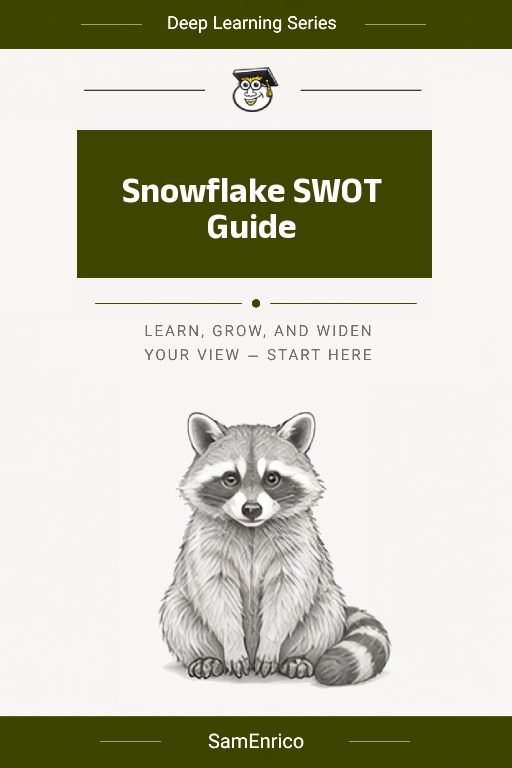
Non-FictionStrategic AtlasData Cloud
Snowflake SWOT Guide eBook
Assess cloud data warehousing leadership, consumpt
Assess cloud data warehousing leadership, consumption model, competition from Databricks, and customer concentration.
Formats
Free sample
Chapter 1: The Ascent Paradox--Snowflake’s origin story is not one of sudden disruption but of patient architectural rebellion. While the technology world obsessed over big data’s volume, velocity, and variety, a small team of engineers at a stealth startup called Snowflake Computing asked a more subversive question: What if the data warehouse didn’t require administration at all? What if you could pause it like a laptop, scale it like a cloud function, and never once think about indexes, partitions, or vacuuming? That question, posed around 2012, set in motion a chain of events that would dethrone Teradata, humble Oracle, force Amazon to rebuild Redshift twice, and create one of the most valuable software companies in history. But the same architectural purity that propelled Snowflake to a $120 billion market cap now threatens to become its greatest vulnerability.
This is the Ascent Paradox: the very features that made Snowflake indispensable are now being commoditized, copied, or strategically undermined by an alliance of open source insurgents and cloud giants. To understand where Snowflake goes from here, we must first understand how it got here—and why its founding genius contains the seeds of its current crisis.The chapter you are about to read establishes the technical and historical foundation for the entire SWOT analysis that follows. By the end of this chapter, you will understand Snowflake’s original innovation—true separation of storage and compute—better than most of its own customers. You will see why incumbents failed to respond, why the data lakehouse emerged as a competitive response, and why the very concept of a “data warehouse” is undergoing its most radical transformation since the 1980s. Most importantly, you will grasp the central tension that animates this entire book: Snowflake won the first generation of the cloud data war through architectural brilliance, but the second generation will be won by whoever solves the open source paradox.
Let us begin at the beginning.The Pre-Snowflake Era: The Tyranny of the Monolith To appreciate Snowflake’s ascent, you must first understand the misery it alleviated. Before 2014, enterprise data warehousing meant one of three painful options: on-premises appliances from Teradata or Oracle, first-generation cloud warehouses like Amazon Redshift (launched 2012), or Hadoop-based data lakes that required a Ph D in distributed systems to operate. Each option suffered from a fatal flaw that Snowflake would later exploit.On-premises appliances were physically constrained. Teradata’s massive parallel processing (MPP) architecture was genuinely innovative in the 1990s, but it required you to predict your data growth years in advance. Order too little capacity, and queries would slow to a crawl during peak seasons.
Order too much, and you had millions of dollars of silicon sitting idle. Worse, scaling required downtime, reconfiguration, and often a visit from professional services. The term “data warehouse administrator” existed because the systems demanded full-time attention—tuning indexes, managing partitions, vacuuming deleted data, and begging vendors for more storage.Amazon Redshift, launched in 2012, seemed like a liberation. It offered the same MPP architecture but on cloud infrastructure, with per-hour pricing. Yet Redshift inherited many of the same operational headaches.
You still had to choose the right number and type of nodes. You still had to distribute and sort keys—essentially manual indexing that required deep knowledge of your query patterns. You still had to vacuum and analyze tables. Amazon called it “petabyte-scale data warehousing at a fraction of the cost,” but customers called it “Teradata with a better payment plan.” The operational burden remained.Hadoop promised a different path. Instead of a monolithic database, you could store data in a distributed file system (HDFS) and process it with Map Reduce or Spark.
This eliminated the need for rigid schemas and expensive appliances. But Hadoop introduced its own horrors: complex cluster management, steep learning curves, and performance that depended on hand-tuned Java code. By 2015, the term “data lake” had become a punchline—a data swamp where data went to die, accessible only to a priesthood of engineers.Into this chaos stepped Snowflake. The founders, Benoit Dageville and Thierry Cruanes (both former Oracle data warehouse architects), and Marcin Żukowski (a database researcher), understood the deep architecture of data systems. They also understood that the cloud changed everything.
If storage and compute could be separated at the physical level—S3 for files, EC2 for processing—why did a data warehouse need to couple them at the architectural level?The Breakthrough: Separation of Storage and Compute The insight was deceptively simple. In every prior data warehouse, storage and compute were tightly coupled. A Teradata node contained both disk drives and processing chips. A Redshift node contained both SSD storage and CPU cores. If you needed more compute but not more storage, you still had to add a full node.
If you needed more storage but not more compute, same problem. This coupling created waste, inflexibility, and cost.Snowflake’s architecture broke this coupling at the deepest level. The system consists of three independent layers: cloud services, compute, and storage. The storage layer uses cloud object stores (S3 on AWS, Azure Blob Storage, Google Cloud Storage) to hold all data in a proprietary, columnar format. The compute layer consists of virtual warehouses—independent clusters of EC2 or equivalent instances that execute queries.
The cloud services layer handles authentication, metadata, query optimization, transaction management, and all the “brain” functions.The genius of this separation becomes apparent when you consider what it enables. First, you can scale compute without touching storage. Need to run a complex query on a massive dataset? Spin up a large virtual warehouse. That warehouse processes the data from storage and then disappears.
The underlying data never moves. Second, you can scale storage without touching compute. As your data grows, S3 simply holds more files. No downtime, no reconfiguration, no additional compute nodes required. Third—and this is the feature that would make Snowflake famous—you can pause compute entirely.
When no queries are running, virtual warehouses consume zero credits. This is not “serverless” in the marketing sense; it is genuinely no compute, no cost.The architectural diagram that follows illustrates the separation, but the intuitive explanation is simpler: imagine a library where the bookshelves (storage) are in one building, the reading rooms (compute) are in another, and the librarians (cloud services) coordinate everything. You can open more reading rooms during busy hours, close them at night, and never move a single book. The books always stay on the shelves. That is Snowflake’s core innovation.The Saa Sification of the Data Warehouse Separating storage and compute was necessary but not sufficient.
Snowflake’s real gift to the market was eliminating administration entirely. This is what the book calls “Saa Sification”—turning a complex infrastructure product into a service that requires no thinking about the underlying machinery.Consider what you do not do in Snowflake. You do not provision hardware. You do not configure clusters. You do not choose distribution keys or sort keys.
You do not vacuum tables. You do not analyze statistics. You do not partition data manually. You do not manage indexes. You do not tune memory settings.
You do not configure replication. You do not plan for disaster recovery. You do not install security patches. You do…
This is the end of the free sample. Get the eBook to keep going. Buy now
About this book
Details
- Author
- Toliver Collin
- Publisher
- SamEnrico
- Language
- English
- Genre
- Non-Fiction, Strategic Atlas, Data Cloud
- Released
- 2026-06-01
- Pages (approx.)
- 142
- Available as
- eBook, Audiobook

Read better in the ZLOADR app
Your eBooks on your phone or tablet. Sign in with your SamEnrico account and start reading.
More by Toliver Collin
 Senior Pet Esteem GuideToliver Collin$11.99
 Assertive Communication for TeensToliver Collin$11.99
 Poverty and HomeworkToliver Collin$11.99
 The Morning Meditation Routine GuideToliver Collin$11.99
 Gratitude for FoodToliver Collin$11.99
 Ra’s Lost Sun Chariot: The Norse Voyage to Egypt’s Forgotten DawnToliver Collin$11.99
 How to Become a Nibbler OperatorToliver Collin$11.99
 Understanding Myoglobinuria Dominant FormToliver Collin$17.99
 Accounting Formulas for Financial AnalysisToliver Collin$12.99
 Cabin Crew ManagementToliver Collin$11.99
You may also like
 Hong Kong Handover 1997Dunn Johnnie$11.99
 Zumba For Postnatal Recovery CourseNeal Christian$11.99
 Zumba for BeginnersLadner Nikia$11.99
 YouTube Comment Mining GuideHumes Pandora$12.99
 Worry Box MeditationCarlin Rudy$11.99
 Workplace Stress MeditationNguyen Lynn$11.99
 Workplace Stress and Sleep RepairHawley Ivory$11.99
 Workplace Perfectionism CureDelaney Jeffry$11.99
 Workplace Injustice Anger GuideWallen Isabelle$11.99
 Work Addiction and Burnout LinkGreenwood Ester$11.99
 Women in Yoga and WellnessBeattie Galina$11.99
 Women in Stand Up ComedyChun Evangeline$11.99