
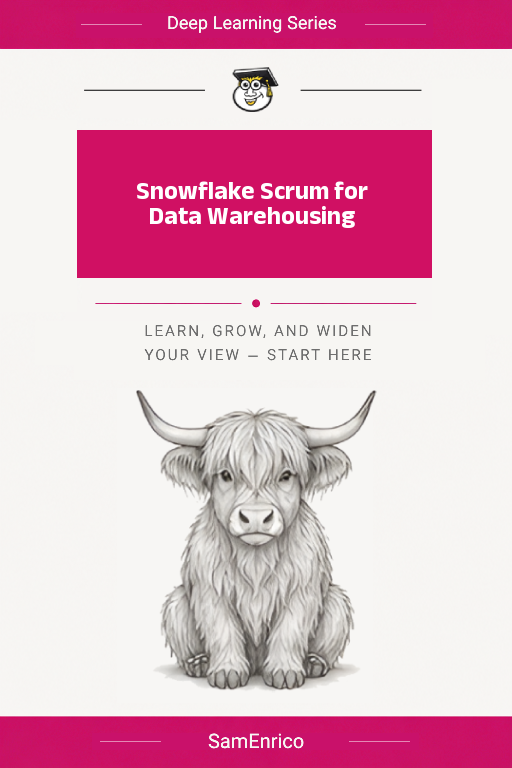
Snowflake Scrum for Data Warehousing eBook
Scale cloud data infrastructure using Snowflake's
by Erwin Corina
Scale cloud data infrastructure using Snowflake's scrum model, managing concurrent queries and storage optimization as product backlog items for startup analytics.
Formats
Free sample
Chapter 1: The 9:00 AM Graveyard--–- The Slack notification arrived at 8:47 AM. Maya ignored it. She was still nursing her coffee, staring at the same line of Python code she had rewritten four times yesterday. The notification was from Brian, the Head of Sales. “Hey Maya, pulling the board deck.
Can you check the dashboard? Seems slow.”At 8:52 AM, another ping. This time from Jenna in Marketing. “Campaign ROI numbers aren't loading. Is there an update?”At 8:58 AM, Maya’s phone buzzed with a text from her boss, Arjun, the CTO.
“Board meeting in 2 hours. Please tell me the dashboards are ready.”She opened her laptop and ran the query herself.The timer in her SQL client ticked past 10 seconds. Then 30. Then 60. At 90 seconds, she closed the window and reopened it, hoping for a different result.
That’s the definition of insanity, she thought. But she did it anyway.At 9:03 AM, the dashboard finally rendered—partially. A gray loading spinner spun endlessly where the "Revenue by Region" chart should have been. Maya refreshed. The spinner kept spinning.
Behind her, she heard the first of what would be many raised voices from the sales floor. Someone shouted, “Is the system down?”It was 9:05 AM. Fifty-three analysts, sales ops managers, and marketing coordinators had just started their day. Fifty-three simultaneous queries had just hit a single X-Small Snowflake warehouse. Forty-nine of them were now queued.
The first one in line had been waiting for over four minutes.Maya’s startup, Swift Retail, was growing faster than anyone had predicted. Six months ago, they had three data analysts and one part-time engineer. Today, they had twelve analysts, four data scientists, and a marketing team that treated Looker like it was a competitive sport. The board meeting was in two hours, and Maya’s dashboard—the one she had promised would be “fast and reliable”—was slower than the dial-up connection she remembered from childhood.She pulled up Snowflake’s Query History. The screen filled with yellow and red.
Queued. Blocked. Queued. Spilling to remote storage. Timeout.Her phone rang.
It was Arjun.“Maya,” he said, his voice flat. “Talk to me.”She wanted to say something technical: “We’re seeing unexpected concurrency patterns due to the lack of workload isolation.” But what came out was, “I don’t know.”Silence.“Fix it,” Arjun said. “The board is flying in. We have two hours.”He hung up.Maya stared at her screen. The loading spinner was still spinning.The Anatomy of a Data Crisis Swift Retail wasn’t a unicorn yet, but it was close.
They had built a two-sided marketplace connecting local artisans with urban buyers. In eighteen months, they had gone from zero to fifteen million in annual recurring revenue. Their data was their oxygen: buyer preferences, seller inventory, shipping times, customer support tickets, payment failures, fraud detection. Every decision ran through Snowflake.But like many startups, Swift Retail had grown their data infrastructure the same way they grew their office furniture—whatever was cheapest and fastest at the time, stacked together until it resembled something functional.The stack looked like this:Fivetran extracting data from 14 different APIs (Shopify, Stripe, Zendesk, Intercom, and ten others) and dumping raw JSON into Snowflake.A collection of Python scripts running on a single EC2 instance, scheduled with cron jobs that no one had documented.dbt models written by three different engineers with three different philosophies about what “clean code” meant.Looker dashboards connected directly to Snowflake, with no caching layer, no query limits, and no oversight.Snowflake itself—a single X-Small warehouse named ANALYTICS_WH that every single person in the company used for everything. ETL, ad-hoc queries, dashboards, exports, you name it.The result was not a data platform.
It was a Franken-stack—a monster stitched together from spare parts, powered by hope and caffeine.And today, that monster had woken up hungry.The Hidden Costs of “It Works on My Machine”Maya had inherited this system six months ago. At the time, the previous engineer (who had left to join a blockchain startup) had assured her that everything was “production-ready.” The code was in a Git Hub repo. The cron jobs were running. The dashboards loaded in under ten seconds.What the previous engineer hadn’t mentioned was that “under ten seconds” only applied at 2:00 PM on a Tuesday when only three people were querying the warehouse. He hadn’t mentioned that the X-Small warehouse had a hard concurrency limit of eight queries.
He hadn’t mentioned that the dbt models were doing full-table scans every hour because no one had defined clustering keys.Maya learned these lessons the hard way.In her first week, she ran a simple COUNT(*) on the events table and waited eleven minutes for a result. That was when she first discovered that the table had 2.4 billion rows and no partition key.In her second week, she got an alert from Snowflake that the account had exceeded its daily credit limit. The bill for that day alone was $847. The culprit? A marketing analyst had written a query with a cross join between the customers table and the products table—two hundred thousand rows times forty thousand rows.
Eight billion intermediate rows. The warehouse had scaled up automatically, burning credits like jet fuel.In her third week, she asked if anyone had documented the data lineage. The answer was a blank stare from the entire data team.“We have a wiki somewhere,” someone offered.The wiki had one page. It said: “Ask Maya.”By month three, Maya had stopped sleeping well. The firefighting was endless.
A dashboard would break, she would fix it, and two days later a different dashboard would break. The root cause was always the same: the infrastructure was brittle because it had been built by people who were sprinting to deliver features and never sprinting to pay down technical debt.She had read about Scrum, the Agile framework that software engineers used to ship software predictably. She had even taken an online course. But the course was about building mobile apps and web services. It didn’t mention Snowflake.
It didn’t mention data warehouses. It didn’t mention the soul-crushing experience of watching a queue of fifty queries crawl toward zero.So Maya did what any desperate engineer would do: she Googled.She found blog posts about “query optimization” and “warehouse sizing.” She found You Tube videos about “Snowflake best practices.” She found a Reddit thread where someone said, “Just use a larger warehouse.” She tried that. The Large warehouse cost four times as much and still queued forty-five queries instead of forty-nine. The problem wasn’t the size of the warehouse; it was the fact that everyone was sharing one.She needed isolation. She needed automation.
She needed a system that didn’t require her to wake up at 3:00 AM to kill a runaway query.She needed something that looked a lot like Scrum—but for data.The Performance SLA That Changed Everything At 9:15 AM, with the board meeting looming, Maya did something drastic. She opened a Google Doc, wrote the words “Data Incident Report,” and started typing.She listed every query that had run in the…
This is the end of the free sample. Get the eBook to keep going. Buy now
About this book
Details
- Author
- Erwin Corina
- Publisher
- SamEnrico
- Language
- English
- Genre
- Non-Fiction, Startup Guide
- Released
- 2026-05-30
- Pages (approx.)
- 113
- Available as
- eBook, Audiobook

Read better in the ZLOADR app
Your eBooks on your phone or tablet. Sign in with your SamEnrico account and start reading.
More by Erwin Corina
 Anki For History StudentsErwin Corina$11.99
 Workaholic Nutrition GuideErwin Corina$11.99
 The Micronutrient Testing GuideErwin Corina$11.99
 Laminate Glass ForensicsErwin Corina$11.99
 Burnout Prevention for VeterinariansErwin Corina$11.99
 Léopold Sédar Senghor Poet PresidentErwin Corina$11.99
 The CPR Skills CheckoffErwin Corina$11.99
 Infant Loss Grief GuideErwin Corina$11.99
 The Magnificent Madam C.J. Walker: The Business Empire That Transformed BeautyErwin Corina$11.99
 Beyond the Summit: The Unseen Ascent of Tamotsu YamadaErwin Corina$11.99
 How to Start a Courier (other Than National Post) Unlicensed Business (Beginners Guide)Erwin Corina$11.99
 Golden Retriever: Eager to PleaseErwin Corina$11.99
You may also like
 Hong Kong Handover 1997Dunn Johnnie$11.99
 Zumba For Postnatal Recovery CourseNeal Christian$11.99
 Zumba for BeginnersLadner Nikia$11.99
 YouTube Comment Mining GuideHumes Pandora$12.99
 Worry Box MeditationCarlin Rudy$11.99
 Workplace Stress MeditationNguyen Lynn$11.99
 Workplace Stress and Sleep RepairHawley Ivory$11.99
 Workplace Perfectionism CureDelaney Jeffry$11.99
 Workplace Injustice Anger GuideWallen Isabelle$11.99
 Work Addiction and Burnout LinkGreenwood Ester$11.99
 Women in Yoga and WellnessBeattie Galina$11.99
 Women in Stand Up ComedyChun Evangeline$11.99