
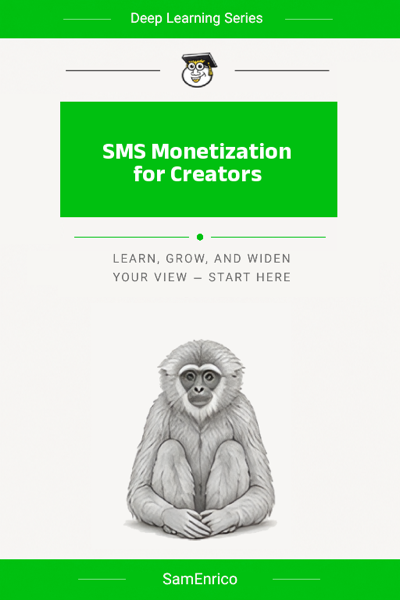
Non-FictionInformativeEducational
SMS Monetization for Creators eBook
A Coursebook on SMS Monetization for Creators
A Coursebook on SMS Monetization for Creators
Formats
Free sample
Chapter 1: The Algorithm’s Eviction Notice...--For three years, Mia built her audience the way every expert told her to. She posted daily on Instagram. She went live on Tik Tok every Tuesday. She replied to every comment within an hour. She did the dances, the trending audio, the carousel posts with the swipe-up links.
By her third year, she had 247,000 followers across three platforms. Brands paid her $2,500 per sponsored post. She was, by every external metric, a successful creator.Then one morning in April, she woke up to a notification that changed everything.Instagram had updated its algorithm overnight. The platform announced a "new focus on original content" and "meaningful social interactions." What that meant in practice was simple: Mia's reach plummeted from an average of 18 percent of her followers to just over 2 percent. A post that used to reach 44,000 people now reached 4,900.
Her engagement rate, which had taken years to build, evaporated in seventy-two hours.She did what the experts now told her to do. She posted more. She added Stories. She tried Reels. She cross-posted to Tik Tok and hoped the algorithm there would be kinder.
It wasn't. Her income dropped by 60 percent in eight weeks. The brand deals dried up first—agencies could see her engagement metrics in real time. Then her own product sales followed. A digital course that had sold 400 copies in its first month sold twelve copies the month after the algorithm change.Mia's story is not unique.
It is the story of nearly every creator who has built an audience on rented land.The Great Unraveling: How Organic Reach Died Let me tell you a number that should scare you: 2 percent.That is the average organic reach of a Facebook Page post in 2024. For Instagram, it hovers between 2 and 5 percent, depending on your niche and how aggressively you beg for engagement through Stories, polls, and "tag three friends" comments. For Tik Tok, the platform that promised discovery, even there organic reach has fallen from nearly 100 percent in 2020 to somewhere between 6 and 10 percent for most creators.Let me give you some comparison numbers so you understand how catastrophic this shift has been.In 2012, a Facebook Page with 10,000 followers could post a link to a blog post and expect roughly 1,600 people to see it. That was a 16 percent organic reach, which creators considered low even then. In 2014, that same post would reach about 800 people.
In 2016, about 400. By 2018, under 200. Today? That same post reaches maybe 200 people—and that is if you are lucky and the algorithm gods smile upon you.The platforms did not hide what they were doing. They called it "optimizing the user experience." They said they were "reducing spammy content" and "prioritizing meaningful interactions." What they were actually doing was selling your audience back to you.
Every time you want to reach the people who voluntarily followed you, who clicked that button and said "I want to see what this creator makes," you now have to pay.This is what I call the rented land crisis.You do not own your social media followers. You do not own your email list if it lives on a platform that can shut down your account. You do not own your audience if you cannot reach them without paying a toll. The platforms own the land. You are a tenant.
And tenants get evicted.The Three Ways Platforms Steal Your Audience The algorithm change that destroyed Mia's income was not a bug. It was a feature. Social media platforms have three primary mechanisms for extracting money from creators, and every single one of them is designed to make you poorer while making the platform richer.Mechanism One: The Reach Tax The first and most obvious mechanism is the paid reach model. Once organic reach collapses, platforms offer you a solution: boost this post for twenty dollars and we will show it to five thousand people. Run a conversion ad for a hundred dollars and we will find you customers.
The platform has simply monetized the access you used to get for free. They took something that belonged to you—the ability to speak to your own followers—and turned it into something you have to rent back.Mechanism Two: The Engagement Farm The second mechanism is even more insidious. Platforms reward content that keeps users on the platform longer. That means they prioritize video over text. They prioritize controversy over kindness.
They prioritize outrage over education. Creators learn that to reach their existing followers, they must produce content that the algorithm loves, not content that their audience needs. The tail starts wagging the dog. You stop making what you want to make. You start making what the algorithm demands.Mechanism Three: The Shadow Ban The third mechanism is the quiet killer.
Shadow banning—the practice of limiting a post's reach without notifying the creator—is the platform's way of punishing you for violating unspoken rules. Post an external link? Reduced reach. Mention a competitor platform? Reduced reach.
Use a word the algorithm has flagged? Reduced reach. The rules change constantly, and you never know when you have broken one until your engagement suddenly collapses.Mia learned about shadow banning the hard way. She posted a Story with a link to her newsletter signup page. The link was not against Instagram's terms of service.
But the algorithm flagged it as "suspicious behavior" because she had posted three links in one week. Her account was restricted for fourteen days. She received no notification. She only knew something was wrong because her DMs stopped arriving and her posts stopped performing.This is the reality of rented land. You play by invisible rules that change without warning.
And when you break them—whether you meant to or not—you lose access to the audience you spent years building.The Data That Changes Everything Now let me show you why this book exists. Let me show you the numbers that made Mia finally abandon her 247,000 followers and start over from zero.SMS open rates: 98 percent.Let me repeat that. Ninety-eight percent of text messages are opened. Not delivered. Opened.
Read. Viewed by human eyeballs. The average person checks their phone 96 times per day. They respond to text messages within 90 seconds on average. They read 98 percent of the texts they receive, compared to 20 percent of the emails that land in their inbox.The three-minute rule: Most people read a text message within three minutes of receiving it.
Three minutes. Not three hours. Not three days. Three minutes.The reply rate: People reply to text messages at a rate of 45 percent, compared to 6 percent for email and less than 1 percent for social media comments.Let me put these numbers in perspective.When Mia posted on Instagram after the algorithm change, her 247,000 followers translated into roughly 4,900 views per post. Of those 4,900 views, perhaps 98 people would engage (like, comment, save).
Of those 98 engaged users, maybe 2 or 3 would click a link. That is a conversion rate of 0.001 percent from followers to actions.When Mia built her first SMS list of 1,000 subscribers, her open rate was 98 percent. That meant 980 people saw every text. Of those 980, roughly 45 percent replied or clicked. That is 441 engaged subscribers.
From a list one four-hundredth the size of her Instagram following, she generated more engagement than she ever had on…
This is the end of the free sample. Get the eBook to keep going. Buy now
About this book
Details
- Author
- Heaton Pearle
- Publisher
- SamEnrico
- Language
- English
- Genre
- Non-Fiction, Informative, Educational
- Released
- 2026-06-02
- Pages (approx.)
- 153
- Available as
- eBook, Audiobook

Read better in the ZLOADR app
Your eBooks on your phone or tablet. Sign in with your SamEnrico account and start reading.
More by Heaton Pearle
 Road Rage and Weather ConditionsHeaton Pearle$11.99
 Meth HIV Risk Prevention GuideHeaton Pearle$11.99
 Nap for New ParentsHeaton Pearle$11.99
 Immigrant Fitness Studio Chain GuideHeaton Pearle$11.99
 Metta for a Partner's FamilyHeaton Pearle$11.99
 Stress And TestosteroneHeaton Pearle$11.99
 Meditation for MemoryHeaton Pearle$11.99
 NVC For Elder ParentsHeaton Pearle$11.99
 Eat the Frog Time BlockHeaton Pearle$11.99
 Frozen Echoes: The Lost World of the Arctic's Ancient HuntersHeaton Pearle$11.99
 Whispers in the Bazaar: The Djinn of the Vanishing CaravanHeaton Pearle$11.99
 Echoes of the Phantom: The Unseen Life of Johnny CarsonHeaton Pearle$11.99
You may also like
 Hong Kong Handover 1997Dunn Johnnie$11.99
 Zumba For Postnatal Recovery CourseNeal Christian$11.99
 Zumba for BeginnersLadner Nikia$11.99
 YouTube Comment Mining GuideHumes Pandora$12.99
 Worry Box MeditationCarlin Rudy$11.99
 Workplace Stress MeditationNguyen Lynn$11.99
 Workplace Stress and Sleep RepairHawley Ivory$11.99
 Workplace Perfectionism CureDelaney Jeffry$11.99
 Workplace Injustice Anger GuideWallen Isabelle$11.99
 Work Addiction and Burnout LinkGreenwood Ester$11.99
 Women in Yoga and WellnessBeattie Galina$11.99
 Women in Stand Up ComedyChun Evangeline$11.99