
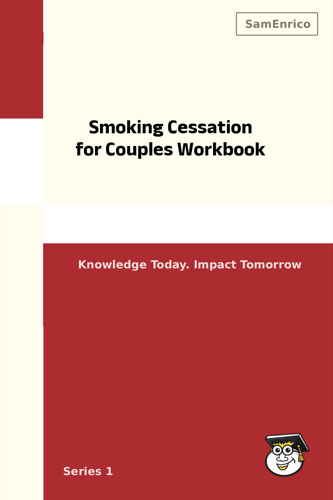
Smoking Cessation for Couples Workbook eBook
When both partners smoke, quit together with mutua
When both partners smoke, quit together with mutual support and accountability.
Formats
Free sample
Chapter 1: The Shared Cage...–- Every morning, you wake up, and before you even speak to each other, you both reach for the same thing. Not each other. Not coffee. Cigarettes. You smoke in silence, side by side, wrapped in a habit that has become the third presence in your relationship.
It dictates when you take breaks, how you handle stress, where you vacation, and even how you argue. For years, you may have told yourselves that at least you’re in this together. At least neither of you has to face the judgment of being the only smoker in the relationship. At least you don’t have to hide it.But here is the truth that no one tells you when both partners smoke: what feels like solidarity is actually a shared cage.The bars of that cage are made of mutual triggers, synchronized cravings, and an unspoken contract that says, “If you smoke, I smoke.” You have learned to read each other’s cues—the way one partner reaching for a pack makes the other’s mouth water. The way an argument isn’t truly over until the post-fight cigarette has been lit.
The way a quiet evening together feels incomplete without stepping outside onto the porch. You are not two independent addicts living parallel lives. You are a dyad, a system, a single smoking unit. And that means that quitting cannot be two solo missions launched from the same living room. It must be something else entirely.This book is built on a deceptively simple premise: when both partners smoke, the most powerful tool you have is not individual willpower but mutual support with clear accountability.
But that power comes with a dangerous mirror image. If one of you relapses, the other is statistically far more likely to relapse as well. You are, for better and worse, locked together. The same dynamic that can help you succeed can also pull you both down. Most smoking cessation programs treat the individual.
This workbook treats the couple as the unit of change because your addiction does not exist in isolation. It exists in the space between you.Before you write a single word in this workbook, before you set a quit date or throw away your last pack, you must understand one thing: quitting together is not the same as quitting at the same time. Quitting together means rewriting the scripts that govern your relationship. It means recognizing that your smoking patterns are not just personal habits but shared rituals. And it means accepting that the blame and defensiveness that have surrounded past quit attempts—the silent resentment, the quiet accusations, the feeling of being policed by the person who is supposed to love you—must be replaced by a new kind of conversation.This chapter is called The Shared Cage not to depress you but to liberate you.
Because once you see the cage for what it is, you can begin to unlock it from the inside. Together.The Paradox of Mutual Smoking Let us start with the numbers because numbers do not lie. Research consistently shows that when one partner in a couple quits smoking, the other partner is significantly more likely to quit as well—not because of pressure but because of modeling and shared environment. That is the good news. Your relationship can be a vehicle for health.The bad news is equally stark.
When both partners smoke and attempt to quit simultaneously, the risk of mutual relapse is higher than the risk of individual relapse in solo quitters. Why? Because your triggers are intertwined. Your dopamine regulation has become synchronized in ways you cannot feel but your brain certainly can. When you argue, you smoke.
When you celebrate, you smoke. When you are bored, you smoke. And when one of you cracks and takes “just one puff,” the other is neurologically primed to follow.This is not a failure of character. It is the nature of paired addiction. Your brains have learned to associate your partner’s presence with nicotine reinforcement.
The smell of smoke on their clothes, the sound of a lighter, even the sight of them heading toward the door—all of these become conditioned cues that trigger your own cravings. You are not weak. You are wired together.Most couples who smoke together have never actually discussed their smoking. Not really. They have exchanged packs, borrowed lighters, stepped outside simultaneously without a word.
But they have not sat down and asked each other: What does smoking do for you? What would you lose if you quit? What scares you about stopping? Instead, smoking has become a silent language, a shared choreography that requires no conversation. And that silence is the first thing this workbook will break.Why Blame Is the Real Enemy If you have tried to quit before—together or separately—you already know the script.
One partner expresses concern about health or money or smell. The other partner hears criticism. Defenses go up. Someone says, “You smoke just as much as I do.” Someone else says, “You’re not my mother.” And within minutes, a conversation about quitting becomes a fight about who is worse, who is to blame, who has the right to speak.Blame is the enemy of every couple-based quit attempt. It is also incredibly seductive.
Blame feels like clarity. When you point at your partner and say, “You are the reason we can’t quit because you always give in first,” you feel a momentary release. You have identified the problem. The problem is them. But that release is a trap.
Blame does not extinguish cigarettes. It burns down the very communication you need to succeed.The couples who successfully quit together share one critical characteristic: they refuse to keep score. They do not track who smoked more yesterday. They do not weaponize past failures. They do not use quit attempts as evidence of who loves whom more.
Instead, they adopt a mindset that this workbook will call The Shared Responsibility Frame. It sounds like this: “Our smoking is a problem we created together, and our quitting is a solution we will build together. Neither of us is the villain. Neither of us is the hero. We are partners in this.”This frame is harder than it sounds.
It requires you to let go of the satisfying injustice of being the “less bad” smoker. It requires you to stop monitoring your partner’s behavior as a proxy for your own commitment. And it requires you to replace the question “Why can’t you?” with the question “How can we?”The First Conversation: A Script You cannot quit together if you cannot talk together. But most couples do not know how to start the quitting conversation without it deteriorating into defensiveness or silence. This chapter provides a simple, field-tested script for that first conversation.
It is not about setting a quit date or making promises. It is about opening a door.Step One: Ask Permission Do not launch into a monologue about health risks while your partner is watching television or exhausted from work. Instead, find a neutral moment and ask: “Can we set aside twenty minutes…
This is the end of the free sample. Get the eBook to keep going. Buy now
About this book
Details
- Author
- Martino Shana
- Publisher
- SamEnrico
- Language
- English
- Genre
- Non-Fiction, Self-Help, Couples Therapy
- Released
- 2026-06-12
- Pages (approx.)
- 141
- Available as
- eBook, Audiobook

Read better in the ZLOADR app
Your eBooks on your phone or tablet. Sign in with your SamEnrico account and start reading.
More by Martino Shana
 Procrastination Student GuideMartino Shana$11.99
 Mindfulness for Public SpeakingMartino Shana$11.99
 Financial Stress and EvictionMartino Shana$11.99
 The Healing Hands of Ancient Egypt: The Forgotten Surgeons of the NileMartino Shana$11.99
 How to Produce an Auger (Drill)Martino Shana$11.99
 Heteroskedasticity Detection WorkbookMartino Shana$12.99
 Director of Public RelationsMartino Shana$11.99
 How to Become a Stock Sheets Cleaner-inspectorMartino Shana$11.99
You may also like
 Therapeutic Disclosure for CouplesCardona Misti$11.99
 Couples Anger Mapping WorkbookYbarra Nydia$11.99
 The Workaholic's Relationship RepairBlocker Cathi$11.99
 Shopping Addiction Recovery For Couples GuideKent Denver$11.99
 Couples Stress Management GuideHeaton Caryl$11.99
 Anger De escalation for CouplesHite Curt$11.99
 Couples Recovery After AddictionBartels Alexander$11.99
 Couples EQ Communication GuideBillingsley Fe$11.99
 The Stress Proof Relationship GuideTimm Latrisha$11.99
 Couples Stress First Aid KitBrowne Edyth$11.99
 Empathy for Partners and SpousesArmijo Shanice$11.99
 Alcoholism Recovery for Couples WorkbookStagner Anitra$11.99