
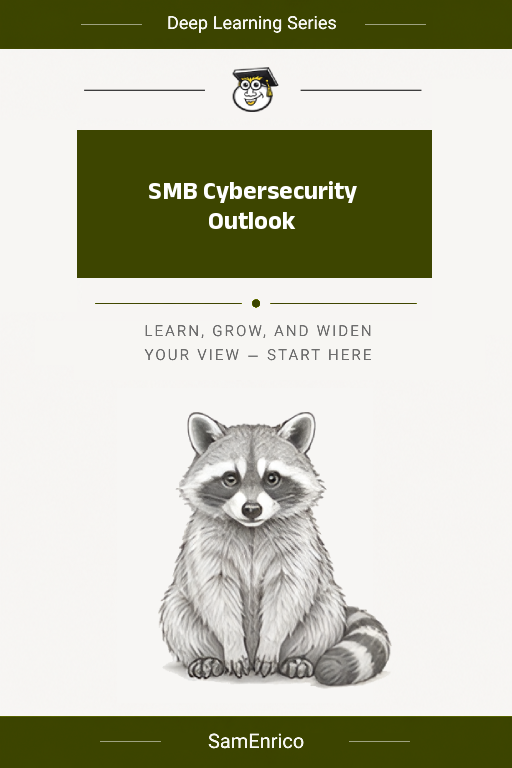
Non-FictionForecast & OutlookSMB Security
SMB Cybersecurity Outlook eBook
Project managed security adoption, budget constrai
by Chester Lupe
Project managed security adoption, budget constraints, compliance pressure, and channel distribution evolution for small businesses.
Formats
Free sample
Chapter 1: The Tuesday Morning--It was 8:47 AM on a Tuesday when Maria’s phone buzzed with a text from her head baker: “Oven temps just reset to zero. Everything is locked. Is this you?”It was not her.By 9:15 AM, every screen in Sweet Salvation Bakery displayed a red skull icon and a countdown timer: 71 hours, 42 minutes. The message beneath read: “Your files are encrypted. Your customer database is copied.
Your bank account is next. Pay 4 Bitcoin ($120,000) to this address. Do not involve law enforcement.”Maria laughed. Then she cried. Then she called her brother, the co-owner, who asked a question that would haunt her for the next six months: “What’s Bitcoin?”That Tuesday morning, Sweet Salvation Bakery had been in business for nineteen years.
It employed seven people, served three hundred regular customers, and had never missed a payroll. It also had no MFA on its banking portal, no offline backups, and a firewall that had not been updated since the Obama administration. The password to the admin account was “bakery123.”By Friday, the bakery was closed. By the following Tuesday, two employees had quit. By the end of the month, Maria had drained her personal savings to pay the ransom.
The attackers gave her a decryption key. It did not work.Sweet Salvation Bakery never reopened.The $189 Billion Truth You Cannot Afford to Ignore Maria’s story is not unique. It is not even rare. It is, by every measure, the new normal.Let us begin with a number so large it almost loses meaning: $189.4 billion.That is the projected size of the global cybersecurity market by the year 2034, up from $78.6 billion in 2025. Nearly doubling in less than a decade.
If you are a small business owner, you might look at that number and think: That is an enterprise problem. That is for banks and hospitals and government contractors. I bake bread. I sell insurance. I run a dental practice.
No one wants my data.That instinct is wrong. And that instinct is why Maria lost her bakery.The growth of the cybersecurity market is not driven by enterprise demand alone. It is driven by a brutal, underreported reality: attackers have discovered that small businesses are easier targets than large ones. Large companies have security teams, incident response plans, cyber insurance, and legal departments. Small businesses have a router from 2018 and a part-time IT person who “knows computers.”Consider the “43% statistic.” Depending on the year and the study, the number shifts slightly, but the truth does not.
Nearly half of all global cyberattacks now target small and medium-sized businesses. Not because attackers hate small businesses. Because attackers love easy money. And small businesses are easy.The logic is chillingly simple. A ransomware gang can spend weeks trying to breach a Fortune 500 company with layers of defense, or they can spend hours phishing an employee at a twenty-person accounting firm that has no MFA and shares passwords via text message.
The payout from the accounting firm might be smaller, but the effort is vastly lower. And when you multiply that across hundreds of attacks per day, the math favors the path of least resistance.That path leads directly to your door.The Six-Month Clock If the 43% statistic does not frighten you, this one will: Sixty percent of small businesses close within six months of a significant cyberattack.Let that land. The majority of businesses that suffer a serious breach do not survive the year. Not because the ransom itself is always unpayable, but because the cascading costs are. Downtime.
Lost customer trust. Legal fees. Regulatory fines. Increased insurance premiums. Forensic investigations.
Reputation damage that no marketing budget can repair.Maria paid the ransom. It did not matter. Her bakery had been offline for six days during the attack – six days of no bread sales, no catering orders, no revenue. By the time she got her systems back (mostly), her regular customers had found other bakeries. Her suppliers demanded cash on delivery because she had missed two payments.
Her employees, terrified of another attack, found jobs elsewhere.The ransom was the headline. The slow death over the following months was the story.Here is what cybersecurity experts know that most business owners do not: The attack is not the disaster. The recovery is. A well-prepared business can survive a breach. A business that treated security as an IT problem rather than a business survival problem almost never does.This book exists because that distinction – IT problem versus business survival problem – is the single most important distinction you will ever make.Why This Book Is Different There are dozens of books about cybersecurity.
Some of them are excellent. Most of them were written for enterprise readers – people with six-figure budgets, dedicated security teams, and compliance departments. Those books will tell you about zero-trust architectures, security information and event management (SIEM) systems, and advanced persistent threats. All of that is real. None of it is useful to you right now.This book is different for three reasons.First, it assumes you have almost no money.
The average small business spends less than $5,000 per year on IT security. Some spend nothing. This book will not tell you to buy expensive tools you cannot afford. It will tell you how to use the tools you already have (your Microsoft 365 subscription, your Google Workspace account, your existing firewall) and where to spend the small amount of money you do have for maximum impact.Second, it assumes you have almost no time. You are not a security professional.
You are a business owner who also needs to manage payroll, please customers, and keep the lights on. This book is structured around projects – small, achievable chunks of work that you can complete in a few hours. No ninety-page security policies. No weeks of planning. Just do this, then this, then this.Third, it assumes you are scared and you should be.
Fear is not the enemy. Complacency is. This book will not try to calm you with empty reassurance. It will channel your fear into action. By the time you finish Chapter 12, you will have a 90-day plan, a set of completed projects, and a security posture that puts you ahead of 90% of businesses your size.
Not because you became an expert, but because you did the small number of things that actually matter.What the Best-Selling Books Get Right (and Wrong)Before we build your security plan, let us briefly look at what the existing literature teaches us. Three best-selling cybersecurity books have shaped the conversation for small businesses, and each contains both wisdom and blind spots.The SMB Cybersecurity Survival Guide (2022) is the most practical of the bunch. Its strength is its relentless focus on basics: MFA, patching, backups. Its weakness is that it treats security as a checklist rather than an ongoing project. Checklists are fine for compliance audits.
They are not fine for surviving attackers who adapt faster than you can check boxes.Computer and Information Security Handbook (Fourth Edition) is the opposite problem. It is encyclopedic – over 1,200 pages of technical depth. It tells you everything about everything. That is its strength and its fatal flaw for SMBs. You do not need…
This is the end of the free sample. Get the eBook to keep going. Buy now
About this book
Details
- Author
- Chester Lupe
- Publisher
- SamEnrico
- Language
- English
- Genre
- Non-Fiction, Forecast & Outlook, SMB Security
- Released
- 2026-06-01
- Pages (approx.)
- 138
- Available as
- eBook, Audiobook

Read better in the ZLOADR app
Your eBooks on your phone or tablet. Sign in with your SamEnrico account and start reading.
More by Chester Lupe
 Empty Quarter Gas TankChester Lupe$11.99
 Portal Theories National Park MysteriesChester Lupe$11.99
 Sexual Addiction and ADHD LinkChester Lupe$11.99
 Harvard Extension Admissions GuideChester Lupe$11.99
 The Sky Pioneers: Gaspar Schott and the Birth of High-Altitude ScienceChester Lupe$11.99
 Tangaroa’s Wrath: The Storm That Swallowed the SunChester Lupe$11.99
 PR Source Credibility PrimerChester Lupe$12.99
 Understanding Homocystinuria Due to Defect In Methylation Cbl EChester Lupe$17.99
 A Beginners Guide to Benchrest shooting (Volume 1)Chester Lupe$11.99
 Night AuditChester Lupe$11.99
You may also like
 Hong Kong Handover 1997Dunn Johnnie$11.99
 Zumba For Postnatal Recovery CourseNeal Christian$11.99
 Zumba for BeginnersLadner Nikia$11.99
 YouTube Comment Mining GuideHumes Pandora$12.99
 Worry Box MeditationCarlin Rudy$11.99
 Workplace Stress MeditationNguyen Lynn$11.99
 Workplace Stress and Sleep RepairHawley Ivory$11.99
 Workplace Perfectionism CureDelaney Jeffry$11.99
 Workplace Injustice Anger GuideWallen Isabelle$11.99
 Work Addiction and Burnout LinkGreenwood Ester$11.99
 Women in Yoga and WellnessBeattie Galina$11.99
 Women in Stand Up ComedyChun Evangeline$11.99