
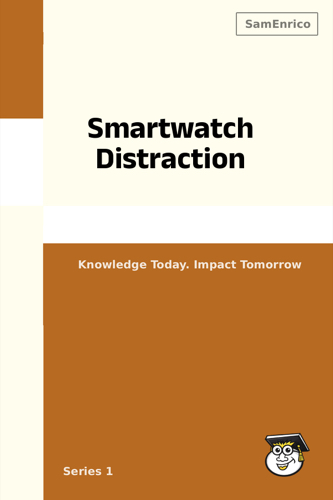
Non-FictionSelf-Help / Wearables
Smartwatch Distraction Audiobook
undefined
by Casper Linn
undefined
Formats
Free sample
Chapter 1: The Phantom on Your Wrist--–- The buzz was barely perceptible. A gentle tap against the underside of your wrist, softer than a mosquito landing, lighter than a falling leaf. You felt it during the meeting, while making dinner, in the middle of a conversation with your child. Your wrist rotated upward before your conscious mind had time to ask the first question. Your eyes dropped.
Your focus shattered. And then, nothing. No message. No alert. No missed call.
Just the phantom memory of a vibration that never happened.This experience has a name. Psychologists call it "phantom vibration syndrome." First documented in 2003 among pager users, then studied extensively in smartphone users, the phenomenon has found a new and more powerful host: the smartwatch. Unlike a phone that sits in a pocket or bag, a smartwatch is strapped to your skin, pressed against the nerves and tendons of your wrist, constant as a heartbeat. And when that device delivers thousands of tiny, unpredictable vibrations over months and years, your nervous system begins to expect them even when they do not arrive. You are not imagining the buzz.
You are anticipating it. And that anticipation is the first symptom of a much deeper problem.This book is about that problem. It is about the thousands of small, unnoticed, seemingly harmless glances that add up to hours of lost focus every single day. It is about the way a device designed to keep you informed has instead kept you distracted, pulling your attention away from the people, tasks, and moments that actually matter. And it is about what you can do to reclaim your wrist, your attention, and your life.But before we can solve the problem, we must understand it.
And to understand it, we must start with a simple but uncomfortable question: What has happened to your attention?The Great Fragmentation Let us begin with a thought experiment. Imagine you are writing an important email. You have composed three sentences when you feel a buzz on your wrist. A text message. You glance down.
It is your spouse asking what you want for dinner. You do not reply immediately because you are in the middle of the email. You return to the email. But something has changed. The four seconds you spent glancing at the text message have left a residue behind.That residue has a formal name.
Psychologist Sophie Leroy coined the term "attention residue" to describe what happens when you switch from Task A to Task…
This is the end of the free sample. Get the Audiobook to keep going. Buy now
About this book
Details
- Author
- Casper Linn
- Publisher
- SamEnrico
- Language
- English
- Genre
- Non-Fiction, Self-Help / Wearables
- Released
- 2026-06-09
- Pages (approx.)
- 141
- Available as
- eBook, Audiobook

Listen in the VoxFlicks app
Audiobooks and audio dramas wherever you go. Sign in with your SamEnrico account and press play.
More by Casper Linn
 Gambling Addiction and Eating DisordersCasper Linn$11.99
 Principled Negotiation WorkbookCasper Linn$11.99
 Gambling Addiction And Art TherapyCasper Linn$11.99
 Trello Automation Butler CommandsCasper Linn$11.99
 Hepatitis C During DetoxCasper Linn$11.99
 Child Loss and BlameCasper Linn$11.99
 Relationship Loss Recovery GuideCasper Linn$11.99
 The Whispering Wake of the *Vasa*Casper Linn$11.99
 The Parramatta Kidnapping: Australia's Colonial Hostage CrisisCasper Linn$11.99
 How to Start a Coal Preparation Plant Business (Beginners Guide)Casper Linn$11.99
 How to Produce Gaming and AccessoriesCasper Linn$11.99
 A Collector's Handbook to the Renault MonaquatreCasper Linn$11.99
You may also like
 Hong Kong Handover 1997Dunn Johnnie$11.99
 Zumba For Postnatal Recovery CourseNeal Christian$11.99
 Zumba for BeginnersLadner Nikia$11.99
 YouTube Comment Mining GuideHumes Pandora$12.99
 Worry Box MeditationCarlin Rudy$11.99
 Workplace Stress MeditationNguyen Lynn$11.99
 Workplace Stress and Sleep RepairHawley Ivory$11.99
 Workplace Perfectionism CureDelaney Jeffry$11.99
 Workplace Injustice Anger GuideWallen Isabelle$11.99
 Work Addiction and Burnout LinkGreenwood Ester$11.99
 Women in Yoga and WellnessBeattie Galina$11.99
 Women in Stand Up ComedyChun Evangeline$11.99