
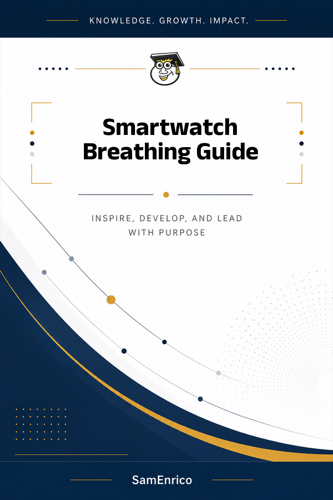
Non-FictionMental WealthBiofeedback
Smartwatch Breathing Guide eBook
Use HRV biofeedback to regulate before high-stakes
by Brant Kori
Use HRV biofeedback to regulate before high-stakes talks.
Formats
Free sample
Chapter 1: The 10-Second Betrayal--You are in a performance review. The fluorescent lights hum overhead. Across the table, your boss leans forward, shuffling papers. You have prepared for this moment for three weeks. You know your numbers.
You have rehearsed your answers in the shower, in the car, in the mirror. You are ready.Then she asks the question.It is not a hard question. In fact, it is the one you anticipated most. “Walk me through the Q3 shortfall,” she says, her pen hovering over a notepad. Your throat tightens.
Your mouth opens. And nothing comes out. Not a single word. Your face flushes. You hear yourself make a small, strangled sound – something between a cough and a whimper.
Your boss looks up, confused. Your colleagues shift in their seats. The silence stretches for three seconds that feel like three years.Finally, you stammer something. It is not eloquent. It is not the polished answer you rehearsed.
Your voice cracks on the third word. You finish. The meeting continues. But something has shifted. You can feel it – a hot, shameful flush crawling up your neck.
You lost that moment. And you have no idea why.Later that night, you lie in bed replaying the scene. “Why did I freeze?” you ask yourself. “I knew the answer.” You conclude, as most people do, that you are simply not good under pressure. That you lack confidence.
That maybe you are not cut out for this level of responsibility.You are wrong.What happened in that conference room was not a failure of character. It was not a lack of preparation. It was a physiological hijack – a lightning-fast cascade of neural signals, hormonal releases, and heart rate changes that unfolded in less time than it takes to blink. And here is the most important thing you will learn in this entire book: Your smartwatch saw it coming ten seconds before you felt a thing.The Physics of a Freeze Let us rewind that scene, but this time, we will watch it in slow motion – not from the outside, but from the inside of your nervous system.Ten seconds before your boss asked the question, your smartwatch was quietly measuring the tiny variations in the timing between your heartbeats. This metric, called Heart Rate Variability or HRV, is the single most sensitive indicator of your nervous system’s current state.
At that moment, your HRV was probably in what we will call the Yellow Zone – slightly below your personal baseline, but not yet critical. You were mildly alert, the way a sprinter is alert in the blocks. That is normal. That is even helpful.Five seconds before the question, something shifted. Your peripheral nervous system – the ancient, automatic part of you that does not care about your career ambitions – detected a pattern it recognized.
The boss’s posture changed. The room got quieter. The social cues that said “you are about to be evaluated” triggered an ancient alarm circuit buried deep in your brainstem. Your watch recorded the first dip in your HRV.Three seconds before the question, your sympathetic nervous system – the so-called “fight or flight” branch – began to activate. Your adrenal glands released a first wave of epinephrine.
Your heart rate increased by ten beats per minute. Your breathing became shallower. Your watch recorded a second, steeper drop in HRV.At the exact moment the question was asked, your brain performed a split-second threat assessment. This happened entirely below your conscious awareness. Your prefrontal cortex – the smart, verbal, strategic part of your brain – was sidelined.
In its place, your amygdala, a small almond-shaped cluster of neurons dedicated to survival, took over. It asked one question: “Is this a threat?”And because your brain has not evolved to distinguish between a sabertooth tiger and a difficult question from a superior, it answered: Yes.Your dorsal vagal nerve – the oldest, most primitive part of your parasympathetic nervous system – engaged what polyvagal theory calls “shutdown.” This is not fight. This is not flight. This is freeze. The same neural circuit that makes opossums play dead.
The same circuit that, in humans, manifests as a blank mind, a tight throat, and a voice that will not come out.Your smartwatch logged the whole thing. The HRV drop. The heart rate spike. The recovery – or lack thereof. When you check your watch later, you will see the evidence: a sharp downward line, then a jagged, slow climb back to baseline.
That graph is not a judgment. It is a crime scene. And you are about to learn how to stop the crime before it happens.The Polyvagal Pause The most important concept in this book is what I call the Polyvagal Pause – the three-to-five second window between the moment a trigger occurs (the question) and the moment your body commits to a response (freeze, flight, fight, or social engagement). During those few seconds, your nervous system is not yet locked in. It is still processing.
It is still deciding.Most people live their entire lives unaware that this window exists. They feel the trigger, and then they feel the response, and they assume the two are inseparable – that anxiety is something that happens to them, not something they can intercept.But here is the truth: the Polyvagal Pause is where you win or lose every high-stakes conversation you will ever have.If you can recognize the pause – if you can train yourself to notice the subtle shift in your body temperature, the slight change in your breathing, the first hint of throat tightness – you can intervene before your nervous system commits to shutdown. You can choose a different response. You can breathe. You can reframe.
You can, as you will learn in later chapters, use your smartwatch’s haptic vibration as a pacemaker for your vagus nerve.The Polyvagal Pause is not a theory. It is a physiological reality. And it is the reason this book exists. Every protocol, every exercise, every breathing pattern you will learn is designed to give you access to that three-to-five second window – and to teach you what to do once you are inside it.What Your Watch Sees That You Cannot Let me tell you about a client I will call Sarah. Sarah was a thirty-eight-year-old marketing director at a mid-sized tech firm.
She came to me because she had bombed two consecutive presentations to the executive team. Both times, she said, she “just froze.” Both times, she knew the material cold. Both times, she left the room humiliated and convinced she was going to be fired.I asked Sarah to wear a heart rate monitor – a chest strap, more accurate than a watch – for two weeks. I asked her to log every meeting, every presentation, every difficult conversation. And I asked her to share the data with me.The first thing we noticed was her baseline.
Sarah’s nightly HRV averaged around 45 milliseconds – respectable for her age, but not exceptional. Her mornings were usually in the Green Zone. So far, so good.Then we looked at the day of the first failed presentation. Her watch showed a steady HRV through the morning. Then, at 10:47 AM – thirteen minutes before…
This is the end of the free sample. Get the eBook to keep going. Buy now
About this book
Details
- Author
- Brant Kori
- Publisher
- SamEnrico
- Language
- English
- Genre
- Non-Fiction, Mental Wealth, Biofeedback
- Released
- 2026-06-06
- Pages (approx.)
- 145
- Available as
- eBook, Audiobook

Read better in the ZLOADR app
Your eBooks on your phone or tablet. Sign in with your SamEnrico account and start reading.
More by Brant Kori
 Upwork Fixed Price vs HourlyBrant Kori$11.99
 Nerve Pain Meditation GuideBrant Kori$11.99
 Sexual Addiction in ClergyBrant Kori$11.99
 Retail Therapy Reality CheckBrant Kori$11.99
 Genetic Testing Circadian GuideBrant Kori$11.99
 Spouse Death and HopeBrant Kori$11.99
 Press Release BoilerplateBrant Kori$11.99
 Information Exchange Penalty LogBrant Kori$11.99
 The Unlikely Mogul: How a Teenage Dropout Built a $100M Empire from a Dorm RoomBrant Kori$11.99
 The Lost Pharaoh's Curse: How a Billionaire Smuggled Egypt's TreasuresBrant Kori$11.99
 Whispers from the Silk Road: The Lost Library of DunhuangBrant Kori$11.99
 Growing ChimonobambusaBrant Kori$11.99
You may also like
 Hong Kong Handover 1997Dunn Johnnie$11.99
 Zumba For Postnatal Recovery CourseNeal Christian$11.99
 Zumba for BeginnersLadner Nikia$11.99
 YouTube Comment Mining GuideHumes Pandora$12.99
 Worry Box MeditationCarlin Rudy$11.99
 Workplace Stress MeditationNguyen Lynn$11.99
 Workplace Stress and Sleep RepairHawley Ivory$11.99
 Workplace Perfectionism CureDelaney Jeffry$11.99
 Workplace Injustice Anger GuideWallen Isabelle$11.99
 Work Addiction and Burnout LinkGreenwood Ester$11.99
 Women in Yoga and WellnessBeattie Galina$11.99
 Women in Stand Up ComedyChun Evangeline$11.99