
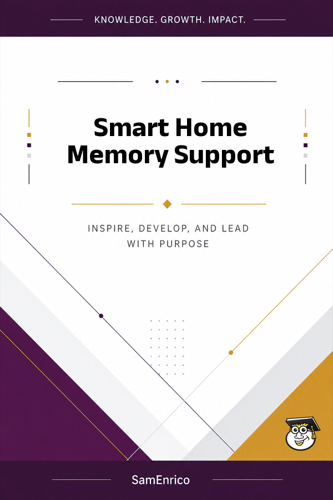
Non-FictionSelf-HelpSmart Home
Smart Home Memory Support eBook
Voice assistants and automation for forgetfulness.
Voice assistants and automation for forgetfulness.
Formats
Free sample
Chapter 1: The 3 AM Question--–- Elena’s phone rang at 3:14 on a Tuesday morning. The caller ID showed her mother’s number, but when she answered, it was a neighbor’s voice—tight, apologetic, trying not to sound alarmed. “Hon, your mom is at my door. She’s in her nightgown. She says she’s looking for her car keys because she needs to go to work, but she hasn’t worked in twelve years.
The gas stove is on in her kitchen. I turned it off. Can you come?”Elena lived forty-five minutes away. She drove the entire way in silence, not because she had nothing to say but because she had too much. Her mother, Carol, had been “forgetful” for a few years—misplacing her glasses, losing the thread of a conversation, asking the same question twice in an hour.
Elena had told herself it was normal aging. Her friends’ parents did the same thing. Then came the first time Carol left a pot of water boiling until it evaporated and the smoke alarm went off. Then came the three voicemails in one night, each saying the same thing: “Honey, what time are you coming over tomorrow?” Then came the 3 AM phone call.When Elena arrived, Carol was sitting on the neighbor’s couch wrapped in a borrowed bathrobe, drinking tea she didn’t remember asking for. She looked up at her daughter and smiled—genuinely, warmly—and said, “Oh good, you’re here.
Did you bring the milk? I need milk for breakfast.” She had no memory of wandering outside. No memory of the stove. No memory of the phone call. Elena took her mother home, made her eggs, and sat at the kitchen table until the sun came up.
That morning, she called her boss and said she would be late. Then she called her brother and said they needed to talk. Then she opened her laptop and typed: “How to keep someone with memory loss safe at home.”She found a lot of advice. Most of it was terrifying. Some of it was useless.
None of it told her where to start.This book is what Elena wished she’d had on that Tuesday morning.The Question That Keeps You Awake If you are reading this book, you have probably already had your own 3 AM moment. Maybe it was a phone call from a neighbor. Maybe it was finding the front door unlocked at 2 AM. Maybe it was realizing your loved one has taken the same medication twice—or not at all—for the third time this week. Or maybe it was quieter than that: a feeling, a suspicion, a weight you cannot name but cannot shake.Here is what that feeling actually is: you have realized, consciously or not, that your loved one’s memory is no longer reliable enough to keep them safe.
And you have also realized, just as clearly, that you cannot be there every second of every day. You cannot quit your job. You cannot move in. You cannot afford 24-hour home care, and even if you could, your loved one might refuse it because they do not believe anything is wrong.This is the central dilemma of memory care in the twenty-first century. Millions of families are living it right now, at this very moment, in kitchens and living rooms and hospital waiting rooms across the country.
And most of them are trying to solve it with sheer force of will—checking in more often, calling more frequently, worrying more intensely. That approach does not scale. It burns out the caregiver and humiliates the person receiving care. There has to be another way.There is.What This Book Is (And What It Is Not)Before we go any further, let me be very clear about what you are holding.This book is not a medical textbook. It will not teach you to diagnose Alzheimer’s disease, differentiate between the seventeen types of dementia, or interpret brain scans.
You do not need any of that to use the strategies in these pages. In fact, one of the core arguments of this book is that you can dramatically improve safety and quality of life without ever mastering the clinical details. You need to understand what your loved one can no longer do reliably. You do not need to understand why at a cellular level.This book is not a catalog of every smart device on the market. Technology changes too fast for any book to be definitive.
By the time you read this, there will be new voice assistants, new sensors, new platforms. That is fine. This book teaches you a framework for thinking about assistive technology—how to evaluate it, how to introduce it, how to troubleshoot it—that will outlast any specific gadget.This book is not a substitute for professional medical advice. If your loved one is actively dangerous to themselves or others—if they are leaving the house at all hours, if they are aggressive, if they have stopped eating or bathing—you need to involve a doctor, a social worker, or an elder care attorney immediately. This book will help you in conjunction with those professionals, not instead of them.What this book is: a practical, compassionate, step-by-step guide to using voice assistants and smart home automation to support a person with memory loss.
It is written for exhausted, overwhelmed, often guilty-feeling family caregivers who do not have time to become tech experts. Every chapter ends with concrete actions you can take today—not next week, not after you have done more research, but today.The Core Insight: Prospective vs. Retrospective Memory To understand why smart homes can help with memory loss, you need to understand one distinction. It is simple but powerful, and once you see it, you will never unsee it.Human memory is not one thing. It is many different systems that work together—or, in the case of memory loss, fail together at different rates.
The most important distinction for our purposes is between retrospective memory and prospective memory.Retrospective memory is what most people mean when they say “memory.” It is the ability to recall things that have already happened. What did you eat for breakfast yesterday? Who was the first person you kissed? What is the capital of North Dakota? That is retrospective memory.
It is about the past.Prospective memory is the ability to remember to do something in the future. It is not about recalling facts; it is about executing intentions. Take your pill at 8 AM. Call your daughter at 2 PM. Turn off the stove when you finish cooking.
That is prospective memory. It is about the future.Here is the crucial thing. Retrospective memory loss is heartbreaking, but it is rarely dangerous. Forgetting your granddaughter’s name is sad. Forgetting the way home from the grocery store is terrifying, but it is still primarily an issue of navigation and recall.
Prospective memory loss is what kills people. Forgetting to take blood pressure medication leads to strokes. Forgetting to turn off the stove leads to house fires. Forgetting to lock the door at night leads to wandering. Forgetting…
This is the end of the free sample. Get the eBook to keep going. Buy now
About this book
Details
- Author
- Grice Saundra
- Publisher
- SamEnrico
- Language
- English
- Genre
- Non-Fiction, Self-Help, Smart Home
- Released
- 2026-06-08
- Pages (approx.)
- 145
- Available as
- eBook, Audiobook

Read better in the ZLOADR app
Your eBooks on your phone or tablet. Sign in with your SamEnrico account and start reading.
More by Grice Saundra
 Anniversary Loss RitualsGrice Saundra$11.99
 Racism Childhood Self EsteemGrice Saundra$11.99
 Paleo Bone Broth ProtocolGrice Saundra$11.99
 Nightmare Rescripting For Suicidal IdeationGrice Saundra$11.99
 Study Abroad Preparation GuideGrice Saundra$11.99
 Hangry Triggers GuideGrice Saundra$11.99
 Eyewitness Reform LegislationGrice Saundra$11.99
 The Black Powder Letters: Siege of Constantinople's Walls (1453)Grice Saundra$11.99
 Riding the Storm: The Untold Story of Africa's Big Wave PioneersGrice Saundra$11.99
 Understanding Transverse MyelitisGrice Saundra$11.99
 Eu Domain Corporate Trustee GuideGrice Saundra$12.99
 Succession Tax for Tech StartupsGrice Saundra$12.99
You may also like
 Hong Kong Handover 1997Dunn Johnnie$11.99
 Zumba For Postnatal Recovery CourseNeal Christian$11.99
 Zumba for BeginnersLadner Nikia$11.99
 YouTube Comment Mining GuideHumes Pandora$12.99
 Worry Box MeditationCarlin Rudy$11.99
 Workplace Stress MeditationNguyen Lynn$11.99
 Workplace Stress and Sleep RepairHawley Ivory$11.99
 Workplace Perfectionism CureDelaney Jeffry$11.99
 Workplace Injustice Anger GuideWallen Isabelle$11.99
 Work Addiction and Burnout LinkGreenwood Ester$11.99
 Women in Yoga and WellnessBeattie Galina$11.99
 Women in Stand Up ComedyChun Evangeline$11.99