
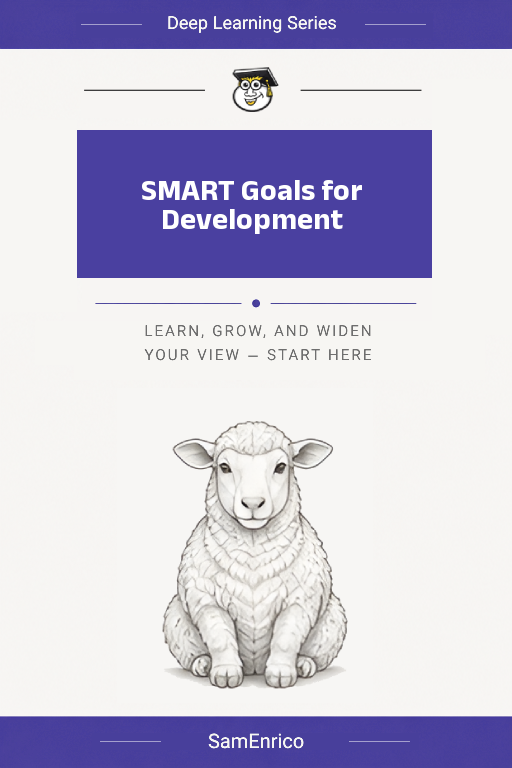
SMART Goals for Development eBook
Set SMART goals for personal development. Specific
Set SMART goals for personal development. Specific, measurable, achievable, relevant, time-bound.
Formats
Free sample
Chapter 1: The Willpower Trap--–- Every January, millions of people make the same promise to themselves: This time will be different. They buy the planner, download the app, or post their goal on social media. For two weeks, they feel invincible. Then, somewhere around the third week of January, the alarm clock rings at 5:30 AM, the gym clothes are still wet from yesterday, and the old voice whispers, "See? You don't have what it takes."–- If you have ever abandoned a goal and blamed yourself for lacking discipline, you are not weak.
You have been misled. The self-help industry has sold you a comforting fiction: that success belongs to those with superhuman willpower, and failure belongs to everyone else. This chapter will dismantle that myth completely. By the time you finish reading, you will understand why most goal failures have nothing to do with character and everything to do with design. And you will never blame your willpower again.The Anatomy of a Broken Resolution–- Consider two people.
Maria decides she wants to "get in shape." She tells herself she will go to the gym more often. She feels motivated. She buys new sneakers. For ten days, she goes after work. Then a late meeting happens.
Then she is tired. Then she misses one day, feels guilty, misses another, and by March, the sneakers are collecting dust in the back of her closet. Maria concludes: "I don't have enough willpower."–- Now consider James. He decides he wants to write a book. He sets a goal: "I will write more." He opens his laptop every evening, intending to work.
But he spends forty-five minutes checking emails, watching You Tube, and reorganizing his desktop folders. At the end of three months, he has written twelve pages. James concludes: "I am lazy."–- Both Maria and James are wrong about the cause of their failure. Neither one lacks willpower. Both lack systems and clarity.
Maria had no specific trigger for when to go to the gym. James had no environmental design to make writing easier than distraction. Their failures were not character flaws. They were design flaws.–- This is the central argument of this chapter, and indeed of this entire book: Failure is almost never a willpower problem. It is almost always a systems problem or a goal-framing problem.The Myth of the Willpower Hero–- Where did we get the idea that willpower is the secret to success?
The cultural mythology runs deep. We love stories of the struggling artist who overcomes addiction through sheer determination, the entrepreneur who slept four hours a night for years, the athlete who pushed through agony to win gold. These stories are inspiring, but they are also dangerously incomplete.–- Research in social psychology and behavioral economics has shown that willpower is not a character trait. It is a resource. And like all resources, it is finite, depletable, and highly sensitive to context.
Roy Baumeister, one of the leading researchers on self-control, demonstrated this through a series of famous experiments involving radishes and chocolate chip cookies. Participants who had to resist eating freshly baked cookies performed significantly worse on subsequent puzzles than those who were allowed to eat the cookies. Resisting the cookies drained their willpower. They had nothing left for the puzzles.–- This phenomenon is called ego depletion, and it explains why most people fail at goals that require constant resistance. If your goal requires you to say "no" all day—no to sugar, no to social media, no to procrastination, no to spending—you are essentially running a marathon of resistance.
By 6 PM, your willpower is exhausted. The failure that happens at 7 PM is not a moral failure. It is a biological inevitability.–- But here is what most books do not tell you: You can design goals that do not require constant willpower. The most successful people are not the ones with the most willpower. They are the ones who design their lives so that the right choice is the easy choice, and the wrong choice requires effort.Systems vs.
Goals: A Critical Distinction–- Scott Adams, the creator of Dilbert, popularized a useful distinction: Goals are for losers. Systems are for winners. This sounds provocative, but his point is important. A goal is a future outcome you hope to achieve. A system is a daily process that makes achievement almost inevitable.
A person with a goal to lose twenty pounds feels like a failure every day until the scale finally shows the number. A person with a system of eating vegetables at every meal, walking ten thousand steps, and tracking calories feels successful every single day because they followed the system.–- The difference is where you put your attention. Goal-focused people ask: "Am I there yet?" System-focused people ask: "Did I do the work today?" The first question produces hope followed by disappointment. The second question produces consistent action followed by eventual results.–- In Chapter 4, we will dive deep into how to measure the right things—specifically, how to track leading indicators (the actions you control) rather than obsessing over lagging indicators (the results you hope for). For now, understand this: If your goal requires willpower to maintain, your system is broken.–- Let us return to Maria and the gym.
Maria had a goal ("get in shape") but no system. A system would look like this:–- A specific trigger: "When my 5 PM work alarm goes off, I will change into gym clothes immediately."–- Reduced friction: "I will pack my gym bag the night before and put it by the front door."–- A minimum viable action: "I will drive to the gym every weekday, even if I only stay for ten minutes."–- An accountability loop: "I will text my friend a photo of my gym shoes every day."–- With a system like this, Maria does not need to decide to go to the gym. The decision is already made. The environment triggers the action. The friction is removed.
The minimum bar is so low that she never has an excuse to skip. Willpower is barely involved.The Two Types of Goal Failures–- When a goal fails, it fails in one of two ways. Understanding this distinction is the single most important diagnostic skill you will learn in this book.Type 1 Failure: The Systems Error–- A systems error occurs when you have the right goal but the wrong process. You know what you want. You have the motivation.
But your environment, habits, or tools are working against you. Symptoms of a systems error include:–- You start strong but fade after two to three weeks.–- You know what to do but somehow "forget" or get distracted.–- You rely on inspiration or "feeling motivated" to take action.–- You have no external triggers or accountability.–- The fix for a systems error is not more willpower. The fix is better design. We will cover environmental design extensively in Chapter 8, habit loops in Chapter 9, and the Review and Reset Cycle in Chapter 11. For now, the diagnostic question is: "If I remove all blame from myself, what about my environment is making…
This is the end of the free sample. Get the eBook to keep going. Buy now
About this book
Details
- Author
- Mize Rachelle
- Publisher
- SamEnrico
- Language
- English
- Genre
- Non-Fiction, Professional's Cheat Sheet, Career Roadmap
- Released
- 2026-05-30
- Pages (approx.)
- 149
- Available as
- eBook, Audiobook

Read better in the ZLOADR app
Your eBooks on your phone or tablet. Sign in with your SamEnrico account and start reading.
More by Mize Rachelle
 Marginal Analysis EconomicsMize Rachelle$11.99
 Menopause Support GroupMize Rachelle$11.99
 Body Scan for Neck and ShouldersMize Rachelle$11.99
 The Kardashian Empire StoryMize Rachelle$11.99
 The Global Game: How Soccer's Broadcast Revolution Changed the World (1980s-1990s)Mize Rachelle$11.99
 Quality Compliance ManagerMize Rachelle$11.99
 How to Start a Bifurcated Rivet Business (Beginners Guide)Mize Rachelle$11.99
 How to Produce an ActivatorMize Rachelle$11.99
You may also like
 Personal Development Plan TemplateLundberg Lizette$12.99
 Personal Development Plan GuideCabrera Elvia$12.99
 Learning Resources for DevelopmentFarnsworth Milan$12.99
 Development Plan Review GuideTRUE Evangelina$12.99
 Development Plan MistakesBecnel Charity$12.99
 Development Plan for PromotionEsposito Cameron$12.99
 Personal Development Success StoriesMallory Sidney$12.99
 Skills Gap Analysis GuideMckeever Sam$12.99
 Development Plan with ManagerPak Dannielle$12.99