
Non-FictionSelf-HelpCreativity
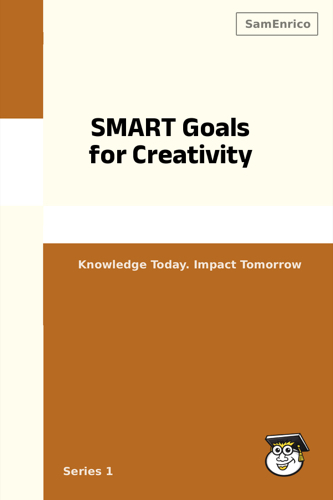
SMART Goals for Creativity eBook
Sets project completion and output targets.
Sets project completion and output targets.
Formats
Free sample
Chapter 1: The Muse Lie...--You have been lied to. Not maliciously, but persistently, by a story so old and so romantic that almost everyone in creative fields believes it without question. The story says that creativity is a mysterious force, that inspiration strikes like lightning, and that your job as an artist, writer, designer, or maker is simply to be ready when it arrives. Wait for the muse. Cultivate the conditions.
Then, when the magic comes, ride the wave.This story feels good. It absolves you of responsibility on the days when nothing comes. It transforms procrastination into “incubation.” It turns a blank page from a problem into a waiting room. But here is the truth that no one tells you in art school or writing workshops: the muse is a myth. Or rather, the muse is a useful metaphor for something that actually works in reverse.
Inspiration does not cause work. Work causes inspiration.You have experienced this before, even if you did not name it. Think of the times you sat down reluctantly, convinced you had nothing to say, and then two hours later looked up to find you had produced something real. That was not the muse arriving late. That was the simple, unglamorous physics of creative labor: starting generates momentum, momentum generates output, and output generates the feeling we call inspiration.
The feeling follows the action. It never precedes it.This chapter is about unlearning the muse lie. It is about replacing a passive, waiting-based creative identity with an active, target-based one. And it begins with a diagnosis of the most common disease in creative fields: output amnesia.The Disease of Output Amnesia Let us run a small experiment. Think back over the last seven days.
Do not count the hours you spent researching, organizing, thinking about, or planning your creative work. Do not count the time you spent watching tutorials, reorganizing your workspace, or “getting in the zone.” Count only the finished artifacts. Count the chapters, the sketches, the mixed audio tracks, the solved design problems, the completed client deliverables.How many can you name? If the number is zero, or if you have to squint to remember what you finished, you have output amnesia.Output amnesia is the state of being busy without being productive. It is the chronic condition of the creative who confuses effort with completion.
The symptoms are unmistakable: you feel exhausted at the end of the week but cannot point to what you actually finished. Your to-do list is full of crossed-off items, but those items say things like “research color palettes” or “brainstorm ideas” or “watch tutorial on lighting.” None of them say “completed three thumbnail sketches” or “wrote 500 words” or “finished the first round of revisions.”Output amnesia thrives because activity feels like progress. Opening Photoshop feels like working. Reading a chapter on craft feels like working. Rearranging your desk feels like working.
But none of these activities produce a finished artifact. They produce the conditions for a finished artifact, which is not the same thing at all. A kitchen stocked with ingredients is not a meal. A canvas with primed gesso is not a painting. A folder full of research PDFs is not a novel.The distinction between activity and output is the single most important distinction in this entire book.
You will see it referenced in every chapter that follows, because it is the foundation upon which all creative productivity is built.Activity includes: researching, organizing supplies, watching tutorials, brainstorming, thinking about making, rearranging a workspace, warming up, sketching ideas without completing them, writing notes to yourself, planning future work, setting up software, cleaning brushes, organizing files, reading about creativity, and talking about your project to friends.Output includes: a drafted page, a mixed thirty seconds of audio, a completed thumbnail sketch, a solved design problem, a finished revision, a recorded vocal take, a coded function, a baked loaf of bread, a framed photograph, a submitted application, a sent manuscript.Notice the difference. Activity is preparatory. Output is terminal. Activity asks “am I ready?” Output asks “did I finish?” Activity is infinite; you can research color theory forever. Output is finite; you either completed the sketch or you did not.Most creatives spend eighty percent of their available energy on activity and twenty percent on output.
Then they wonder why their portfolios are thin, why their projects drag on for years, why they feel like impostors when asked what they have made recently. The problem is not talent. The problem is not even discipline, exactly. The problem is a confusion about what counts as work.Here is the rule that will govern everything else in this book: Only output moves a project toward completion. Activity does not.
You can research for a year and still have zero finished chapters. You can organize your brushes for a month and still have zero finished paintings. You can brainstorm ideas every morning for a decade and still have zero finished products. Activity is not nothing. It has its place.
But it does not advance a project. Only output does.The Zeigarnik Trap There is a psychological reason why unfinished projects haunt you, and why finishing feels so much better than starting. In the 1920s, a Russian psychologist named Bluma Zeigarnik observed something strange about waiters in Vienna. They could remember unpaid orders with perfect clarity, but as soon as the bill was paid, the details vanished from memory. Zeigarnik designed experiments to test this phenomenon and discovered what is now called the Zeigarnik Effect: people remember unfinished tasks significantly better than completed ones.Your brain holds open a mental tab for every incomplete project.
Each open tab consumes a small amount of cognitive bandwidth. Ten open tabs? You feel scattered. Twenty? You feel exhausted.
Fifty? You feel like you are failing at everything, even though you have not actually done anything wrong.Here is the cruel irony: unfinished creative projects drain more energy than finished ones, even though finished projects required more total work. The brain does not care about the work you did. It cares about the work you did not finish. A painting that is ninety percent done might as well be zero percent done, as far as your cognitive load is concerned.
The open tab remains open until the artifact is complete.This is why finishing feels disproportionately good. You close a tab. You free up bandwidth. You gain mental energy not by resting, but by completing. The Zeigarnik Effect explains why people often feel more tired after a day of half-finished tasks than after a day of focused, completed work.
Half-finished tasks multiply open tabs. Completed tasks close them.The practical implication is stark and counterintuitive: if you want to feel less tired, finish more things. Do not rest more. Do not take more breaks. Do not wait for energy to return.
Close the tabs. Finish the artifact. The energy will return when the tab closes.This is not motivational fluff. This is cognitive psychology. Your brain is not punishing you for working hard.
It is punishing you for leaving things open. And the only way to close a creative tab is to produce output.Binding…
This is the end of the free sample. Get the eBook to keep going. Buy now
About this book
Details
- Author
- Bannister Carly
- Publisher
- SamEnrico
- Language
- English
- Genre
- Non-Fiction, Self-Help, Creativity
- Released
- 2026-06-06
- Pages (approx.)
- 145
- Available as
- eBook, Audiobook

Read better in the ZLOADR app
Your eBooks on your phone or tablet. Sign in with your SamEnrico account and start reading.
More by Bannister Carly
 Lucid Dream Induction LogBannister Carly$11.99
 Sibling Wedding RivalryBannister Carly$11.99
 Elderly Parent TalksBannister Carly$11.99
 Self Esteem During MergersBannister Carly$11.99
 Meth and HIV RiskBannister Carly$11.99
 Metacognition for Exam PreparationBannister Carly$11.99
 Stop Shopping For ComfortBannister Carly$11.99
 The Lost Opal and the Vanishing Child: Australia's Darkest HeistBannister Carly$11.99
 Iron Typhoon: The Battle of the Philippine Sea That Broke Japan's NavyBannister Carly$11.99
 How to Produce Used Computers and AccessoriesBannister Carly$11.99
 Service Providers Guide to Van RentalsBannister Carly$11.99
 How to Start a Military Base Hospitals Business (Beginners Guide)Bannister Carly$11.99
You may also like
 Hong Kong Handover 1997Dunn Johnnie$11.99
 Zumba For Postnatal Recovery CourseNeal Christian$11.99
 Zumba for BeginnersLadner Nikia$11.99
 YouTube Comment Mining GuideHumes Pandora$12.99
 Worry Box MeditationCarlin Rudy$11.99
 Workplace Stress MeditationNguyen Lynn$11.99
 Workplace Stress and Sleep RepairHawley Ivory$11.99
 Workplace Perfectionism CureDelaney Jeffry$11.99
 Workplace Injustice Anger GuideWallen Isabelle$11.99
 Work Addiction and Burnout LinkGreenwood Ester$11.99
 Women in Yoga and WellnessBeattie Galina$11.99
 Women in Stand Up ComedyChun Evangeline$11.99