
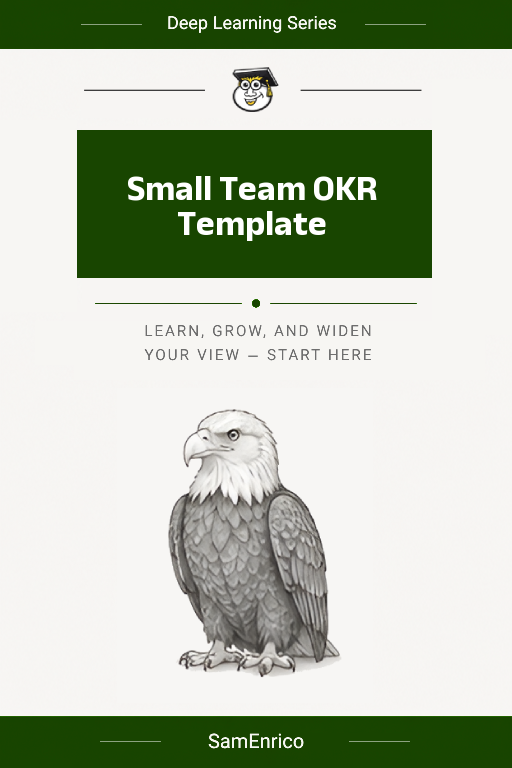
Non-FictionProfessional's Cheat SheetGoal Setting
Small Team OKR Template eBook
Ready-to-use OKR template for small teams. Company
Ready-to-use OKR template for small teams. Company, team, and individual OKR examples included.
Formats
Free sample
Chapter 1: Beyond the Chaos--–- The Monday morning meeting started, as it always did, with good intentions. The CEO, Marcus, had booked the conference room from 9:00 AM to 10:00 AM. The agenda said “Q2 Planning.” The twelve people in the room represented every function: product, engineering, marketing, sales, customer success, and operations. They were smart, motivated, and exhausted. For thirty minutes, they argued about whether the “big bet” should be the new mobile feature (Product’s priority), the enterprise sales push (Sales’ priority), or the brand awareness campaign (Marketing’s priority).
Everyone had data. Everyone had a compelling story. Everyone was right. And everyone was wrong, because they were all pulling in different directions.By 9:45, the conversation had devolved into trade-offs no one wanted to make. “If we do mobile, we can’t do enterprise.” “If we do brand, we can’t do product.” The room fell silent.
Marcus looked at the whiteboard, now covered with crossed-out ideas and question marks. “So what are we actually doing this quarter?” he asked. No one answered. They had spent forty-five minutes talking about everything and agreed on nothing. The meeting ended with a vague commitment to “circle back” and a shared sense of dread.
Three months later, they had shipped the mobile feature (barely), closed zero enterprise deals, and run out of budget for brand awareness. The team was exhausted, the metrics were flat, and the post-mortem was a blame game. They had been busy. They had not been effective.This is the chaos that OKRs are designed to end. This chapter is about what OKRs are, why they work for small teams, and how to implement them without the bureaucracy that kills most goal-setting systems.
You will learn the three specific problems that OKRs solve for small teams, what OKRs are NOT (because the confusion is real), and the simple 90-day rhythm that has worked for thousands of teams. By the end of this chapter, you will understand why OKRs are the answer to the Monday morning meeting from hell—and why small teams need a simpler approach than the one Google uses.What the Heck Is an OKR?Let us start with the acronym. OKR stands for Objectives and Key Results. The framework was developed at Intel in the 1970s by Andy Grove, the legendary CEO who mentored Steve Jobs and countless other Silicon Valley leaders. Grove needed a way to align thousands of employees around a shared set of priorities without micromanaging anyone.
His insight was simple but radical: tell people where you want to go, tell them how you will measure progress, and then get out of the way.Decades later, John Doerr—an early Google investor who had learned OKRs from Grove—introduced the framework to Larry Page and Sergey Brin. Google adopted OKRs in its first year and has used them every quarter since. Today, OKRs are used by thousands of companies worldwide, from startups to nonprofits to enterprises like Spotify, Linked In, and The New York Times.But that is the history. Here is the practical definition that actually matters for your team:An OKR answers two questions:Where do we want to go? (That is the Objective.)How will we know we are getting there?
(Those are the Key Results.)That is it. Everything else—the templates, the meetings, the scoring, the software—is process. The core idea is simple enough to fit on a sticky note. An Objective is a qualitative, inspirational statement of what you want to achieve. A Key Result is a quantitative, measurable metric that tracks progress toward that Objective.
You set 3-5 Objectives per quarter. Each Objective has 2-3 Key Results. And then you check progress weekly.Here is an example from a real small team. A Saa S startup in their second year had an Objective: “Drive self-serve revenue growth.” Their Key Results were: “Increase trial-to-paid conversion from 15% to 25%” and “Achieve 50Kmonthlyrecurringrevenuefromself−serve.”Thatwasit.Two Key Results.One Objective.Every Mondayat10:00AM,theyspentthirtyminutesreviewingprogress.Bytheendofthequarter,theyhadhit2250K monthly recurring revenue from self-serve.” That was it. Two Key Results.
One Objective. Every Monday at 10:00 AM, they spent thirty minutes reviewing progress. By the end of the quarter, they had hit 22% conversion and 50Kmonthlyrecurringrevenuefromself−serve.”Thatwasit.Two Key Results.One Objective.Every Mondayat10:00AM,theyspentthirtyminutesreviewingprogress.Bytheendofthequarter,theyhadhit2248K in MRR. They missed both targets slightly. But they had moved the needle, aligned the entire team around revenue growth, and stopped fighting about whether to build features or run ads.
The OKRs had done their job.The Three Problems That OKRs Solve for Small Teams Small teams face three universal problems that OKRs solve directly. If you recognize any of these problems, OKRs are for you.Problem 1: Shiny Object Syndrome.When you are small, every opportunity looks worth pursuing. That feature request from a big customer. That partnership that might lead to something. That new marketing channel your competitor is crushing.
Your team says yes to everything because saying no feels like leaving money on the table. But saying yes to everything means saying no to focus. You spread your limited people, time, and budget across ten different initiatives. Nothing gets the resources it needs. Everything ships late or half-baked.
Your team is exhausted, and your metrics are flat.OKRs force you to say no. If it is not in your top 3-5 Objectives this quarter, it waits. Not forever. Not because it is a bad idea. Just because you cannot do everything at once.
The discipline of choosing 3-5 Objectives means you have to have honest conversations about what matters most. Those conversations are uncomfortable. They are also the most important conversations you will have.Problem 2: “Busy But Not Productive.”Your team is working late. Everyone is tired. The Slack channels are active at 10:00 PM.
But when you look at what actually shipped—not the hours logged, not the meetings attended, not the emails sent—it is not much. You are measuring inputs (hours worked, tasks completed) instead of outputs (did we move the needle on what matters?). Your team is busy. They are not productive.OKRs focus on outcomes, not outputs. It does not matter how many blog posts you wrote.
What matters is whether you drove traffic. It does not matter how many features you shipped. What matters is whether customers adopted them. The shift from “did we do the thing?” to “did the thing work?” is the single most important cultural change OKRs create. When you measure outcomes, you stop rewarding busywork and start rewarding results.Problem 3: Misalignment.The product team is building X.
Sales is promising Y. Marketing is messaging Z. Everyone is rowing in different directions. At the end of the quarter, you have a product that does not match what sales sold, messaging that confuses customers, and a team that feels like they are working for different companies.OKRs create a shared language for priorities. When everyone’s OKRs are visible in a single document, alignment becomes obvious.
If Marketing’s OKRs do not support Sales’ OKRs, you have a problem. If Product’s OKRs do not support the company’s OKRs, you have a problem. Visibility creates accountability. Not the punitive kind of accountability where you blame people…
This is the end of the free sample. Get the eBook to keep going. Buy now
About this book
Details
- Author
- Wallen Whitley
- Publisher
- SamEnrico
- Language
- English
- Genre
- Non-Fiction, Professional's Cheat Sheet, Goal Setting
- Released
- 2026-06-01
- Pages (approx.)
- 117
- Available as
- eBook, Audiobook

Read better in the ZLOADR app
Your eBooks on your phone or tablet. Sign in with your SamEnrico account and start reading.
More by Wallen Whitley
 Emotional Regulation For RetirementWallen Whitley$11.99
 Ukrainian Construction CEOWallen Whitley$11.99
 Stress B Vitamin DepletionWallen Whitley$11.99
 Sexual Sobriety for CouplesWallen Whitley$11.99
 Blood on the Olive Groves: The Siege of MissolonghiWallen Whitley$11.99
 Leather Cleaner and RestorerWallen Whitley$11.99
 How to Become a Gas-engine OperatorWallen Whitley$11.99
 Learn to Play the Rock OckWallen Whitley$11.99
You may also like
 Hong Kong Handover 1997Dunn Johnnie$11.99
 Zumba For Postnatal Recovery CourseNeal Christian$11.99
 Zumba for BeginnersLadner Nikia$11.99
 YouTube Comment Mining GuideHumes Pandora$12.99
 Worry Box MeditationCarlin Rudy$11.99
 Workplace Stress MeditationNguyen Lynn$11.99
 Workplace Stress and Sleep RepairHawley Ivory$11.99
 Workplace Perfectionism CureDelaney Jeffry$11.99
 Workplace Injustice Anger GuideWallen Isabelle$11.99
 Work Addiction and Burnout LinkGreenwood Ester$11.99
 Women in Yoga and WellnessBeattie Galina$11.99
 Women in Stand Up ComedyChun Evangeline$11.99