
Non-FictionSelf-HelpWedding Etiquette
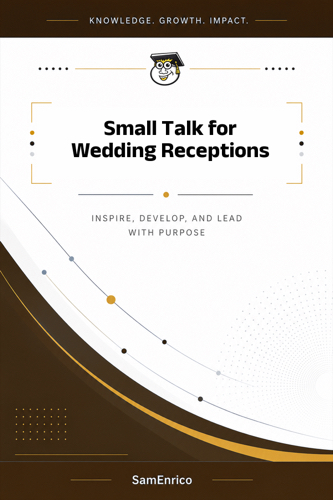
Small Talk for Wedding Receptions eBook
Chat with strangers at your table and dance floor
by Yazzie Rikki
Chat with strangers at your table and dance floor without faux pas.
Formats
Free sample
Chapter 1: The Frozen Brain--–- The moment the waiter removes your salad plate, you realize you have forgotten how to speak. The person to your left is a complete stranger. The person to your right is your date's college roommate whom you met once for approximately seven seconds. Across the table, someone is already laughing at a private joke you will never understand. Your water glass is sweating.
Your palms are sweating. Your brain has become a white-noise machine playing a single, unhelpful track on repeat: Say something. Say something. Say something. But what?
What do you say to a stranger at a wedding reception without accidentally offending them, boring them, or—worst of all—becoming a story they tell at future weddings about that one weird guest?This chapter is about why that happens. Not the social mechanics of it, but the neurological and psychological reality of why your brain freezes at weddings. Because here is the truth: you are not bad at small talk. You are not socially inept. You are not broken.
You are, quite simply, a normal human being who has been dropped into one of the most emotionally complex social environments ever invented. A wedding reception is not a dinner party. It is not an office happy hour. It is not a family reunion. It is all of those things at once, plus alcohol, plus formalwear, plus a timeline, plus a thousand unspoken rules, plus the crushing awareness that someone spent a small fortune on this afternoon and you really, really do not want to be the person who ruins it by asking the wrong question to the wrong person.The goal of this chapter is to convince you that your anxiety is both normal and manageable.
We will name the forces that make weddings uniquely terrifying. We will introduce the single most important rule of wedding receptions. And we will begin the process of rewiring your brain from "hostage negotiation" mode to "temporary ally in celebration" mode. By the end of this chapter, you will not be a master conversationalist. But you will understand why you are not one yet.
And that understanding is the first step toward becoming one.The Unique Terror of the Wedding Reception Let us begin with a simple question: Why is it easier to give a presentation at work than to make small talk at a wedding? After all, a work presentation has higher stakes. Your salary, your reputation, and your career trajectory are all on the line. A wedding reception, by contrast, has no performance review. No one is grading you.
And yet, for most people, the wedding reception feels far more dangerous.The answer lies in the nature of the consequences. At work, you understand the rules. You know what constitutes a mistake. You know your audience. At a wedding, the rules are invisible, the audience is a chaotic mix of strangers and semi-strangers, and the consequences of a mistake are not professional but social.
And social consequences feel worse. A bad presentation might cost you a promotion. A bad comment at a wedding might cost you a family relationship for the next twenty years. You will be remembered. That is the terrifying part.
Weddings have memories. Unlike a crowded bar where no one will recall your face tomorrow, a wedding reception is documented. There are photographs. There are stories told at future Thanksgivings. There is a couple who will, for the rest of their lives, associate you with whatever you said or did on their special day.This is the first psychological principle we need to understand: weddings have emotional consequences that far exceed the event itself.
A faux pas at a wedding can haunt family lore for decades. I have interviewed countless couples for research on this book, and every single one of them could name a guest who said something regrettable. Not one of them could name a guest who was boring. Think about that for a moment. No one ever says, "Remember that wedding where the guy at table seven was perfectly pleasant but a little forgettable?" They say, "Remember when Aunt Carol asked the bride if she was sure about the dress?" The boring guest is invisible.
The offending guest is immortal. This is both terrifying and liberating. It means your goal is not to be memorable. Your goal is to be safe. And being safe is much easier than being charming.Consider the mathematics of wedding memory.
A typical wedding reception lasts about five hours. During that time, the average guest will interact with perhaps twenty to thirty people. The couple will interact with everyone. After the wedding, the couple will go home, open gifts, and fall into bed exhausted. The next morning, they will begin the process of telling stories about the day.
They will remember the flower girl who tripped. They will remember the best man's tearful toast. They will remember the uncle who danced too enthusiastically. They will remember the cousin who complained about the salmon. What they will not remember is the polite, pleasant guest at table eight who said, "The flowers are beautiful," and then ate their dinner without incident.
You want to be that guest. The invisible one. Because the alternative is being the salmon complainer, and the salmon complainer gets mentioned at every family gathering for the next decade.The Spotlight Effect: Why No One Is Watching You Here is the most liberating psychological discovery you will ever encounter, and it applies to weddings more than almost any other social situation. It is called the Spotlight Effect. The term was coined by social psychologists Thomas Gilovich and Kenneth Savitsky, who demonstrated through a series of experiments that human beings consistently overestimate how much others notice their mistakes.In one famous study, participants walked into a room wearing an embarrassing t-shirt featuring a picture of Barry Manilow.
The participants estimated that about half of the people in the room would notice the shirt and judge them for it. In reality, only about twenty percent of people noticed the shirt at all. And even those who noticed did not care nearly as much as the participants imagined. They glanced at the shirt, thought "huh," and then went back to worrying about their own concerns. The participants had projected their own embarrassment onto everyone else, assuming that others would be as focused on their mistake as they were.
They were wrong.Why does this matter at a wedding? Because your brain is lying to you. When you stumble over a greeting, forget someone's name, or spill a drop of red wine on the tablecloth, you feel as though a spotlight has landed on you. Every eye in the room, you imagine, is watching your humiliation. The bride is whispering to the groom about your clumsiness.
The mother of the bride is making a mental note to exclude you from future events. The stranger across the table is silently laughing at you.But here is the truth: everyone else is worried about their own performance. The person across the table is mentally rehearsing what they will say to the mother of the bride. The person to your left is…
This is the end of the free sample. Get the eBook to keep going. Buy now
About this book
Details
- Author
- Yazzie Rikki
- Publisher
- SamEnrico
- Language
- English
- Genre
- Non-Fiction, Self-Help, Wedding Etiquette
- Released
- 2026-06-06
- Pages (approx.)
- 127
- Available as
- eBook, Audiobook

Read better in the ZLOADR app
Your eBooks on your phone or tablet. Sign in with your SamEnrico account and start reading.
More by Yazzie Rikki
 Meditation for Knee OsteoarthritisYazzie Rikki$11.99
 Pinterest VA For NonprofitsYazzie Rikki$11.99
 Email Legal Hold GuideYazzie Rikki$11.99
 Alcohol Breast Cancer RiskYazzie Rikki$11.99
 The Great Bitcoin Heist: How a Single Hacker Stole $600 MillionYazzie Rikki$11.99
 Ibn Battuta: The Unseen Paths of the Islamic WorldYazzie Rikki$11.99
 Understanding Coloboma of Lens Ala NasiYazzie Rikki$17.99
 YC Interview For Pre SeedYazzie Rikki$12.99
 M&A Due Diligence BlockYazzie Rikki$12.99
 Database AdministratorYazzie Rikki$11.99
 How to Start a Cartons Made of Corrugated Board Business (Beginners Guide)Yazzie Rikki$11.99
You may also like
 Hong Kong Handover 1997Dunn Johnnie$11.99
 Zumba For Postnatal Recovery CourseNeal Christian$11.99
 Zumba for BeginnersLadner Nikia$11.99
 YouTube Comment Mining GuideHumes Pandora$12.99
 Worry Box MeditationCarlin Rudy$11.99
 Workplace Stress MeditationNguyen Lynn$11.99
 Workplace Stress and Sleep RepairHawley Ivory$11.99
 Workplace Perfectionism CureDelaney Jeffry$11.99
 Workplace Injustice Anger GuideWallen Isabelle$11.99
 Work Addiction and Burnout LinkGreenwood Ester$11.99
 Women in Yoga and WellnessBeattie Galina$11.99
 Women in Stand Up ComedyChun Evangeline$11.99