
Non-FictionSelf-HelpRemote Work
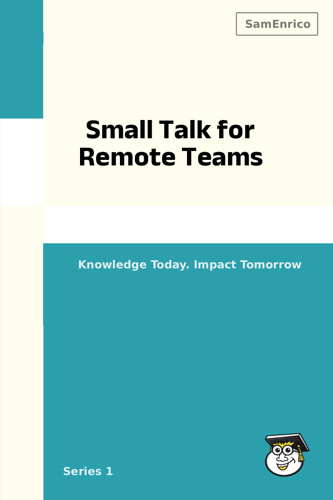
Small Talk for Remote Teams eBook
Initiate casual chat in Slack, Zoom, and virtual c
by Guest Eden
Initiate casual chat in Slack, Zoom, and virtual coffee breaks without awkwardness.
Formats
Free sample
Chapter 1: The Loneliest Mute Button--–- Sarah had been staring at the Slack message for eleven minutes. Three gray checkmarks meant it had been delivered. No reply. She typed "Just checking in..." then deleted it. She typed a thumbs-up emoji, deleted that too.
Then she closed her laptop, leaned back in her chair, and whispered to her empty home office: "Why is this so hard?"Sarah is not an introvert. In the office, she was the one who organized birthday lunches, knew everyone's coffee order, and could chat comfortably with the CEO in the elevator. But after her company went fully remote eighteen months ago, something shifted. The hallway disappeared. The coffee machine went silent.
And suddenly, the simplest act of saying "Hey, how was your weekend?" felt like walking onstage without a script.Sarah's experience is not unusual. It is the defining emotional reality of remote work in the 2020s: the people who were great at office small talk often become the people most paralyzed by digital small talk. The skills that used to work—reading body language, catching someone between meetings, sharing a knowing glance—do not translate to Slack, Zoom, or Teams. And in their place is something far more uncomfortable: the mute button, the typing indicator, and the slow, agonizing realization that you have forgotten how to be casually human with the people you work with every single day.This chapter is about why that happened, why it matters more than you think, and how to rebuild the one thing remote work accidentally destroyed: the art of the accidental conversation.The Vanishing Hallway Before remote work, most workplace relationships were not built in conference rooms during scheduled meetings. They were built in the margins: the three minutes waiting for the printer to warm up, the shared eye roll during a boring presentation, the unexpected run-in at the coffee station.
Sociologists call these "weak ties"—loose, low-stakes social connections that are surprisingly powerful.In a landmark study published in the journal Science, researchers found that weak ties are often more valuable than strong friendships when it comes to career opportunities, innovation, and access to new information. Your best friend at work probably knows the same people you know and reads the same newsletters. But the person you nod to in the hallway from the accounting department? That person might know about an opening on a different team, a new tool you have never heard of, or a perspective you would never have considered.Weak ties thrive on proximity and randomness. You do not schedule a conversation with the person from legal about their weekend.
It just happens because you both arrived at the elevator at the same time. That spontaneity is the engine of weak ties.Remote work did not just reduce weak ties. It eliminated the architecture that produced them.On Slack, you do not bump into anyone. You ping them. Every interaction requires an explicit decision to initiate, which immediately raises the stakes.
A hallway nod costs nothing emotionally. A Slack DM that says "Hey" costs a surprising amount. It feels like an interruption, an imposition, a demand for attention. So many people simply choose not to send it.The result is what researchers call "proximity bias in reverse." In the office, proximity bias meant people near the manager got more attention and better opportunities. In remote work, proximity bias has been replaced by "inertia bias"—the tendency to only talk to people you already talk to, because initiating a new conversation feels like too much effort.
Teams become siloed. New hires feel invisible. And the quiet loneliness of the home office grows heavier by the week.The Awkwardness Paradox Here is the cruelest twist: silence on a video call feels exponentially worse than silence in a room. There is a name for this. Let us call it the Awkwardness Paradox.In a physical office, silence is normal.
People walk past each other without speaking. The coffee machine hums. Keyboards click. Silence is just the background texture of shared space. It does not feel personal because there are a hundred other sensory inputs competing for your attention.On Zoom, silence is deafening.When five people sit on a video call with nothing to say, the silence is amplified by the technology itself.
Microphones are designed to pick up sound. When there is no sound, they pick up absence—the faint hiss of a room, the distant hum of a refrigerator, the shallow breath of someone who is desperately trying to think of something to say. That absence feels like a spotlight. And a spotlight on silence feels like judgment.The Awkwardness Paradox triggers a mild fight-or-flight response. Your brain, evolutionarily wired to interpret silence in a one-on-one encounter as a potential threat, releases a small amount of cortisol.
Your heart rate increases slightly. You start looking for an escape—the "Leave Meeting" button, a fake emergency, anything. And because that response is unpleasant, you learn to avoid the situations that cause it. You stop trying to make small talk. You join meetings exactly on time or one minute late to skip the pre-roll.
You type in Slack instead of speaking. You retreat into the safe, cold efficiency of text.This is not a personal failing. It is a neurological response to a technological environment that our brains did not evolve to navigate. And the first step to fixing it is understanding that the awkwardness is not coming from you. It is coming from the gap between how humans are built to connect and how remote tools force us to connect.The Myth of Wasted Time If the Awkwardness Paradox explains why small talk feels hard, a separate myth explains why many remote workers do not even try: the belief that small talk is wasted time.This myth is pervasive in remote culture, especially among high-performing teams.
Every minute spent talking about weekend plans or pets or television shows is a minute not spent shipping code, closing deals, or answering emails. The logic seems irrefutable. It is also wrong.Consider the research from the University of Chicago Booth School of Business. In a series of studies, researchers found that even brief, seemingly trivial social interactions—the kind most people dismiss as "just chatting"—significantly improve individual and team performance. In one experiment, participants who engaged in two minutes of casual conversation before a task performed 30 percent better on collaborative problem-solving than those who went straight to work.
In another, teams that were instructed to "waste time" chatting before a meeting resolved conflicts 30 percent faster and reported higher satisfaction with the outcomes.Why? Because small talk does not replace productivity. It lubricates it.When you know that your colleague has a dog named Mochi, or that they are anxious about a presentation later, or that they stayed up too late watching a documentary about octopuses, you are not just exchanging facts. You are building trust. Trust is the mechanism that allows teams to give honest feedback, admit mistakes, and ask for help without fear of looking incompetent.
Without trust, teams are polite and slow. With trust, teams are direct and fast.Small talk is how remote teams build…
This is the end of the free sample. Get the eBook to keep going. Buy now
About this book
Details
- Author
- Guest Eden
- Publisher
- SamEnrico
- Language
- English
- Genre
- Non-Fiction, Self-Help, Remote Work
- Released
- 2026-06-08
- Pages (approx.)
- 127
- Available as
- eBook, Audiobook

Read better in the ZLOADR app
Your eBooks on your phone or tablet. Sign in with your SamEnrico account and start reading.
More by Guest Eden
 Nightmare Processing For Exploding Head SyndromeGuest Eden$11.99
 Memory Clinics Assessment GuideGuest Eden$11.99
 Tourette Childhood ShameGuest Eden$11.99
 Guilt After Boundary SettingGuest Eden$11.99
 Cervical InsufficiencyGuest Eden$11.99
 Retiree Gambling AddictionGuest Eden$11.99
 IGF 1 LevelsGuest Eden$11.99
 The Phantom of the Andes: Colombia's Unsolved Hostage Horror (1980)Guest Eden$11.99
 Kali’s Shadow Dance: The Dark Goddess and the Demon KingGuest Eden$11.99
 Mastering The Art of Army Hand-to-hand FightGuest Eden$11.99
 A Collector's Handbook to the Daimler Sovereign Series IiiGuest Eden$11.99
 How to Produce Sports ToysGuest Eden$11.99
You may also like
 Hong Kong Handover 1997Dunn Johnnie$11.99
 Zumba For Postnatal Recovery CourseNeal Christian$11.99
 Zumba for BeginnersLadner Nikia$11.99
 YouTube Comment Mining GuideHumes Pandora$12.99
 Worry Box MeditationCarlin Rudy$11.99
 Workplace Stress MeditationNguyen Lynn$11.99
 Workplace Stress and Sleep RepairHawley Ivory$11.99
 Workplace Perfectionism CureDelaney Jeffry$11.99
 Workplace Injustice Anger GuideWallen Isabelle$11.99
 Work Addiction and Burnout LinkGreenwood Ester$11.99
 Women in Yoga and WellnessBeattie Galina$11.99
 Women in Stand Up ComedyChun Evangeline$11.99