
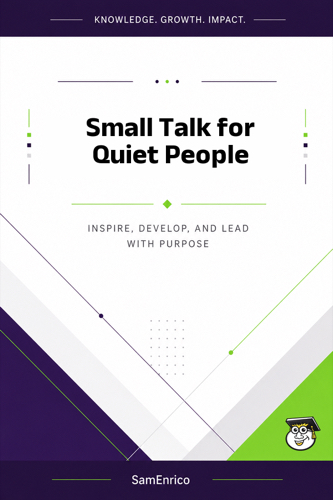
Small Talk for Quiet People eBook
Conversation scripts for naturally reserved indivi
by Lord Caroll
Conversation scripts for naturally reserved individuals.
Formats
Free sample
Chapter 1: The Permission Slip--–- The fluorescent lights hummed overhead. Thirty-seven people chattered in clusters around the conference room. You were standing near the window, holding a cup of coffee that had gone cold ten minutes ago, doing the math. If you could just make eye contact with someone—anyone—you could force yourself to walk over. But every time you looked up, the math got harder.
What would you say? How would you enter? What if they looked past you? What if they asked a question you couldn't answer? What if, worst of all, they found you boring?So you stayed by the window.
And you told yourself the same thing you have told yourself a hundred times before: Next time. Next time I'll be different. Next time I'll just fake it.But here is the secret that no one has ever told you, and it is the single most important sentence in this entire book: Faking it is exactly why you are exhausted, and faking it is also completely unnecessary.Welcome to the first chapter of Small Talk for Quiet People. If you have ever left a party feeling like you ran a mental marathon, if you have ever rehearsed a simple greeting in your head for twenty seconds before saying it, if you have ever been asked "Why are you so quiet?" and felt your stomach drop—this chapter is your permission slip to stop pretending. Not permission to stay silent forever, and not permission to hide.
Permission to stop performing a version of yourself that was never yours to begin with.The Great Lie of "Fake It Till You Make It"Somewhere along the way, well-meaning people began giving quiet individuals the worst advice in the history of social skills: Just pretend to be confident. Act like an extrovert. Fake it till you make it.On the surface, this sounds reasonable. After all, confidence can be learned. Posture can be adjusted.
Smiles can be practiced. But here is what the "fake it" advocates never tell you: for quiet people, faking extroversion is not a bridge to authenticity. It is a direct path to burnout.Let us understand why. Your brain, like every human brain, contains a network called the reticular activating system (RAS). Think of the RAS as a bouncer at the door of your conscious mind.
It decides which stimuli from the outside world are important enough to let in. For extroverts, the RAS is naturally wide open. It welcomes noise, movement, conversation, and social input with enthusiasm. For quiet people—and this is not a flaw, it is a variation—the RAS is more selective. It prefers depth over breadth.
It processes fewer inputs but processes each one more thoroughly.When you "fake it" at a party, you are asking your selective RAS to suddenly act like an extrovert's RAS. You are forcing your brain to process twenty conversations at once, to monitor your own performance while also monitoring others' reactions, to generate small talk on demand while also suppressing the natural urge to step back and observe. This is not socializing. This is cognitive overclocking. And just like overclocking a computer, it works for a little while—and then the system crashes.The research backs this up.
A 2018 study published in the Journal of Experimental Social Psychology found that introverts who were instructed to act like extroverts for an extended period showed significant increases in stress markers and decreases in mood, even when they performed the extroverted behaviors successfully. In other words, you can fake it. You can make people believe you are having a great time. But your body will know the truth. And it will charge you interest.The Quiet Brain: Not Broken, Just Different Before we go any further, we need to retire a word that has done enormous damage to quiet people everywhere: flaw.You are not a flawed extrovert.
You are not an introvert who needs fixing. You are not shy, broken, antisocial, rude, aloof, or stuck-up—unless you actually are those things, in which case this book cannot help you anyway. But for the vast majority of quiet people, the difficulty with small talk is not a character defect. It is a design feature.Consider the following differences between the quiet brain and the extroverted brain, all supported by neurological research:Processing depth: Quiet people process social information more slowly but more completely. While an extrovert might hear a question and respond immediately with a surface-level answer, a quiet person is more likely to consider the question, evaluate possible responses, and choose the most accurate one.
This takes time. In small talk, that time feels like an eternity.Sensory sensitivity: Quiet people's nervous systems are generally more reactive to stimuli. Loud music, bright lights, strong smells, and crowded spaces do not "add atmosphere" for you; they consume cognitive bandwidth that could otherwise be used for conversation.Dopamine response: Extroverts experience a dopamine rush from social rewards like laughter, attention, and approval. Quiet people also experience dopamine from social rewards, but they require less of it to feel satisfied. A single meaningful exchange can fuel you for an entire evening, whereas an extrovert might need a dozen such exchanges to reach the same level.None of these differences is a deficit.
They are variations in human neurology, no more pathological than having blue eyes instead of brown. But because our culture celebrates the fast-talking, quick-thinking, always-on social performer, quiet people grow up believing that something is wrong with them. That belief is the real problem. And it is the first thing this chapter will help you unlearn.Redefining Success: From "Life of the Party" to "One Interesting Person"Here is the most practical reframe in this entire book, and it will change everything about how you approach social situations from this moment forward.Traditional small talk advice says: Success at a party means working the room. It means talking to many people, leaving a good impression, being remembered, and collecting business cards or Instagram follows or future lunch invitations.
It means being seen as charming, confident, and socially valuable.This book says: That definition of success was written by extroverts, for extroverts. You do not have to play by their rules.The Quiet Talker definition of success: At any social event, your only goal is to identify one genuinely interesting person and have one real conversation that leaves you feeling even slightly more connected than before you arrived. That is it. One person. One conversation.
Everything else is decoration.Let me tell you a story. A few years ago, I attended a holiday party at a colleague's house. There were maybe sixty people there. I knew perhaps five of them by name. For the first hour, I did what I had always done: I faked it.
I smiled at everyone. I laughed at jokes I did not find funny. I asked the standard questions ("How are you?" "Busy?" "Crazy weather, right?") and received the standard answers. By 8:30 PM, I was exhausted. My face hurt from smiling.
My throat was dry from talking over the music. And I had not had a single conversation that meant anything.Then I noticed…
This is the end of the free sample. Get the eBook to keep going. Buy now
About this book
Details
- Author
- Lord Caroll
- Publisher
- SamEnrico
- Language
- English
- Genre
- Non-Fiction, Self-Help, Introvert
- Released
- 2026-06-05
- Pages (approx.)
- 141
- Available as
- eBook, Audiobook

Read better in the ZLOADR app
Your eBooks on your phone or tablet. Sign in with your SamEnrico account and start reading.
More by Lord Caroll
 Dream Apocalypse LogLord Caroll$11.99
 Home Country Summer VisitsLord Caroll$11.99
 Micro Expressions GuideLord Caroll$11.99
 Calm Parenting Anger ManagementLord Caroll$11.99
 Stop Home Distractions GuideLord Caroll$11.99
 Remote Group Creativity GuideLord Caroll$11.99
 Progressive Overload GuideLord Caroll$11.99
 The Arsenic Kingpins: Poison, Profit, and the Fall of a Prohibition-Era EmpireLord Caroll$11.99
 David Hockney: Painting the Yorkshire Wolds - A Digital Revolution in Landscape ArtLord Caroll$11.99
 Tyrolite MiningLord Caroll$11.99
 How to Start a Costumes for Women and Girls Business (Beginners Guide)Lord Caroll$11.99
 How to Produce Office Supply ManualsLord Caroll$11.99
You may also like
 Hong Kong Handover 1997Dunn Johnnie$11.99
 Zumba For Postnatal Recovery CourseNeal Christian$11.99
 Zumba for BeginnersLadner Nikia$11.99
 YouTube Comment Mining GuideHumes Pandora$12.99
 Worry Box MeditationCarlin Rudy$11.99
 Workplace Stress MeditationNguyen Lynn$11.99
 Workplace Stress and Sleep RepairHawley Ivory$11.99
 Workplace Perfectionism CureDelaney Jeffry$11.99
 Workplace Injustice Anger GuideWallen Isabelle$11.99
 Work Addiction and Burnout LinkGreenwood Ester$11.99
 Women in Yoga and WellnessBeattie Galina$11.99
 Women in Stand Up ComedyChun Evangeline$11.99