
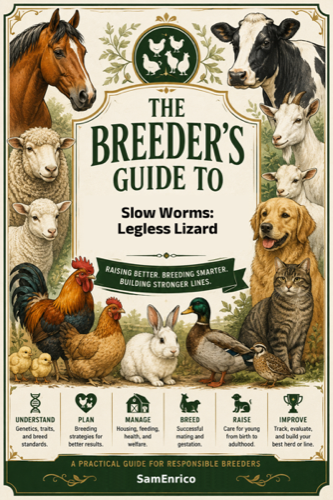
Non-FictionInformativeEducational
Slow Worms: Legless Lizard eBook
This wildlife publication, published by SamEnrico,
This wildlife publication, published by SamEnrico, covers Slow Worms: Legless Lizard
Formats
Free sample
Chapter 1: The Serpent Deception...--–- The creature beneath your flowerpot is not what you think it is. It does not want to bite you. It cannot sting you. It has no venom, no fangs, and no interest in your ankles. Yet for centuries, gardeners have screamed at the sight of it.
Children have been told to run from it. Poets and playwrights have cast it as a villain. And all of this—every single moment of fear, every crushed body under a garden spade, every well-intentioned but tragically misguided killing—has been based on a lie.The slow worm, Anguis fragilis, is one of the most misunderstood animals in the Northern Hemisphere. It is also one of the most harmless, one of the most beneficial, and, once you learn to see it clearly, one of the most fascinating. But before we can appreciate what it actually is, we must first dismantle what it is not.
This chapter is an exorcism of centuries of bad reputation. It is the unmasking of a creature that has been hiding not just under stones, but behind a curtain of folklore, fear, and flat-out falsehood.The Accidental Villain of English Literature Let us begin with the most famous slow worm in Western literature—a creature that never actually appears on stage but looms over one of Shakespeare’s most unsettling scenes. In Macbeth, the titular character has just murdered King Duncan and is spiraling into paranoia. He demands to know if his hired killers have murdered Banquo. When he learns that Banquo is dead but his son Fleance has escaped, Macbeth curses his luck and compares himself to a serpent:“We have scotch’d the snake, not kill’d it.”But in the same speech, he uses another image:“What man dare, I dare: / Approach thou like the rugged Russian bear, / The arm’d rhinoceros, or the Hyrcan tiger; / Take any shape but that, and my firm nerves / Shall never tremble: or be alive again, / And dare me to the desert with thy sword; / If trembling I inhabit then, protest me / The baby of a girl.
Hence, horrible shadow! / Unreal mockery, hence!”The “snake” is Banquo’s legacy. But elsewhere in the canon, Shakespeare names the slow worm directly. In A Midsummer Night’s Dream, Titania speaks of “the worm, the slow worm, and the blind worm” as creatures associated with dark, damp, magical places. In King Lear, Edgar describes a “blind-worm” as a creature to be feared.
And in Antony and Cleopatra, the asp that kills Cleopatra—the most famous serpent in literary history—is often misidentified in performance notes as possibly a slow worm, though the text suggests an Egyptian cobra or viper.Shakespeare was not a biologist. He was a playwright working with the bestiary of his day, and the bestiary of his day was wrong. The “blind worm” of Elizabethan England was believed to be a venomous snake that could kill with a glance—a folk tradition dating back to Pliny the Elder, who wrote in his Natural History (AD 77) that the “blindworm” had eyes so poisonous that its very gaze was lethal. This is nonsense, of course. But nonsense repeated for fifteen centuries becomes tradition, and tradition repeated becomes “common knowledge.”Shakespeare did not invent the slow worm’s bad reputation.
He inherited it. And then he amplified it, because that is what great writers do—they take the raw material of their culture and forge it into unforgettable images. The slow worm became a shorthand for hidden danger, for the threat that slithers beneath the surface of everyday life. A gardener in 1600 who heard “blind worm” reached for a stick. A gardener in 2024 who hears “slow worm” might still reach for a spade, even though the science has been clear for two hundred years.The science says: put the spade down.The Blindness Myth: An Anatomy of a Lie Why “blind worm”?
The name appears in English as early as the 10th century—blindwyrm in Old English—and it persists in modern languages: Blindschleiche in German, orvet aveugle in French. The myth is that the slow worm has no eyes, or that its eyes are non-functional, or that it is somehow “blind” in a spiritual or metaphorical sense.Here is the truth, and it is so simple that you can verify it yourself the next time you find a slow worm in your garden. The slow worm has two perfectly functional eyes. Those eyes have movable eyelids, which means the slow worm can blink. It can close its eyes when it sleeps.
It can squint in bright sunlight. This is not a trivial distinction. Snakes—true snakes—do not have eyelids. They have a transparent scale called a brille (from the German word for “spectacles”) that covers the eye permanently. A snake cannot blink.
A snake cannot close its eyes. When a snake sleeps, its eyes remain open, staring at nothing.The slow worm is not a snake. It blinks. And because it blinks, people who only glimpse it—people who see a limbless shape sliding into long grass—assume it must be a snake. The blink happens too fast to register.
The ear openings (which snakes also lack) are hidden on the sides of the head. The tongue is not deeply forked but only slightly notched. To the untrained eye, a slow worm looks like a snake. To the trained eye, the differences are immediate and unmistakable.So where did the blindness myth come from? Three theories are plausible, and all three may be true in combination.First, the slow worm’s eyes are small and dark, set into a head that is often covered in dirt or debris.
A slow worm that has just emerged from a burrow may have soil on its face, making the eyes appear to be absent. Second, when threatened, a slow worm will often close its eyes tightly and tuck its head beneath its own coils—a defensive posture that makes it look, to a panicked observer, like a creature without eyes. Third, and most mundanely, “blind” in Old English could also mean “hidden” or “dark.” A blindwyrm might have originally meant a “hidden worm” (one that lives underground), not a “sightless worm.” The meaning shifted over centuries, and by Shakespeare’s time, the creature was firmly established as both hidden and sightless.Whatever the origin, the myth is persistent. Even today, wildlife organizations receive calls from people who have “found a snake with its eyes closed, maybe injured?” The answer is always the same: it’s a slow worm. It’s fine.
Let it blink in peace.Venom, Fangs, and the Fear of Slithering The second great lie about the slow worm is that it is venomous. This is the lie that has killed more slow worms than any other. A gardener sees a slow worm, thinks “snake,” thinks “poison,” and reaches for the nearest heavy object. The slow worm dies. The gardener feels relieved.
Everyone goes home believing a hero has protected the family.Here is the truth, and it is absolute: the slow worm has no venom glands. It has no fangs. It has no mechanism whatsoever for delivering…
This is the end of the free sample. Get the eBook to keep going. Buy now
About this book
Details
- Author
- Stanfield Clemmie
- Publisher
- SamEnrico
- Language
- English
- Genre
- Non-Fiction, Informative, Educational
- Released
- 2026-05-18
- Pages (approx.)
- 139
- Available as
- eBook, Audiobook

Read better in the ZLOADR app
Your eBooks on your phone or tablet. Sign in with your SamEnrico account and start reading.
More by Stanfield Clemmie
 SMART For Work Life BalanceStanfield Clemmie$11.99
 Morning Flow RoutineStanfield Clemmie$11.99
 Collaborative Assumption Busting GuideStanfield Clemmie$11.99
 Student Mental HealthStanfield Clemmie$11.99
 Stretch Break HabitStanfield Clemmie$11.99
 Acupuncture for FatigueStanfield Clemmie$11.99
 Self Hypnosis for Control AnxietyStanfield Clemmie$11.99
 Massage CEU HoursStanfield Clemmie$11.99
 The Great New Zealand Prison Break: The Escape of Martin CrimminsStanfield Clemmie$11.99
 Starlight Betrayal: The Cosmonaut Who VanishedStanfield Clemmie$11.99
 How to Produce Picture FramesStanfield Clemmie$11.99
 How to Produce Dental EquipmentStanfield Clemmie$11.99
You may also like
 Hong Kong Handover 1997Dunn Johnnie$11.99
 Zumba For Postnatal Recovery CourseNeal Christian$11.99
 Zumba for BeginnersLadner Nikia$11.99
 YouTube Comment Mining GuideHumes Pandora$12.99
 Worry Box MeditationCarlin Rudy$11.99
 Workplace Stress MeditationNguyen Lynn$11.99
 Workplace Stress and Sleep RepairHawley Ivory$11.99
 Workplace Perfectionism CureDelaney Jeffry$11.99
 Workplace Injustice Anger GuideWallen Isabelle$11.99
 Work Addiction and Burnout LinkGreenwood Ester$11.99
 Women in Yoga and WellnessBeattie Galina$11.99
 Women in Stand Up ComedyChun Evangeline$11.99