
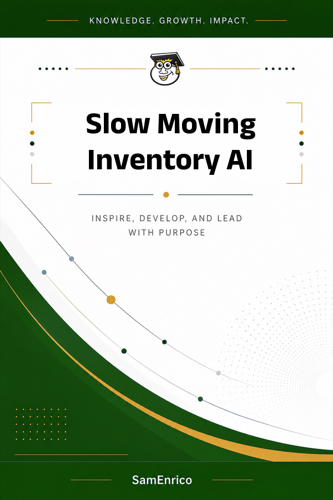
Non-FictionAI OperatorObsolescence
Slow Moving Inventory AI
Identify obsolete stock using pattern recognition
by Earls Jacki
Identify obsolete stock using pattern recognition algorithms.
Formats
About this book
Free sample
Chapter 1: The Millions in Darkness...--–- The warehouse was silent except for the hum of fluorescent lights and the occasional beep of a forklift backing up. Maria Chen walked the aisles with a clipboard that contained more bad news than she cared to admit. Aisle seven, section twelve. Twelve pallets of lawn furniture. It was November.
The furniture had arrived in April, sold well for six weeks, then stopped. Now it sat, shrink-wrapped and patient, while the calendar turned toward winter. Each pallet represented capital that could have been used for holiday inventory. Each square foot represented space that could have held products customers actually wanted. And each day the furniture sat, its value dropped—not on the accounting books, where it was still listed at cost, but in the real world, where no one was buying.Maria was the warehouse manager for a mid-sized home goods retailer with fifteen stores across three states.
Her bonus was tied to inventory turns. Her CFO was demanding answers. And her ERP system was telling her that the lawn furniture was fine—it had sold 100 units in the past quarter, right in line with forecast. What the ERP system did not tell her was that all 100 units sold in the first two weeks of April, and nothing had moved since.This is the problem with metrics. This is the problem with traditional slow-moving inventory detection.
And this chapter is about why the problem exists, what it costs you, and how a different approach—pattern recognition—can see what metrics miss.The Lifecycle of a Product Every product that enters your warehouse has a lifecycle. It arrives with promise. It sells. It slows. And eventually, it stops.
The shape of that lifecycle varies by product category, seasonality, market conditions, and a hundred other factors. But the pattern is universal.For a seasonal product like lawn furniture, the lifecycle looks like a spike: high sales in spring, declining sales in summer, near-zero sales in fall and winter. For a staple product like paper towels, the lifecycle looks like a flat line: consistent sales year-round, with…
This is the end of the free sample. Get the eBook to keep going. Buy now
Contents
- Chapter 1
- Chapter 2
- Chapter 3
- Chapter 4
- Chapter 5
- Chapter 6
- Chapter 7
- Chapter 8
- Chapter 9
- Chapter 10
- Chapter 11
- Chapter 12
Details
- Author
- Earls Jacki
- Publisher
- SamEnrico
- Language
- English
- Genre
- Non-Fiction, AI Operator, Obsolescence
- Released
- 2026-06-06
- Pages (approx.)
- 126
- Available as
- eBook, Audiobook

Read better in the ZLOADR app
Your eBooks on your phone or tablet. Sign in with your SamEnrico account and start reading.
More by Earls Jacki
 Bedtime Power StrugglesEarls Jacki$11.99
 Bipolar And Omega 3 GuideEarls Jacki$11.99
 Carson Pollinator ProtectionEarls Jacki$11.99
 The Postpartum Metabolic GuideEarls Jacki$11.99
 Sibling Anticipatory GriefEarls Jacki$11.99
 Assertiveness Skills for WomenEarls Jacki$11.99
 Improv for WritersEarls Jacki$11.99
 The Peacock Gang: A Family’s War Against Victorian LondonEarls Jacki$11.99
 The Angels of Vukovar: Surgeons in the StormEarls Jacki$11.99
 How to Produce Outdoor StructuresEarls Jacki$11.99
 How to Produce Concrete RepairEarls Jacki$11.99
 EU VAT Compliance Software GuideEarls Jacki$12.99
You may also like
 Hong Kong Handover 1997Dunn Johnnie$11.99
 Zumba For Postnatal Recovery CourseNeal Christian$11.99
 Zumba for BeginnersLadner Nikia$11.99
 YouTube Comment Mining GuideHumes Pandora$12.99
 Worry Box MeditationCarlin Rudy$11.99
 Workplace Stress MeditationNguyen Lynn$11.99
 Workplace Stress and Sleep RepairHawley Ivory$11.99
 Workplace Perfectionism CureDelaney Jeffry$11.99
 Workplace Injustice Anger GuideWallen Isabelle$11.99
 Work Addiction and Burnout LinkGreenwood Ester$11.99
 Women in Yoga and WellnessBeattie Galina$11.99
 Women in Stand Up ComedyChun Evangeline$11.99