
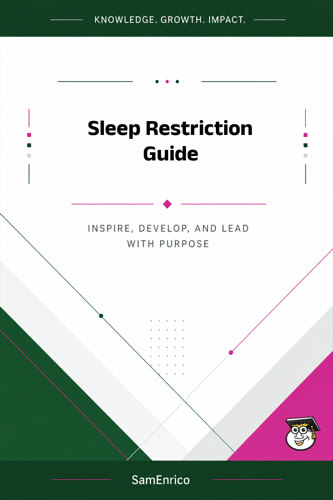
Sleep Restriction Guide eBook
Teaches limiting time in bed to increase sleep eff
Teaches limiting time in bed to increase sleep efficiency.
Formats
Free sample
Chapter 1: The 8-Hour Lie--–- On a Wednesday night in March, after forty-seven minutes of staring at the ceiling, I did something I had never done before. I got out of bed at 2:00 AM, walked to my home office, and wrote a single sentence on a whiteboard: "What if everything I know about sleep is backwards?"That sentence became this book. And before you read another word, I need you to understand what drove me to write it. For fifteen years, I was a chronic insomniac. I tried warm milk, valerian root, melatonin in three different dosages, prescription sleeping pills (zolpidem, then eszopiclone, then a brief and terrifying experiment with off-label quetiapine), acupuncture, cranial sacral therapy, a $3,000 "sleep surface optimization system," and a meditation app that made me so angry I threw my phone across the bedroom.
Nothing worked. Or rather, everything worked for exactly three nights, after which my insomnia returned with what felt like personal vengeance.The turning point came not from a doctor but from a research paper I found at 3:00 AM while searching for anyone else who had tried everything and failed. The paper, published in the journal Sleep in 1987, described a counterintuitive treatment for chronic insomnia. The treatment did not involve pills, herbs, or meditation. It did not involve buying anything.
In fact, it involved doing something that sounded, on its face, completely insane: it told insomniacs to spend less time in bed.Not less sleep. Less time in bed.I read that sentence seven times. Then I read the study methodology. Then I read the replication studies that followed over the next three decades. And then, with the desperate calculus of someone who has nothing left to lose, I decided to try it.
I restricted my time in bed from nine hours (of which I slept maybe five) to six hours (of which I slept five and a half). Within ten days, my sleep efficiency—the ratio of time asleep to time in bed—went from 58 percent to 86 percent. Within three weeks, I was sleeping through the night for the first time since college. Within six months, I had stopped thinking about sleep entirely.That is the promise of this book. Not a marginal improvement.
Not a "sleep hygiene checklist" that you'll abandon by February. A complete restructuring of your relationship with the bed, based on one simple, uncomfortable, and profoundly effective truth: you cannot fix insomnia by doing more of what caused it.The Myth That Keeps You Awake Let me name the lie explicitly. You have been told, repeatedly and by sources you trust—your doctor, your parents, every wellness article you have ever read—that if you are not sleeping enough, you should spend more time in bed. Go to bed earlier. Sleep in on weekends.
Take a nap. "Catch up." This advice is so deeply embedded in our cultural understanding of sleep that questioning it feels like questioning whether the sun rises in the east.The advice is wrong. Not slightly imprecise. Not in need of minor adjustment. Flatly, demonstrably, dangerously wrong for the approximately 30 percent of adults who experience insomnia symptoms and the 10 percent who meet the clinical threshold for insomnia disorder.Here is why.
Your brain is a learning machine. It constantly tracks associations between environments, behaviors, and outcomes. When you repeatedly spend time in bed awake—whether from anxiety, racing thoughts, physical discomfort, or simply the pressure to fall asleep—your brain learns a specific and devastating lesson: bed equals wakefulness. This is not a metaphor. This is classical conditioning, the same mechanism that made Pavlov's dogs salivate at the sound of a bell.
Your bed becomes a conditioned stimulus for arousal. By the time chronic insomnia takes hold, getting into bed is neurologically equivalent to drinking espresso.I have seen this in my own body. During the worst years of my insomnia, my heart rate would increase by twelve to fifteen beats per minute the moment I lay down. My palms would sweat. My thoughts would race.
This was not anxiety about sleep causing wakefulness. This was my nervous system treating the bed as a threat. And every time I followed the standard advice—"just go to bed earlier, give yourself more opportunity to sleep"—I was strengthening that association. I was digging the hole deeper.The 8-hour lie is not about the number eight. Some people genuinely need eight hours.
Some need nine. Some need seven. The lie is the causal claim hidden inside the recommendation: that more time in bed causes more sleep. For the insomniac brain, the opposite is true. More time in bed causes more wakefulness, more frustration, and more conditioned arousal.
It is the sleep equivalent of treating a broken leg by running a marathon.Sleep Efficiency: The One Number That Matters If you take nothing else from this chapter, take this: stop measuring your sleep by how many hours you think you slept. Start measuring it by sleep efficiency.Sleep efficiency is a simple ratio. You calculate it by dividing the total time you actually sleep by the total time you spend in bed, then multiplying by 100 to get a percentage. That is it. No subjective ratings.
No comparison to some ideal number. Just the cold, clarifying math of what your body is actually doing.Let me give you two examples.Person A spends 7.5 hours in bed and sleeps for 7 of those hours. Their sleep efficiency is 7 ÷ 7.5 = 0.933 × 100 = 93.3 percent. This is excellent. This person is sleeping soundly, waking rarely, and spending almost all of their bed time asleep.Person B spends 9 hours in bed and sleeps for 5.5 of those hours.
Their sleep efficiency is 5.5 ÷ 9 = 0.611 × 100 = 61.1 percent. This person is in the clinical range for insomnia. They are spending more than three and a half hours awake in bed every single night.Here is what most people get wrong. Person B will almost certainly describe themselves as "only getting five and a half hours of sleep." They will focus on that number. They will worry about it.
They will try to increase it by going to bed even earlier or sleeping in later. But the problem is not that five and a half hours is insufficient. The problem is that nine hours in bed is producing terrible sleep efficiency. The problem is conditioned wakefulness. The problem is that the bed has become a trigger for arousal, and every additional minute spent awake in bed makes that trigger stronger.A healthy sleeper consistently achieves sleep efficiency above 85 percent.
Many healthy sleepers are above 90 percent. Insomniacs often fall below 70 percent—not because they are incapable of sleeping, but because they are spending so much time awake in bed that the ratio collapses. I have worked with clients who spent eleven hours in bed and slept four. Their efficiency was 36 percent. They were not suffering from a lack of sleep opportunity.
They were suffering from a catastrophic mismatch between time in bed and time asleep.The goal of this book is to get you above 85 percent. Not 100 percent—that is neither realistic nor necessary. Above 85 percent is the threshold at which sleep becomes restorative, predictable, and free from the exhausting mental gymnastics of "trying" to…
This is the end of the free sample. Get the eBook to keep going. Buy now
About this book
Details
- Author
- Self Kemberly
- Publisher
- SamEnrico
- Language
- English
- Genre
- Non-Fiction, Health & Wellness, Sleep
- Released
- 2026-06-06
- Pages (approx.)
- 143
- Available as
- eBook, Audiobook

Read better in the ZLOADR app
Your eBooks on your phone or tablet. Sign in with your SamEnrico account and start reading.
More by Self Kemberly
 SMART History GuideSelf Kemberly$11.99
 Teamster Boss Hoffa Biography Complete ManualSelf Kemberly$11.99
 Post Cheating Guilt RecoverySelf Kemberly$11.99
 Burnout Recovery For Flight AttendantsSelf Kemberly$11.99
 Remote Work BoundariesSelf Kemberly$11.99
 Atomic Habits For ParentingSelf Kemberly$11.99
 The Lampkeeper's Bargain: A Djinn's Last WishSelf Kemberly$11.99
 Headspace Meditation Minute RivalrySelf Kemberly$11.99
 The Last Stand of 'Iron Mike': Tyson’s Unbreakable ComebackSelf Kemberly$11.99
 How to Start a Coach Hire With Driver Business (Beginners Guide)Self Kemberly$11.99
 How to Produce a Music CentreSelf Kemberly$11.99
 Growing BrodiaeaSelf Kemberly$11.99
You may also like
 Sleep Optimization for HGHLombardo Harriette$11.99
 HIIT for Better SleepHayden Rochel$11.99
 Bipolar Sleep Management GuideReilly Marlena$11.99
 Power Nap 20 Minute GuideSalazar Luke$11.99
 Aromatherapy for InsomniaTijerina Versie$11.99
 The Nocturnal HGH PeakMaples Kecia$11.99
 Recovery Sleep for AthletesCraig Devin$11.99
 Dysthymia And Sleep DisturbanceBillings Earleen$11.99
 The Sleep Debt Recovery PlanBlakely Collen$11.99
 Sleep And IBS GuideGladden Marinda$11.99
 PCOS Melatonin Sleep GuideCollado Richard$11.99
 Napping Like CentenariansAltman Coral$11.99