
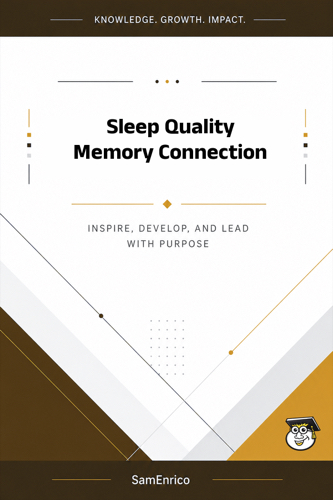
Non-FictionSelf-HelpSleep Hygiene
Sleep Quality Memory Connection eBook
Improve recall by enhancing overall sleep architec
by Monroe Vania
Improve recall by enhancing overall sleep architecture and efficiency.
Formats
Free sample
Chapter 1: The Overnight Librarian...--–- The cashew-shaped wreckage in your skull is about to betray you. Not because it’s broken. Because you’ve been asking it to do the impossible every single night of your adult life.Meet your hippocampus. It lives deep in your temporal lobe, one on each side of your brain, each roughly the size of a small cashew. This tiny structure is your brain’s temporary holding tank for everything you learn.
Every face you met today. Every fact you read. Every word of this sentence, for the next thirty seconds. That’s the limit, by the way—about thirty seconds of conscious memory before your hippocampus starts overwriting itself unless something intervenes.Something does intervene. Or at least, something should.That something is sleep.
Specifically, the ninety-minute cycles of Non-Rapid Eye Movement sleep that act as your brain’s overnight filing system. Without it, your hippocampus becomes a hoarder’s apartment—stuffed to the ceiling with unlabeled boxes, no system for storage, and a landlord (your neocortex) who refuses to open the door.This chapter is about why you forget. Not the cute, everyday “where are my keys” forgetting. The real, costly, embarrassing, career-limiting forgetting that happens when you sacrifice sleep for productivity. We’re going to dismantle the single most dangerous myth of modern life: that sleep is passive.
That it’s downtime. That nothing important happens between the hours of 11 PM and 7 AM.Everything important happens. And if you read nothing else in this book, read this: You do not have a memory problem. You have a sleep architecture problem.The Bet You Didn’t Know You Were Losing Let’s run a small experiment. Right now, without looking back, try to recall the third sentence of this chapter’s first paragraph.
Not the title. Not the bolded section. The third sentence of the very first paragraph.Can you do it? Probably not. And that’s not because you’re distracted or lazy.
It’s because that information never left your hippocampus. It was never transferred to long-term storage. In neuroscience terms, you didn’t “forget” it—you never encoded it for permanence in the first place.Here’s the distinction that will change how you think about memory forever:Forgetting is when you once knew something, stored it, and now can’t retrieve it. (Example: the name of your third-grade teacher.)Never-saved is when you encountered information, but your brain never moved it from temporary to permanent storage. (Example: the third sentence of this paragraph.)Most people blame forgetting when the real culprit is never-saved.
And the number one reason information never gets saved? Sleep deprivation.Matthew Walker, the neuroscientist who wrote Why We Sleep, puts it bluntly: “After nineteen hours without sleep, you are as cognitively impaired as someone who is legally drunk.” But here’s what most summaries leave out—impairment isn’t just about slow reactions or brain fog. It’s about a specific, measurable failure of your hippocampus to do its job.Think of your hippocampus as a concierge desk in a busy hotel. Guests (new memories) arrive all day long. The concierge takes their bags and puts them in a temporary holding room.
But the hotel only has one holding room. It’s small. By the end of the day, that room is overflowing. The only solution is to move the bags to permanent guest rooms upstairs—the neocortex, your brain’s long-term hard drive.The moving crew only works at night. And their shift is called NREM sleep.If you cut that shift short, the concierge starts stacking bags in the hallway.
Then in the lobby. Then outside the front door. New guests arrive, but there’s no space. So you turn them away. You never even take their bags.That’s not forgetting.
That’s a hotel that stopped checking luggage in because the overnight crew didn’t show up.The Anatomy of a Memory (No Medical Degree Required)Before we go further, let’s map the territory. You don’t need to memorize these terms, but you do need to understand the job each part performs.The Hippocampus (Temporary Storage)Located in your medial temporal lobe. Roughly the size of a cashew. Capacity: extremely limited—estimates suggest it can hold only about thirty seconds of raw sensory information before it must either consolidate or discard. Its job is to tag new memories with time, place, and context.
It’s the “what just happened” recorder.The Neocortex (Long-Term Hard Drive)The wrinkled outer layer of your brain. This is where memories live once they’ve been consolidated. Unlike the hippocampus, the neocortex has enormous capacity—you will never fill it. The problem isn’t space. The problem is getting memories from the hippocampus to the neocortex.The Synapse (Connection Point)The gap between neurons where information jumps.
Every memory is encoded as a specific pattern of synaptic connections. Strong connections = strong memories. Weak connections = forgettable ones.The Overnight Crew (NREM Sleep)Non-Rapid Eye Movement sleep, specifically Stage 3 (Slow Wave Sleep). This is when the hippocampus replays the day’s events at ten to twenty times normal speed, transferring those patterns to the neocortex.Now for the elegant, slightly disturbing part: during that replay, your brain doesn’t just copy memories. It edits them.The Synaptic Homeostasis Hypothesis (Or: Why Your Brain Needs a Delete Button)This is the most important concept in this chapter, so read it twice.The Synaptic Homeostasis Hypothesis (SHY) proposes that wakefulness strengthens synapses across the brain.
Every experience, every thought, every sensation increases the “weight” of your neural connections. That sounds good—stronger connections, stronger memories, right?Not exactly.Because here’s the problem: if every synapse strengthened all the time, your brain would eventually saturate. You’d have no room for new learning. Every connection would be “on” at full volume, creating a constant roar of neural noise. You wouldn’t be able to distinguish important information from trivial background.Think of it like a recording studio.
During the day, you’re recording sound from fifteen microphones simultaneously. Every microphone is picking up something—the guitarist, the drummer, the air conditioner, traffic outside, someone coughing in the control room. By the end of the session, you have hundreds of hours of raw audio. It’s all “memory” in the sense that it was recorded. But most of it is useless.Sleep is the mixing engineer.
It doesn’t just store everything. It listens to the raw tracks, identifies the signal, and deletes the noise. It turns down the irrelevant connections (synaptic downscaling) and turns up the important ones. It makes room for tomorrow’s recording session by clearing out today’s garbage.Without that nightly cleanup, your hippocampus fills up. And a full hippocampus cannot encode new information.This is why pulling an all-nighter before an exam is actively stupid.
Not “suboptimal.” Not “less than ideal.” Stupid. You’re not gaining eight hours of study time. You’re ensuring that most of what you studied never leaves your hippocampus. You’re cramming a hotel luggage room that the overnight crew never empties.The Replay Mechanism (Your Brain’s Hidden Study Session)Here’s where…
This is the end of the free sample. Get the eBook to keep going. Buy now
About this book
Details
- Author
- Monroe Vania
- Publisher
- SamEnrico
- Language
- English
- Genre
- Non-Fiction, Self-Help, Sleep Hygiene
- Released
- 2026-06-06
- Pages (approx.)
- 122
- Available as
- eBook, Audiobook

Read better in the ZLOADR app
Your eBooks on your phone or tablet. Sign in with your SamEnrico account and start reading.
More by Monroe Vania
 Name Recall for In LawsMonroe Vania$11.99
 Emmylou Harris Wrecking BallMonroe Vania$11.99
 The Underfunctioning PartnerMonroe Vania$11.99
 F1 Driver Manager RoleMonroe Vania$11.99
 Time Outs for AngerMonroe Vania$11.99
 Pregnancy Alcohol DetoxMonroe Vania$11.99
 Group Therapy For Low LiteracyMonroe Vania$11.99
 The Silk and Stone Bridge: How an 18th-Century African Architect Defied the ImpossibleMonroe Vania$11.99
 The Shanghai Express Heist: A Prohibition-Era Hostage CrisisMonroe Vania$11.99
 How to Produce For Kids ProductsMonroe Vania$11.99
 Understanding CraniosynostosisMonroe Vania$11.99
 Argumentative Essay Prompt LibraryMonroe Vania$12.99
You may also like
 Hong Kong Handover 1997Dunn Johnnie$11.99
 Zumba For Postnatal Recovery CourseNeal Christian$11.99
 Zumba for BeginnersLadner Nikia$11.99
 YouTube Comment Mining GuideHumes Pandora$12.99
 Worry Box MeditationCarlin Rudy$11.99
 Workplace Stress MeditationNguyen Lynn$11.99
 Workplace Stress and Sleep RepairHawley Ivory$11.99
 Workplace Perfectionism CureDelaney Jeffry$11.99
 Workplace Injustice Anger GuideWallen Isabelle$11.99
 Work Addiction and Burnout LinkGreenwood Ester$11.99
 Women in Yoga and WellnessBeattie Galina$11.99
 Women in Stand Up ComedyChun Evangeline$11.99