
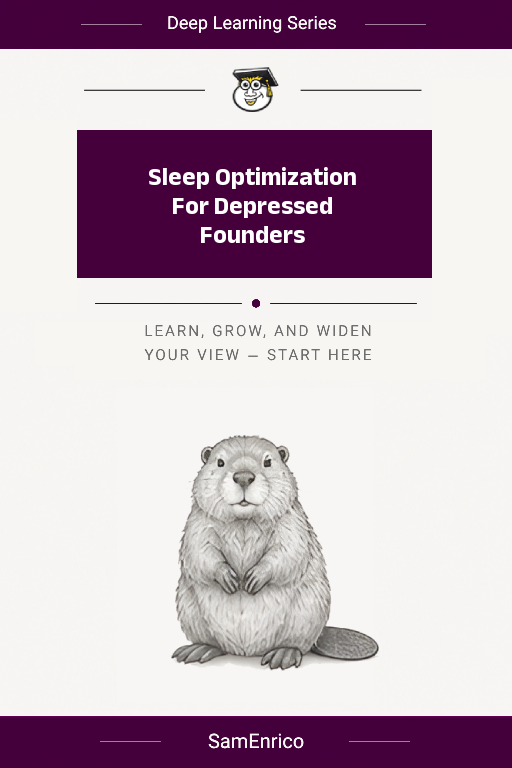
Sleep Optimization For Depressed Founders eBook
Use blue light blocking and morning bright light t
by Parham Emely
Use blue light blocking and morning bright light therapy to regulate circadian rhythms and mood.
Formats
Free sample
Chapter 1: The $10 Million Insomnia--The email arrived at 3:47 AM. It was a term sheet. Not a soft inquiry, not a “we’d like to learn more,” but an actual, signed, binding term sheet from a top-tier venture capital firm. The founder—let’s call him Alex—had been grinding for eighteen months to get to this moment. His bootstrapped Saa S company had just crossed 2millioninannualrecurringrevenue.Histeamoftwelvewasrunningonfumesandloyalty.Andnow,finally,thevalidationhehadbeenchasing:a2 million in annual recurring revenue.
His team of twelve was running on fumes and loyalty. And now, finally, the validation he had been chasing: a 2millioninannualrecurringrevenue.Histeamoftwelvewasrunningonfumesandloyalty.Andnow,finally,thevalidationhehadbeenchasing:a10 million valuation and a check large enough to hire a real engineering team.Alex stared at the email on his phone. The screen was too bright. His eyes burned. He had been lying in the dark for three hours, cycling through the same loop: what if the product fails?
what if the investors pull out? what if I’m a fraud? By the time the term sheet arrived, his brain was so fogged with exhaustion that he could not feel joy. He could not feel relief. He could not feel anything except a dull, pulsing ache behind his eyes and the vague sense that something was deeply wrong with him.He signed the term sheet at 4:15 AM.
He sent it back at 4:16 AM. Then he lay awake until his 7:00 AM alarm, at which point he drank four shots of espresso, forgot to eat breakfast, and walked into a boardroom to negotiate with lawyers while running on ninety minutes of fragmented sleep. He closed the round. He celebrated with champagne. And then he went home and did the same thing the next night.Six months later, Alex sold his shares and stepped down as CEO.
He was thirty-two years old. He had made more money than his parents would see in their lifetimes. And he could not remember the last time he had felt genuinely happy. He had been diagnosed with depression, then with treatment-resistant depression, then with “burnout” so severe that his psychiatrist recommended a six-month leave from work. The term sheet that arrived at 3:47 AM did not save him.
It buried him.This book is for Alex. And for every founder who has ever stared at a glowing screen in the middle of the night, wondering why their brain will not shut off, why their mood is crumbling, why the success they worked so hard for feels like nothing at all.The Myth That Kills Founders Startup culture has a creation myth. You have heard it a thousand times. It goes like this: sleepless nights are a badge of honor. The founder who grinds the hardest wins.
If you are not waking up at 4:00 AM to answer emails, if you are not coding until 2:00 AM, if you are not skipping weekends and meals and sleep—you do not want it badly enough.This myth is not just false. It is biologically destructive.The traits that make a great founder—hypervigilance, persistence, a tolerance for chaos, the ability to operate under extreme uncertainty—are the same traits that make restorative sleep nearly impossible. Your brain’s threat-detection system (the amygdala) never turns off. Your sympathetic nervous system (the “fight or flight” accelerator) stays pinned to the floor. And your circadian clock, the ancient biological timekeeper that evolved over millions of years to align your sleep and wake with the rising and setting sun, gets smashed to pieces by a 24/7 cycle of screens, stress, and schedule chaos.This chapter is going to show you exactly how that happens.
More importantly, it is going to show you why your depression is not a character flaw, why your insomnia is not a moral failure, and why the solution is not more willpower—it is better biology.The Statistics That Should Terrify You Let us start with the numbers, because founders respect data.A large-scale study of small business owners found that over 80% report “broken sleep” on a regular basis. Not “slightly less than ideal”—broken. Fragmented. The kind of sleep where you wake up four or five times per night, check your phone, and then lie there watching the minutes tick by.Entrepreneurs have significantly higher rates of insomnia than the general population. Not a little higher—two to three times higher.
They also have significantly higher rates of depression. A 2018 study of over 500 startup founders found that 72% reported experiencing mental health struggles, with depression and burnout at the top of the list. Another study found that entrepreneurs are twice as likely to report a lifetime history of depression compared to non-entrepreneurs.Here is the part that does not make it into the motivational Linked In posts: the same founders who report the highest levels of “grit” and “perseverance” also report the worst sleep. There is an inverse relationship between how much you pride yourself on grinding and how well you actually rest. The harder you push, the more your biology pushes back.And the consequences are not just about feeling tired.
Chronic sleep disruption is a direct, causal driver of depression. Longitudinal studies have shown that insomnia predicts depression—not the other way around. If you have persistent sleep problems, your risk of developing clinical depression increases by a factor of two to four. If you already have depression, poor sleep makes it resistant to treatment. Antidepressants work less well.
Therapy works less well. Everything works less well when your circadian clock is broken.The term sheet at 3:47 AM did not cause Alex’s depression. But the sleep deprivation that preceded it—the months and years of fragmented, misaligned, biologically inappropriate rest—created the neural conditions in which depression could take hold and flourish.The Social Jetlag Trap There is a specific pattern of sleep disruption that is almost universal among founders, and it has a name: social jetlag.Social jetlag is the mismatch between your biological clock (when your body wants to sleep) and your social clock (when your schedule demands that you be awake). It is called “jetlag” because the effects are identical to flying across time zones—except you do not get to go anywhere interesting, and you do it every single week.Here is how it works for most founders. Monday through Friday, you wake up early.
Maybe 6:00 AM, maybe 7:00 AM, but early enough to get a jump on the day. You drink coffee. You answer Slack. You push through the afternoon slump. By Friday night, you are exhausted.
You collapse into bed at 11:00 PM, which is two hours earlier than your body actually wants to sleep, because your natural bedtime is closer to 1:00 AM. You lie there for an hour. You finally drift off. Then you sleep in on Saturday until 10:00 AM or 11:00 AM, because you “deserve” to catch up.That Saturday sleep-in is not recovery. It is a time zone shift.By sleeping in three to four hours later than your weekday wake time, you have effectively traveled west across three or four time zones.
Your biological clock is now set to a later schedule. On Sunday, you try to go to bed at 11:00 PM again, but your body thinks it is 8:00 PM…
This is the end of the free sample. Get the eBook to keep going. Buy now
About this book
Details
- Author
- Parham Emely
- Publisher
- SamEnrico
- Language
- English
- Genre
- Non-Fiction, Mental Wealth
- Released
- 2026-05-29
- Pages (approx.)
- 142
- Available as
- eBook, Audiobook

Read better in the ZLOADR app
Your eBooks on your phone or tablet. Sign in with your SamEnrico account and start reading.
More by Parham Emely
 Meditation for Abandonment FearParham Emely$11.99
 Older Worker MigrationParham Emely$11.99
 Metta For Social AnxietyParham Emely$11.99
 Fishery Quota SystemsParham Emely$11.99
 Assertive Communication HandbookParham Emely$11.99
 Mindful Conflict Resolution GuideParham Emely$11.99
 Food Insecurity Student GuideParham Emely$11.99
 Parent Caregiver Grief GuideParham Emely$11.99
 Self Worth And Body ImageParham Emely$11.99
 The Whispering Apothecary: Ancient Nubia's Forgotten HealersParham Emely$11.99
 The Platters: Only You, Only ThemParham Emely$11.99
 The Last Whistle: The Haunting of the Centralia Mine FireParham Emely$11.99
You may also like
 Hong Kong Handover 1997Dunn Johnnie$11.99
 Zumba For Postnatal Recovery CourseNeal Christian$11.99
 Zumba for BeginnersLadner Nikia$11.99
 YouTube Comment Mining GuideHumes Pandora$12.99
 Worry Box MeditationCarlin Rudy$11.99
 Workplace Stress MeditationNguyen Lynn$11.99
 Workplace Stress and Sleep RepairHawley Ivory$11.99
 Workplace Perfectionism CureDelaney Jeffry$11.99
 Workplace Injustice Anger GuideWallen Isabelle$11.99
 Work Addiction and Burnout LinkGreenwood Ester$11.99
 Women in Yoga and WellnessBeattie Galina$11.99
 Women in Stand Up ComedyChun Evangeline$11.99