
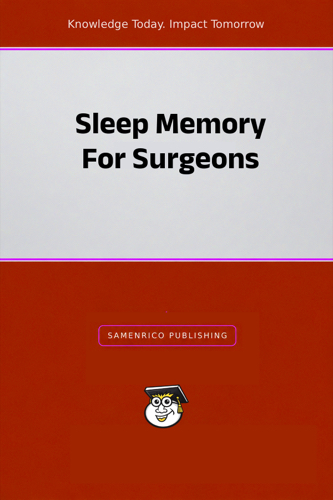
Sleep Memory For Surgeons Audiobook
Protect cognitive function despite on-call schedul
Protect cognitive function despite on-call schedules.
Formats
Free sample
Chapter 1: The 3 AM Confession--I almost killed a man at 3:47 AM. Not because my hand slipped. Not because I lacked the technical skill. Not because the anatomy was unexpected. I almost killed him because my brain went offline for six seconds while I was looking directly at the problem.
I remember the moment with the clarity that only profound shame can provide. The resident handed me the clamp. I took it. And then I just stood there. The bleed was right in front of me—a small venous ooze from the retroperitoneum, nothing catastrophic, nothing that required heroism.
But I could not make a decision. I could not sequence the steps in my head. I looked at the field, and my working memory was a blank whiteboard. For six seconds—which is the length of a surgical eternity—I did nothing. Then I clamped, tied, and finished.
The patient survived. But I knew, in that moment, that I had crossed a line I did not know existed. I had been awake for twenty-two hours. I had operated on three previous cases that day. I had told myself, as surgeons always do, that I was fine.
I was not fine. I was legally drunk by every neurocognitive metric that matters. And no one stopped me.The Myth of the Invincible Surgeon Every surgeon knows the story of the greats who operated through the night, slept in the on-call room for ninety minutes, and returned to the podium the next morning to deliver a Grand Rounds lecture on surgical innovation. We tell these stories to ourselves as proof that fatigue is a weakness for other people. We are trained from the first day of residency that endurance is a virtue, that the ability to function without sleep is a sign of character, that the best surgeons are the ones who can be paged at 2 AM, operate until 6 AM, and still make morning clinic.This is a lie.
And it is a lie that kills people.The data are unambiguous and have been for decades. After seventeen hours of sustained wakefulness, hand-eye coordination and reaction time degrade to a level equivalent to a blood alcohol concentration of 0.05 percent. After twenty hours, that impairment reaches 0.08 percent—the legal limit for driving in most jurisdictions. After twenty-two hours, as in my case, performance approaches 0.10 percent. Let me say that plainly: a surgeon who has been…
This is the end of the free sample. Get the Audiobook to keep going. Buy now
About this book
Details
- Author
- Cartwright Darell
- Publisher
- SamEnrico
- Language
- English
- Genre
- Non-Fiction, Self-Help, Surgery
- Released
- 2026-06-10
- Pages (approx.)
- 150
- Available as
- eBook, Audiobook

Listen in the VoxFlicks app
Audiobooks and audio dramas wherever you go. Sign in with your SamEnrico account and press play.
More by Cartwright Darell
 Imposter Syndrome Calming GuideCartwright Darell$11.99
 Marvin Gaye Whats Going OnCartwright Darell$11.99
 Social Media Commerce DivideCartwright Darell$11.99
 The Single Tasking Pledge GuideCartwright Darell$11.99
 Keto Cravings Control GuideCartwright Darell$11.99
 Portfolio Rebalancing GuideCartwright Darell$11.99
 Interracial Couple AngerCartwright Darell$11.99
 The Last King of the Sky: Howard Hughes and the Birth of Modern AviationCartwright Darell$11.99
 The Great London Forgery: How a Fake Architect Changed Urban DesignCartwright Darell$11.99
 Understanding Heredopathia Atactica PolyneuritiformisCartwright Darell$11.99
 A Collector's Handbook to the Cadillac 75Cartwright Darell$11.99
 How to Become a Marker ICartwright Darell$11.99
You may also like
 Surgeon Organ TransplantSchrimsher Emmy$11.99
 Opioid Recovery and SurgeryStiles Chandra$11.99
 Post Surgical Pain MindfulnessChong Lovella$11.99
 Trance for Surgery PreparationToro Angella$11.99
 Stress Surgery Recovery GuideAshe Judson$11.99
 Pre Surgery Breath Calming GuideAshby Leigh$11.99
 Trauma Surgeon Coping GuideGrogan Jarrod$11.99
 TM for Pre Surgery PreparationPrichard Marshall$11.99
 Post Surgery Pain ReliefSherwood Stefania$11.99
 The EQ for Surgeons GuideGilmore Fidela$11.99
 Breath Meditation Before SurgeryWorley Delcie$11.99
 Body Scan for Surgery RecoveryGainey Sade$11.99