
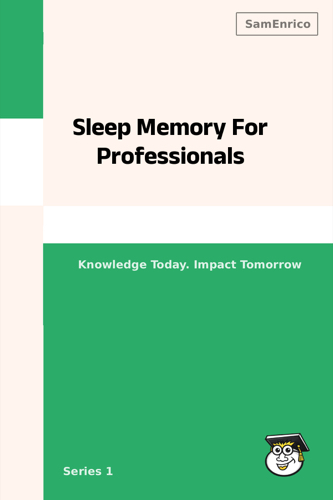
Sleep Memory For Professionals eBook
Enhance work performance, learning, and recall thr
Enhance work performance, learning, and recall through better rest.
Formats
Free sample
Chapter 1: The $63 Billion Blindspot...--It was 2:47 AM when Sarah Chen, a 34-year-old senior manager at a global consulting firm, sent what would become the most expensive email of her career.She had been awake for nineteen hours. Her third cup of coffee sat cold beside her laptop. Her team had missed a deadline, and a client was threatening to pull a $4 million contract. In her sleep-deprived state, Sarah fired off a blistering email to her junior associate, copying three senior partners. She called the associate's work "incompetent," "unprofessional," and "a embarrassment to the firm"—the typo in "embarrassment" would haunt her later.She hit send and finally collapsed into bed at 3:15 AM.The next morning, Sarah woke to fifteen missed calls and forty-two Slack messages.
The junior associate had quit. Two partners had forwarded her email to HR with the subject line "Conduct concern." The client, who had heard about the internal chaos through industry gossip, did pull the contract. Sarah was placed on a performance improvement plan. Within six months, she was out of the firm.The post-exit review identified the root cause as "poor judgment under pressure." But the real root cause never appeared in the official documents: sleep deprivation.Sarah was not a bad leader. She was not incompetent.
She was not cruel. She was a talented, driven professional who had bought into a lie—the lie that sacrificing sleep is a sign of dedication, that burning the midnight oil is heroic, and that the truly committed don't need rest.That lie costs U.S. companies over $63 billion every year.The Myth You Have Been Taught to Worship Let me ask you a question, and I want you to answer honestly.When you think of a high-performing professional—the partner who closes the deal, the surgeon who saves the patient, the developer who ships the code, the executive who turns around a failing division—what do you imagine?Most people imagine someone who works longer hours than everyone else. Someone who is the first to arrive and the last to leave. Someone who answers emails at 11 PM and sends follow-ups at 5 AM.
Someone who proudly says, "I'll sleep when I'm dead."This image is not just wrong. It is dangerously, expensively, biologically wrong.The corporate cult of "burnout as a badge of honor" has been sold to us as the price of success. We have been taught that sleep is for the weak, that napping is for children, and that the truly ambitious can "hack" their biology to need only four or five hours of rest. We have been told stories of Thomas Edison sleeping four hours a night, of Margaret Thatcher thriving on five, of Elon Musk sleeping under his desk.What we are not told is that Edison privately regretted his anti-sleep stance later in life, admitting that his erratic sleep patterns contributed to failed inventions and strained relationships. We are not told that Margaret Thatcher's later years were marked by cognitive decline linked to chronic sleep deprivation.
We are not told that Elon Musk has publicly acknowledged that his sleep-deprived tweets have cost Tesla millions and damaged his reputation.The myth persists because it serves a purpose. It justifies overwork. It excuses poor management. It allows organizations to extract more hours from employees without improving systems. And it gives individual professionals a story to tell themselves: "I am working harder than everyone else, so I deserve to succeed."But the data tells a very different story.The $63 Billion Calculation In 2016, the Journal of Clinical Sleep Medicine published a landmark study that should have stopped every CEO in their tracks.
Researchers calculated the economic burden of insufficient sleep among U.S. workers. They accounted for absenteeism (days missed), presenteeism (days worked but with reduced cognitive function), and workplace accidents linked to fatigue.The total: $63.2 billion annually.To put that number in perspective, it is larger than the GDP of more than 80 countries. It is roughly equivalent to the entire advertising industry's annual revenue. It is more than the combined budgets of the Department of Education, the Environmental Protection Agency, and the National Endowment for the Arts.And that figure, startling as it is, almost certainly underestimates the true cost.
The study only counted direct productivity losses. It did not account for the long-term health consequences of chronic sleep deprivation—the increased risk of cardiovascular disease, diabetes, depression, and cognitive decline—that drive up healthcare costs and shorten careers. It did not account for the catastrophic failures, like the Chernobyl meltdown, the Three Mile Island accident, and the Exxon Valdez oil spill, all of which have been linked to sleep-deprived decision-making. It did not account for the quiet catastrophes: the relationship destroyed by a sleep-deprived outburst, the promotion lost because of a foggy interview, the brilliant idea that never surfaced because the brain was too exhausted to make the connection.Every professional reading this book has experienced the $63 billion problem personally. You have stared at a spreadsheet for an hour without seeing the obvious pattern.
You have walked into a meeting and forgotten the key point you rehearsed on the way in. You have snapped at a colleague and spent the rest of the day apologizing. You have made a decision at 11 PM that seemed brilliant and looked foolish at 9 AM.You told yourself you were just tired. You told yourself it would be better tomorrow. You told yourself that this is just what hard work feels like.But here is the truth those stories hide: Sleep deprivation does not make you stronger.
It makes you stupid.The Neuroscience of Mental Fog To understand why, we need to look inside your brain.The prefrontal cortex—located right behind your forehead—is the part of your brain that makes you a professional. It is responsible for executive functions: planning, decision-making, impulse control, focus, working memory, and emotional regulation. When you are solving a complex problem, the prefrontal cortex is doing the heavy lifting. When you are resisting the urge to check your phone during a meeting, your prefrontal cortex is applying the brakes. When you are reading a dense report and extracting key insights, your prefrontal cortex is the engine.Here is what most people do not know: the prefrontal cortex is exquisitely sensitive to sleep loss.
In fact, it is one of the first brain regions to degrade when you are tired.Why? Because the prefrontal cortex requires an enormous amount of energy in the form of glucose. Your brain, which represents only 2% of your body weight, consumes 20% of your daily glucose. And the prefrontal cortex, a small region within that 2%, consumes a disproportionate share of that 20%.When you are sleep-deprived, your body becomes less efficient at metabolizing glucose. Blood glucose levels may remain normal, but the glucose does not enter your brain cells as readily.
The prefrontal cortex, with its voracious energy demands, is hit first and hardest.Without sufficient glucose, neurons in the prefrontal cortex cannot fire efficiently. They cannot maintain the rapid, coordinated firing patterns required for complex cognition. The result is what neuroscientists call "local sleep"—small regions of the brain entering sleep-like states while you are still technically awake. Your eyes are open.…
This is the end of the free sample. Get the eBook to keep going. Buy now
About this book
Details
- Author
- Cabrera Nella
- Publisher
- SamEnrico
- Language
- English
- Genre
- Non-Fiction, Self-Help, Career Performance
- Released
- 2026-06-10
- Pages (approx.)
- 150
- Available as
- eBook, Audiobook

Read better in the ZLOADR app
Your eBooks on your phone or tablet. Sign in with your SamEnrico account and start reading.
More by Cabrera Nella
 Name Memory for Religious LeadersCabrera Nella$11.99
 Martina McBride Independence DayCabrera Nella$11.99
 Elvis Presley Memphis FlashCabrera Nella$11.99
 The Check-In HabitCabrera Nella$11.99
 B2B Software Renewal TriggersCabrera Nella$11.99
 Detox And DiabetesCabrera Nella$11.99
 Grief Counseling In Poor CountriesCabrera Nella$11.99
 The War of the Two Rivers: Iran-Iraq's Mechanical Inferno (1980-1988)Cabrera Nella$11.99
 The Golden Quill of Timbuktu: Pirates of the Saharan MindCabrera Nella$11.99
 UAE B2B Sales HandbookCabrera Nella$12.99
 A Collector's Handbook to the Bsa 10 HPCabrera Nella$11.99
 Thesis Statement Generator PromptsCabrera Nella$12.99