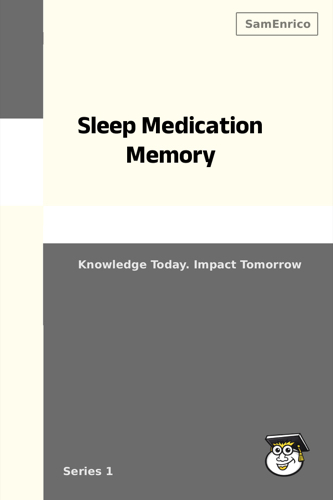
Sleep Medication Memory eBook
How prescription sleep aids affect cognitive funct
How prescription sleep aids affect cognitive function.
Formats
Free sample
Chapter 1: The Pseudo-Sleep Deception--–- The first lie arrives in a smooth, white pill. It is small enough to swallow without water, elegant in its simplicity, and stamped with a brand name that sounds like a lullaby. Ambien. Lunesta. Sonata.
Restoril. The names themselves promise peace. They do not promise what they actually deliver: a state that neurologists call pseudo-sleep, a pharmacologically induced unconsciousness that shares almost nothing with the restorative, memory-consolidating, brain-cleansing process that evolution spent three hundred million years perfecting.The modern sleep crisis is real, and it is crushing. One in three adults suffers from chronic insomnia. The CDC estimates that 13.5 million Americans fill prescriptions for sleep medications each month, and that number does not count the millions more who purchase over-the-counter antihistamines or use off-label sedatives like trazodone.
Between 2010 and 2020, prescription hypnotic use among young adults increased by nearly 300 percent. We are a society that cannot sleep, and we have reached for a chemical solution with the same desperate faith that our ancestors reached for trepanning or opium tinctures.But here is the paradox that will unspool across this book: the drugs taken to rescue memory and cognition through sleep may be actively undermining those same functions. The 2025 Lancet microsimulation study involving 15.3 million patients found that if chronic users ceased sleep medications, there would be a 2.1 percentage point drop in cognitive impairment diagnoses among that population—representing approximately 321,000 fewer cases—and over $101 billion in annual societal savings from reduced healthcare costs, lost productivity, and accidents. This chapter begins the journey by answering a single question: what is actually happening inside your brain when you take a sleeping pill versus when you fall asleep naturally?The answer will unsettle you. It should.The Architecture of Natural Sleep Before we can understand what sleep medications do wrong, we must understand what natural sleep does right.
The human brain did not evolve sleep as a single, uniform state of rest. It evolved a highly choreographed, cyclical process that alternates through distinct stages, each serving a different restorative purpose. This architecture is not a luxury. It is a biological necessity as fundamental as breathing.Natural sleep divides into two broad categories: non-rapid eye movement (NREM) sleep and rapid eye movement (REM) sleep. NREM sleep further subdivides into three stages, N1, N2, and N3, with N3 being the deepest and most restorative.
A typical night unfolds in cycles lasting approximately ninety minutes each. You descend from wakefulness into N1, a light sleep from which you can be easily roused. You then move into N2, where your heart rate slows and body temperature drops. Then comes N3, also called slow-wave sleep or deep sleep, characterized by high-amplitude, low-frequency delta waves on an electroencephalogram. After roughly twenty to forty minutes of deep sleep, you cycle back up through N2 and then into REM sleep, where your eyes dart rapidly behind closed lids, your breathing becomes irregular, and your brain exhibits activity patterns nearly indistinguishable from wakefulness.Over eight hours, you will complete four to six of these cycles.
But the composition changes. Early in the night, N3 deep sleep dominates. Late in the night, REM sleep dominates. This temporal distribution is not random. Your brain is executing a precisely timed sequence of biological processes, each dependent on the others, each occurring in a specific window.What are those processes?
The list is staggering. During deep NREM sleep, your brain consolidates declarative memories—facts, events, names, dates. The hippocampus replays the day's experiences at twenty times normal speed, transferring them to the neocortex for long-term storage. During this same window, your glymphatic system—discovered only in 2012 and detailed fully in Chapter 5—activates, pumping cerebrospinal fluid through brain tissue to clear metabolic waste, including beta-amyloid and tau proteins associated with Alzheimer's disease. During REM sleep, your brain processes emotional memories, separating the affective charge from the episodic content, essentially performing overnight therapy for the day's traumas and joys.
Your motor skills consolidate during late NREM. Your creative problem-solving capacity sharpens during REM.Natural sleep is not a single process. It is a symphony. And the conductor is an intricate network of neurotransmitters and neuromodulators that must rise and fall in precise rhythms.The Neurochemistry of Falling Asleep Naturally The journey into natural sleep begins with a molecule you have probably heard of: adenosine. Throughout the day, adenosine accumulates in your brain as a byproduct of cellular metabolism.
Adenosine binds to receptors that promote sleepiness, creating what sleep scientists call "sleep pressure." Caffeine works by blocking these same receptors, which is why your morning coffee makes you feel artificially alert.As evening approaches and light dims, your suprachiasmatic nucleus—a tiny master clock buried deep in your hypothalamus—signals your pineal gland to release melatonin. Melatonin does not cause sleep directly. It opens the gate, telling your brain that darkness has arrived and that sleep is now permissible. The gates swing open around 9 PM for most adults and close around 7 AM, a window known as the circadian sleep opportunity.The actual induction of sleep requires a second system: the GABAergic system. GABA, or gamma-aminobutyric acid, is the brain's primary inhibitory neurotransmitter.
When GABA binds to GABA-A receptors on neurons, those neurons become less likely to fire. As you prepare for sleep, GABAergic neurons in the ventrolateral preoptic nucleus—a sleep-promoting region of the hypothalamus—begin firing in earnest, sending inhibitory signals to wake-promoting regions such as the locus coeruleus (norepinephrine), raphe nuclei (serotonin), and tuberomammillary nucleus (histamine). These wake-promoting centers quiet down. Norepinephrine levels drop. Histamine levels drop.
Serotonin levels drop. Your thalamus, the brain's sensory relay station, begins to block incoming information from your eyes, ears, and skin. Consciousness fades.This process is not a switch. It is a gradual, oscillating handoff. During the transition from wakefulness to N1, you experience hypnic jerks—those sudden muscle contractions that feel like falling—as your motor cortex disengages.
Brain waves slow from alpha (relaxed wakefulness, 8-12 Hz) to theta (light sleep, 4-8 Hz). Then, as you enter N2, sleep spindles appear: brief bursts of 12-16 Hz activity that protect the brain from external stimuli. Then, finally, as you descend into N3, delta waves (0.5-4 Hz) dominate, and your brain enters its most restorative state.Everything about this process is dynamic, oscillatory, and precisely regulated. Your brain does not simply "turn off." It undergoes a complex, state-dependent reconfiguration that cycles every ninety minutes through the night.The Pharmacology of Induced Unconsciousness Now consider what happens when you take a sleeping pill. You swallow a tablet.
Thirty to sixty minutes later, depending on whether you took it on an empty stomach, the drug crosses your blood-brain barrier. Unlike the natural process, which involves a gradual, oscillating interplay between dozens of neurotransmitters and brain regions, prescription hypnotics act as blunt instruments. They do not orchestrate a symphony. They hit the entire orchestra with a tranquilizer dart.Benzodiazepines—Valium, Xanax, Klonopin, Restoril—bind to GABA-A receptors at a specific site (the benzodiazepine binding site) distinct from where GABA itself binds. This binding does not directly activate the receptor.
Instead, it increases the receptor's affinity for GABA, meaning that when GABA does bind, the receptor stays open longer, chloride ions flow into…
This is the end of the free sample. Get the eBook to keep going. Buy now
About this book
Details
- Author
- Aguiar Mallie
- Publisher
- SamEnrico
- Language
- English
- Genre
- Non-Fiction, Self-Help, Sleep Aids
- Released
- 2026-06-09
- Pages (approx.)
- 149
- Available as
- eBook, Audiobook

Read better in the ZLOADR app
Your eBooks on your phone or tablet. Sign in with your SamEnrico account and start reading.
More by Aguiar Mallie
 Benchmark Positioning WorkbookAguiar Mallie$11.99
 Music Memorization for StudentsAguiar Mallie$11.99
 Etsy Digital Planner Automation WorkflowAguiar Mallie$11.99
 HPV Vaccine Cancer PreventionAguiar Mallie$11.99
 Operation Golden Fleece: The Secret War for Afghanistan's OpiumAguiar Mallie$11.99
 Understanding Cholesterol Ester Storage DiseaseAguiar Mallie$17.99
 Global Team Internal Brand GuideAguiar Mallie$12.99
 Advisor Communication GuideAguiar Mallie$12.99
 Ultimate Handbook Guide to Palermo : (Italy) Travel GuideAguiar Mallie$11.99
 Magnetic Circular Dichroism Spectrometer TechnicianAguiar Mallie$11.99