
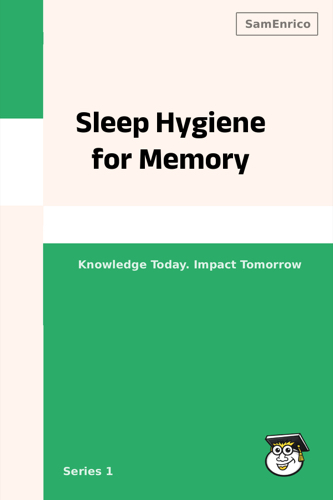
Sleep Hygiene for Memory eBook
Teaches bedtime routines and environment for optim
Teaches bedtime routines and environment for optimal consolidation.
Formats
Free sample
Chapter 1: The Midnight Librarian...–- Every night, while you sleep, a silent librarian works in your brain. This librarian does not dust shelves or stamp due dates. Instead, it performs one of the most critical functions of human existence: it decides what you will remember and what you will forget. Most people never meet this librarian, never thank it, and—tragically—never learn how to help it do its job. This chapter introduces you to that librarian, explains the three stages of memory, debunks the myth that sacrificing sleep improves learning, and lays the foundation for the Memory Hygiene Score—a tool you will build throughout this book to transform your bedroom into a memory-consolidation machine.The Metaphor That Will Change How You Sleep Imagine your brain is a vast, chaotic library.
Throughout the day, you are bombarded with information: conversations, lectures, emails, road signs, song lyrics, worries, to-do lists, facts, faces, and feelings. Each piece of information is like a new book arriving at the loading dock. But there is no system. Books pile up on carts, stack in hallways, and get shoved under desks. Some are dropped on the floor.
Others are stuffed into random corners. By bedtime, the library is in complete disarray.If you never hired a librarian, you would never find anything again. Important books would be lost. The library would become useless.That librarian works only at night, and its name is Sleep.During the day, you are the frantic patron, grabbing books off shelves, scribbling notes, and shoving new volumes anywhere they might fit. This is the phase of memory called encoding—the act of acquiring new information.
You are good at encoding. You do it constantly, often without realizing it. But encoding alone is worthless if the books are never properly shelved.At night, the librarian takes over. It collects the scattered books, decides which are worth keeping, discards the trash, and places the keepers on the correct shelves in the correct order. This is consolidation—the stabilization of memory into long-term storage.
Consolidation happens almost exclusively during sleep.Then, when you wake up, you can find what you need. That is retrieval—accessing stored information when you need it.Here is the problem that this entire book exists to solve: most people obsess over encoding (studying harder, reading more, highlighting text) and retrieval (taking tests, quizzing themselves, practicing recall). But they completely neglect consolidation. They treat sleep as a passive void—a waste of time between learning sessions. Some even pride themselves on sleeping less to study more.This is like a librarian who throws books into the dumpster so they can receive more shipments in the morning.
It is not only inefficient; it is self-destructive.The Three Stages of Memory: Encoding, Consolidation, Retrieval Before we go further, let us define these three stages precisely, because this book will refer to them constantly.Encoding is the process of taking sensory input—sights, sounds, words, feelings—and converting it into a neural representation that the brain can store. When you read a sentence, hear a lecture, or watch a demonstration, your brain is encoding. Encoding is fragile. It requires attention. If you are distracted, tired, or stressed, encoding fails.
You cannot consolidate what you never encoded in the first place. Most people understand this intuitively, which is why they drink coffee to stay alert during study sessions.Consolidation is the process of stabilizing a memory trace after initial encoding. This happens through a series of neural replays and synaptic changes that strengthen some connections and weaken others. Consolidation takes time—hours to days—and requires specific brain states. The most powerful consolidation occurs during sleep, particularly during Slow Wave Sleep (SWS) and REM sleep, which we will explore in detail later in this chapter.
Without consolidation, a memory degrades within hours. You might remember a fact long enough to repeat it once, but it will not survive until tomorrow.Retrieval is the process of accessing a stored memory. When you take a test, recall a name, or remember where you parked, you are retrieving. Retrieval is often what people mean when they say "memory." But retrieval is only possible if consolidation succeeded. You cannot retrieve what was never consolidated.Here is the crucial insight that most books miss: consolidation is the bottleneck.
Human beings are excellent encoders under the right conditions. Retrieval can be trained with practice. But consolidation is entirely dependent on sleep architecture, and most people have terrible sleep architecture. They sleep too little, too irregularly, or in environments that fragment the very stages of sleep required for memory storage.This book is not about how to study better. It is about how to sleep better so that your studying actually works.The Myth of Burning the Midnight Oil There is a cultural story we tell ourselves: the harder you work, the less you sleep.
The student who pulls an all-nighter before an exam is seen as dedicated. The executive who sleeps four hours a night is admired for their drive. The entrepreneur who answers emails at 2 AM is praised for their hustle.This story is wrong. And the scientific evidence is overwhelming.Consider a landmark study conducted by Matthew Walker and Robert Stickgold at Harvard Medical School. They taught participants a series of finger-tapping sequences—a procedural memory task similar to learning a piano scale.
One group slept normally after training. Another group was kept awake the entire night. The results were dramatic: the sleep-deprived group showed a 30-50% reduction in learning improvement the next day, even after they were allowed two full nights of recovery sleep. The memory was simply never consolidated.The damage was not temporary. Two nights of recovery sleep did not fix it.
The window for consolidation had closed.Another study looked at declarative memory—facts, dates, vocabulary. Students learned a set of paired word associations (like "ocean-breeze") at 9 PM. Half the students slept normally. The other half stayed awake all night. At 9 AM the next morning, both groups were tested.
The sleep-deprived group remembered 40% less than the slept group. But here is the kicker: when the sleep-deprived group was tested again after two full nights of recovery sleep, they were still 30% behind. The memory had never been transferred from the temporary hippocampus to the permanent cortex.The metaphor of the librarian is not just poetic. It is physiological.The hippocampus is your brain's temporary storage area—the loading dock where new books arrive. During deep sleep, the hippocampus replays the day's events at approximately 10 times normal speed, sending those signals to the neocortex, where long-term memories are stored.
This is called hippocampal-neocortical dialogue. If sleep is disrupted, truncated, or delayed, this dialogue never happens. The books stay on the loading dock. And by morning, most of them have been cleared away to make room for the next day's shipments.Burning the midnight oil, therefore, is not a trade-off between study time and sleep. It is a betrayal of the study time you already invested.
You might as well have not studied at all.The Architecture of a Memory-Boosting Night To understand how sleep consolidates memory, we must first understand the structure of a normal night.…
This is the end of the free sample. Get the eBook to keep going. Buy now
About this book
Details
- Author
- Almond Hannelore
- Publisher
- SamEnrico
- Language
- English
- Genre
- Non-Fiction, Self-Help, Hygiene
- Released
- 2026-06-07
- Pages (approx.)
- 133
- Available as
- eBook, Audiobook

Read better in the ZLOADR app
Your eBooks on your phone or tablet. Sign in with your SamEnrico account and start reading.
More by Almond Hannelore
 Indian BPO Data Security GuideAlmond Hannelore$12.99
 Opioid Recovery and Anger ManagementAlmond Hannelore$11.99
 Pol Pot KillingAlmond Hannelore$11.99
 Pattern Recognition for DesignersAlmond Hannelore$11.99
 The Dream Journal WorkbookAlmond Hannelore$11.99
 Parallel Parking Frustration GuideAlmond Hannelore$11.99
 Imposter Syndrome for EntrepreneursAlmond Hannelore$11.99
 Gridiron Warrior Mindset TrainingAlmond Hannelore$11.99
 Dopamine Agonist AugmentationAlmond Hannelore$11.99
 Whispers of the Jade Serpent: China's Forgotten Dragon CultAlmond Hannelore$11.99
 The Vanishing Hiker of the Appalachian TrailAlmond Hannelore$11.99
 Growing Pyrola (Wintergreen)Almond Hannelore$11.99
You may also like
 Hong Kong Handover 1997Dunn Johnnie$11.99
 Zumba For Postnatal Recovery CourseNeal Christian$11.99
 Zumba for BeginnersLadner Nikia$11.99
 YouTube Comment Mining GuideHumes Pandora$12.99
 Worry Box MeditationCarlin Rudy$11.99
 Workplace Stress MeditationNguyen Lynn$11.99
 Workplace Stress and Sleep RepairHawley Ivory$11.99
 Workplace Perfectionism CureDelaney Jeffry$11.99
 Workplace Injustice Anger GuideWallen Isabelle$11.99
 Work Addiction and Burnout LinkGreenwood Ester$11.99
 Women in Yoga and WellnessBeattie Galina$11.99
 Women in Stand Up ComedyChun Evangeline$11.99