
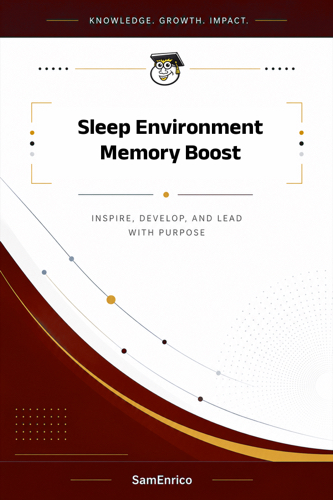
Non-FictionSelf-HelpEnvironmental Design
Sleep Environment Memory Boost eBook
Design your bedroom for optimal memory consolidati
Design your bedroom for optimal memory consolidation.
Formats
Free sample
Chapter 1: The Midnight Heist...--–- Every night, while you sleep, your brain runs a critical backup of everything you learned, experienced, and felt during the day. And every morning, you wake up having lost nearly half of it—not because your memory is broken, but because your bedroom has been stealing from you while you dreamed.This is not a metaphor. It is a biological fact.The average person forgets 40 to 60 percent of new information within twenty-four hours. Most people blame aging, stress, or a "bad memory." But the truth is far more disturbing—and far more fixable. The difference between those who remember and those who forget is not IQ, not genetics, and not effort.
It is sleep. Specifically, it is the quality of the environment in which that sleep occurs.You have been told that sleep is a passive state—a kind of biological off switch where your body rests and your brain goes blank. That is a lie. Sleep is the most active, most orchestrated, most vulnerable cognitive process you will ever experience. And your bedroom, as it is currently designed, is sabotaging it.This chapter will rewire everything you think you know about sleep and memory.
You will learn why your brain cannot "save" what you learned today unless your bedroom is dark, cool, and quiet in very specific ways. You will discover the two brain structures that act as your memory's inbox and hard drive—and why a cluttered bedroom creates "neural noise" that jams the transfer between them. And by the end of this chapter, you will understand why the rest of this book exists: because your bedroom is not a place to rest. It is a cognitive workshop. And right now, your workshop is on fire.The Great Betrayal: What You Lose Every Night Let us start with a simple experiment you can perform yourself.Take a moment to think back to yesterday.
What did you eat for lunch? What was the weather like? What was the last thing you read or watched? How many of those details can you recall with clarity?Now think back to last week. A conversation you had.
A name you learned. A task you completed. How much of that remains?If you are like most people, the answer is: not nearly enough.Here is what is actually happening. Every day, your brain is bombarded with millions of pieces of sensory information—sights, sounds, smells, textures, emotions, thoughts. Most of this information is discarded immediately.
Your brain has a strict policy: only what matters gets saved. But the problem is not with the saving. The problem is with the time of day when saving occurs.You see, your brain does not save memories while you are awake. It cannot. The neural pathways required for encoding new information are the same pathways required for processing current information.
Your brain has to choose: either pay attention to the present moment, or file away the past. It cannot do both at full capacity.So evolution solved this problem with a brilliant, counterintuitive solution: it outsourced memory consolidation to the night shift.While you sleep, your brain replays the day's events at twenty times the normal speed. It decides what to keep, what to delete, and what to connect to older memories. This process is called consolidation, and it is the single most important factor in determining whether you will remember something tomorrow, next week, or next year.But here is the betrayal: your bedroom environment controls whether that consolidation happens at all.If your bedroom is too warm, your brain cannot enter the deep sleep stage required for saving factual memories. If there is even a sliver of light, your brain's master clock delays the entire consolidation process by hours.
If there is intermittent noise—a car passing, a partner snoring, a dog barking—your brain's memory "save button" gets destroyed hundreds of times per night without you ever waking up.You are not losing memories because you are getting older or because you are stressed. You are losing memories because your bedroom is a cognitive crime scene. And the perpetrators are light, heat, and noise.The Two Brain Structures You Never Knew You Had To understand why your bedroom matters so much, you need to meet two tiny structures inside your skull. They are small, ancient, and absolutely critical to everything you will read in this book.The Hippocampus: Your Brain's Inbox The hippocampus is a seahorse-shaped cluster of neurons located deep in your temporal lobe. In memory terms, it is your brain's temporary inbox.
Throughout the day, every new experience, fact, name, and emotion gets routed to the hippocampus for temporary storage. But here is the catch: the hippocampus is small. Very small. It can only hold about one day's worth of new information before it becomes full.Think of it like a desk. During the day, you pile new papers on that desk.
By the end of the day, the desk is cluttered, overloaded, and unable to accept another single sheet of paper. You cannot learn anything new tomorrow until you clear the desk tonight.That clearing process happens during sleep. The hippocampus spends the night sorting through the day's papers, deciding what to keep and what to throw away. But it does not keep the files itself. It has a partner.The Cortex: Your Brain's Hard Drive The cortex is the wrinkled, outer layer of your brain.
It is massive—about the size of a large dinner napkin if flattened out. In memory terms, it is your long-term hard drive. Unlike the hippocampus, which is temporary and small, the cortex is permanent and vast. It can store a lifetime of knowledge, skills, and experiences.During sleep, the hippocampus transfers the day's important memories to the cortex for permanent storage. This transfer is called consolidation.
Once a memory reaches the cortex, it becomes stable, durable, and resistant to forgetting. It can be recalled years later.But here is the problem that every bedroom design in this book will address: the transfer from hippocampus to cortex is fragile. It requires specific brain states that only occur under specific environmental conditions. If your bedroom is too warm, the transfer slows or stops. If there is light, the transfer is delayed.
If there is noise, the transfer is corrupted.And if the transfer fails, those memories are lost forever. The hippocampus empties itself at the end of each night—whether the transfer succeeded or not. By morning, your inbox is cleared. But if the transfer failed, those memories did not go to the hard drive. They simply disappeared.That is why you forget.
Not because you are not trying hard enough. Because your bedroom did not allow the transfer to complete.Neural Noise: The Hidden Threat in Every Cluttered Bedroom There is another thief in your bedroom, one that most people never consider. It is not light, not temperature, not noise. It is clutter.Neuroscientists have known for decades that the brain is a pattern-matching machine. It is constantly scanning the environment for stimuli—visual, auditory, tactile, olfactory—and processing those stimuli even when you are not paying attention.
This is called the default mode network, and it runs continuously in the background of your consciousness.When your bedroom is…
This is the end of the free sample. Get the eBook to keep going. Buy now
About this book
Details
- Author
- Santiago Georgia
- Publisher
- SamEnrico
- Language
- English
- Genre
- Non-Fiction, Self-Help, Environmental Design
- Released
- 2026-06-08
- Pages (approx.)
- 148
- Available as
- eBook, Audiobook

Read better in the ZLOADR app
Your eBooks on your phone or tablet. Sign in with your SamEnrico account and start reading.
More by Santiago Georgia
 Second Generation FriendshipSantiago Georgia$11.99
 Sam Hunt Montevallo LifeSantiago Georgia$11.99
 Keto Diet Weight Loss GuideSantiago Georgia$11.99
 Working Memory in Math AbilitySantiago Georgia$11.99
 The Criticism Immunity CourseSantiago Georgia$11.99
 Live Event Streaming ChurnSantiago Georgia$11.99
 Detox For VeteransSantiago Georgia$11.99
 The Silk Road Cyclists: Love, Rivalry, and the Birth of Endurance RacingSantiago Georgia$11.99
 Frozen Echoes: The Vanishing of the Franklin ExpeditionSantiago Georgia$11.99
 Middle East Digital Sales BlueprintSantiago Georgia$12.99
 Cause and Effect Prompt LibrarySantiago Georgia$12.99
 How to Produce Signal BoostersSantiago Georgia$11.99
You may also like
 Hong Kong Handover 1997Dunn Johnnie$11.99
 Zumba For Postnatal Recovery CourseNeal Christian$11.99
 Zumba for BeginnersLadner Nikia$11.99
 YouTube Comment Mining GuideHumes Pandora$12.99
 Worry Box MeditationCarlin Rudy$11.99
 Workplace Stress MeditationNguyen Lynn$11.99
 Workplace Stress and Sleep RepairHawley Ivory$11.99
 Workplace Perfectionism CureDelaney Jeffry$11.99
 Workplace Injustice Anger GuideWallen Isabelle$11.99
 Work Addiction and Burnout LinkGreenwood Ester$11.99
 Women in Yoga and WellnessBeattie Galina$11.99
 Women in Stand Up ComedyChun Evangeline$11.99