
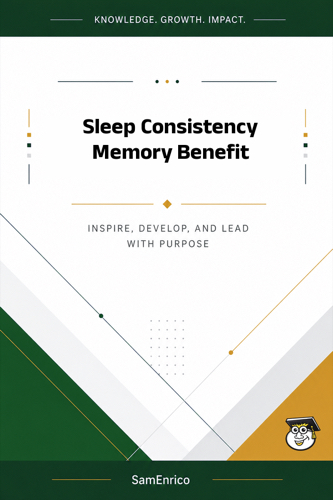
Sleep Consistency Memory Benefit eBook
Maintain regular bedtimes for better learning and
Maintain regular bedtimes for better learning and recall.
Formats
Free sample
Chapter 1: The Saturday Morning Trap--Sarah had done everything right. At least, that's what she told herself as she stared at her organic chemistry exam score: a 62. She had studied for twelve hours over the weekend. She had reviewed her flashcards until her eyes blurred. She had even gotten eight hours of sleep on Saturday night—more than most of her classmates, who were running on coffee and anxiety.
So why had she failed?The answer wasn't in the hours she slept. It was in the when.Sarah was a classic weekend warrior of sleep. Monday through Thursday, she was a law student by day and a restaurant shift manager by night. She crawled into bed at 1:30 AM, sometimes 2:00 AM, and dragged herself awake at 7:00 AM. By Friday, she was running on a deficit of approximately seven hours.
So she did what every well-meaning advice column recommends: she caught up. Friday night, she was asleep by 11:00 PM. Saturday, she slept until 9:00 AM, then took a two-hour afternoon nap. Sunday, she repeated the pattern. By Monday morning, she felt restored.
Her Fitbit congratulated her on her "recovery sleep." Her friends envied her discipline.But her hippocampus—the small, seahorse-shaped memory center buried deep in her temporal lobe—was in chaos.The Myth You've Been Sold Let me say this as clearly as possible: you cannot catch up on sleep. Not really. Not in the way that matters for memory.This claim sounds like heresy. We've all heard the metaphor that sleep is like a bank account: you make deposits, you make withdrawals, and if you overdraw, you can always make a larger deposit later. It's intuitive.
It's comforting. It's also completely wrong.The truth is far stranger and far more important. Your brain does not track total sleep hours like a bank balance. It tracks predictability. When you shift your bedtime by two hours on Friday night—even if you sleep more total hours—you create a biological event called social jetlag.Defining Social Jetlag Social jetlag is the disconnect between your body's internal clock and the sleep schedule your social life or work demands.
It's the reason you feel groggy on Monday morning even after a full eight hours on Sunday. It's the reason international travelers experience brain fog after crossing time zones. And it's the reason Sarah's organic chemistry exam ended in disaster.Here's what happened inside her brain.During the week, her suprachiasmatic nucleus—the master clock, a tiny bundle of 20,000 neurons in her hypothalamus—had calibrated itself to expect sleep around 1:30 AM. By Thursday, every cell in her body was synchronized to that schedule. Her body temperature dipped at the right time.
Her melatonin rose at the right time. Her hippocampus had even begun to predict the nightly memory transfer window, a period of approximately ninety minutes when short-term memories are filed into long-term storage.Then Friday night arrived. Instead of 1:30 AM, Sarah was asleep by 11:00 PM. Two hours and thirty minutes earlier.To her master clock, this was the equivalent of flying from New York to Los Angeles without leaving her apartment. Her brain had no idea what time it was.
Her melatonin surge, which normally began at 10:30 PM, hadn't even started when she closed her eyes at 11:00 PM. She fell asleep, yes—but she fell asleep without the proper hormonal preparation. The critical memory transfer window, normally triggered by predictable bedtime cues, never fully activated.The result? Despite sleeping longer on Friday night than any night that week, Sarah's brain consolidated only about 60 percent of what she had studied on Friday afternoon. The remaining 40 percent—including the reaction mechanisms for aldehydes and ketones—simply evaporated.The Hippocampal Factory To understand why this happens, you need to meet two characters who will appear throughout this book.
Think of them not as abstract neuroscience terms but as the night shift workers of your memory.The first is your hippocampus. I want you to imagine it as a busy factory floor manager. Throughout your waking hours, the hippocampus grabs every piece of information that seems potentially important—the face of a new colleague, a recipe you read, a passage from a textbook—and writes it down on a metaphorical sticky note. It works quickly, sloppily, and without discrimination. By the end of the day, your hippocampus is buried under thousands of sticky notes, most of which are irrelevant.The second character is your neocortex.
This is the long-term storage library, a vast archive where memories are meant to live for years or decades. But the neocortex is picky. It doesn't accept sticky notes directly. It requires those notes to be transcribed onto permanent file cards, cross-referenced with existing knowledge, and physically encoded into neural circuits.Here's the critical point: the hippocampus and neocortex only talk to each other during specific windows of sleep. And those windows are triggered by regular bedtimes.When you go to bed at the same time every night—within thirty minutes, ideally—your brain learns to predict that window.
It begins preparing ninety minutes before sleep. The hippocampus organizes its sticky notes by priority. The neocortex opens its filing cabinets. The thalamus, a relay station deep in the brain, starts generating the electrical rhythms that will carry memories from one region to the other.But when you shift your bedtime unpredictably—even by just two hours, even just on weekends—your brain cannot predict the window. The hippocampus holds onto its sticky notes, unsure when to release them.
The neocortex waits for a signal that never comes. And the memories that you studied with genuine effort simply fade away.The Data That Will Change Your Mind This is not speculation. The data on sleep consistency and memory is among the most robust in all of neuroscience.A 2018 study by Wright and colleagues at the University of Colorado Boulder followed seventy-eight college students through a semester of organic chemistry—the same course Sarah was failing. The researchers tracked sleep duration, bedtime, and wake time using wrist actigraphy, a validated method for measuring sleep patterns. They also collected every exam score.The results were startling.
Total sleep duration—the amount everyone obsesses over—had almost no correlation with exam performance. Students who averaged seven hours performed no better than those who averaged six hours, provided their bedtimes were consistent.But bedtime variability? That was a different story. For every thirty minutes of bedtime variability (the difference between the earliest bedtime and the latest bedtime in a given week), exam scores dropped by 8 percent. Students with a variability of less than thirty minutes averaged a B+.
Students with variability of more than ninety minutes averaged a D+.Let me repeat that because it's important: Sleeping less but consistently predicted better grades than sleeping more but erratically.The study controlled for everything: caffeine use, exercise, study hours, baseline GPA, even socioeconomic status. The result held. Consistency was not just a factor. It was the factor.Why Your Weekend Catch-Up Is Failing You You might be thinking: "But I feel better after a long weekend sleep. Surely that counts for something."Yes, you feel better.
No, that doesn't mean your memory is intact.The feeling of "catching up" is primarily driven by the reduction of sleep…
This is the end of the free sample. Get the eBook to keep going. Buy now
About this book
Details
- Author
- Hatchett Hans
- Publisher
- SamEnrico
- Language
- English
- Genre
- Non-Fiction, Self-Help, Sleep Routine
- Released
- 2026-06-12
- Pages (approx.)
- 122
- Available as
- eBook, Audiobook

Read better in the ZLOADR app
Your eBooks on your phone or tablet. Sign in with your SamEnrico account and start reading.
More by Hatchett Hans
 The Parenting Stress SplitHatchett Hans$11.99
 Returning To Ancestral LandHatchett Hans$11.99
 Lynn Anderson Rose GardenHatchett Hans$11.99
 Magazine Subscription Renewal TrendsHatchett Hans$11.99
 HOMA IR GuideHatchett Hans$11.99
 Student Working Memory SuccessHatchett Hans$11.99
 Detox Discharge PlanningHatchett Hans$11.99
 Operation Tūhura: New Zealand's Scientific OdysseyHatchett Hans$11.99
 The Tanker War: Oil, Missiles, and the Unseen Battle of the GulfHatchett Hans$11.99
 A Collector's Handbook to the Bugatti Type 40Hatchett Hans$11.99
 How to Produce FragranceHatchett Hans$11.99
 Philosophy Essay Prompt GuideHatchett Hans$12.99