
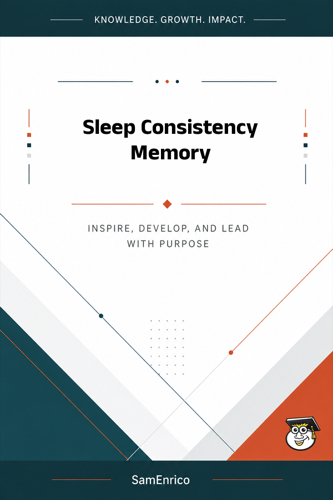
Sleep Consistency Memory eBook
Regular bedtimes improve memory more than total sl
Regular bedtimes improve memory more than total sleep hours.
Formats
Free sample
Chapter 1: The 8-Hour Illusion--–- It was 7:45 on a Monday morning, and two men sat across from each other in a memory research lab at the University of California, Berkeley. Both had slept exactly seven and a half hours the night before. Both had eaten similar breakfasts. Both were in their early thirties, healthy, non-smokers, and free of any known sleep disorders. Yet their performance on the memory test they were about to take would differ by nearly 40 percent.
One would remember a list of twenty words with near-perfect accuracy. The other would struggle to recall even half of them. The researchers running the study had seen this pattern hundreds of times before, and they already knew what the difference was before looking at the data. It wasn't genetics. It wasn't intelligence.
It wasn't caffeine or stress or the quality of their mattresses. It was the consistency of their bedtimes over the previous week.This chapter will dismantle the single most pervasive myth in all of sleep science: the belief that total hours of sleep are the primary driver of memory, cognition, and brain health. That myth has been reinforced by decades of public health messaging, countless best-selling books, and even the recommendations of major medical organizations. Sleep more, we are told. Get your eight hours.
Prioritize duration above all else. And while those recommendations are not entirely wrong, they are dangerously incomplete. The evidence now shows that two people sleeping the exact same number of hours can have vastly different memory abilities, cognitive performance, and even long-term risk of dementia. The difference lies not in how long they sleep, but in when they sleep and how consistent that timing is from night to night.The Opening Gambit: A Tale of Two Sleepers Let me introduce you to Sarah and Michael, two composite figures drawn from real participants in circadian rhythm studies conducted over the past fifteen years. Sarah is a freelance graphic designer who works from home.
Her schedule is flexible, which she considers a blessing. She typically goes to bed between 11 p.m. and midnight on weeknights, sleeps until about 7 a.m., and feels reasonably rested. On weekends, she stays up later—sometimes 1 a.m. or 2 a.m.—and sleeps in until 9 or 10 a.m.
Her total weekly sleep averages fifty-six hours, exactly eight hours per night. By every standard public health metric, Sarah is getting adequate sleep.Michael is a high school biology teacher. His schedule is rigid. He wakes at 5:30 a.m. every day, including weekends, because his body has adapted to that rhythm.
He goes to bed at 9:45 p.m., plus or minus fifteen minutes, seven days a week. Michael sleeps only six and a half hours per night—forty-five and a half hours per week, nearly eleven hours less than Sarah. By conventional wisdom, Michael is sleep-deprived and Sarah is well-rested. But when both undergo standardized memory testing, Michael consistently outperforms Sarah. He recalls details from professional development workshops more accurately.
He remembers student names after a single introduction. His working memory during his afternoon classes is sharper than Sarah's during her morning creative sessions.How can this be? The answer lies not in the quantity of their sleep but in the quality of their circadian alignment. Michael's brain knows exactly when sleep is coming and prepares for it. His suprachiasmatic nucleus—the master clock we will explore in Chapter 2—releases melatonin at the same predictable time each evening.
His sleep architecture follows a consistent, reliable pattern of ninety-minute cycles. His hippocampus replays his daily memories without interruption. Sarah's brain, by contrast, experiences what sleep scientists call circadian misalignment. Her weekend schedule shifts her internal clock by two to three hours relative to her weekdays. This is not a minor adjustment.
It is the equivalent of flying from New York to Los Angeles every Friday and back again every Monday. We call that jet lag when it happens on an airplane. When it happens in your own bedroom, we call it social jet lag, and it is silently destroying your memory.Social Jet Lag: The Hidden Epidemic The term "social jet lag" was coined by chronobiologist Till Roenneberg at Ludwig Maximilian University of Munich, who spent decades studying sleep patterns across industrialized nations. His research revealed something astonishing: the average person in the modern world experiences a one- to two-hour shift between their weekday and weekend sleep schedules. This is not a choice.
It is a consequence of social demands—work, school, family obligations—that force us to wake earlier than our internal clocks would prefer, followed by weekend catch-up sleep that further desynchronizes our rhythms.Roenneberg's data, drawn from more than sixty-five thousand participants across multiple countries, showed that social jet lag is not merely uncomfortable. It is associated with poorer cognitive performance, increased body mass index, higher rates of smoking and caffeine consumption, and even shorter life expectancy. But the most striking finding, for our purposes, involves memory. Individuals with more than one hour of social jet lag perform significantly worse on tests of declarative memory (memory for facts and events) compared to those with consistent schedules, even when total sleep time is identical. The effect is so robust that it appears across age groups, genders, and socioeconomic strata.Consider a 2019 study published in the journal Sleep that tracked 267 adults for two weeks using wrist actigraphy (devices that measure sleep-wake cycles through movement) and daily memory assessments.
The researchers found that bedtime irregularity—defined as the standard deviation of bedtime from night to night—predicted next-day memory performance more strongly than total sleep time. Participants whose bedtimes varied by more than ninety minutes from night to night had memory recall scores that were 28 percent lower than those with consistent bedtimes, even when both groups slept the same average number of hours. A 28 percent difference is not subtle. That is the difference between remembering where you parked your car and spending twenty minutes wandering a parking garage. It is the difference between recalling a client's name during a meeting and experiencing that horrible moment of blank-faced silence.Why Duration Became King and Why That Was a Mistake To understand why we have been so fixated on sleep duration, we need to look at the history of sleep science.
The modern era of sleep research began in the 1950s with the discovery of REM (rapid eye movement) sleep by Eugene Aserinsky and Nathaniel Kleitman at the University of Chicago. In the decades that followed, researchers established that different stages of sleep serve different functions. Deep slow-wave sleep (SWS) consolidates declarative memories. REM sleep consolidates emotional and procedural memories. Total sleep deprivation impairs both.
These findings were revolutionary, and they led to a simple, powerful public health message: get enough sleep.But somewhere along the way, nuance was lost. The message became "eight hours for everyone," as though human biology were as uniform as a toaster oven instruction manual. In reality, sleep needs vary significantly between individuals due to genetics, age, and a host of other factors. More importantly, the relationship between sleep and memory is not linear. A person who sleeps eight highly irregular hours will often have worse memory outcomes than a person who…
This is the end of the free sample. Get the eBook to keep going. Buy now
About this book
Details
- Author
- Pritchard Elke
- Publisher
- SamEnrico
- Language
- English
- Genre
- Non-Fiction, Self-Help, Routine
- Released
- 2026-06-07
- Pages (approx.)
- 139
- Available as
- eBook, Audiobook

Read better in the ZLOADR app
Your eBooks on your phone or tablet. Sign in with your SamEnrico account and start reading.
More by Pritchard Elke
 Video Message Best PracticesPritchard Elke$12.99
 The Forgiveness DiscussionPritchard Elke$11.99
 Hysterectomy Surgical HistoryPritchard Elke$11.99
 Blue Ocean Positioning PrimerPritchard Elke$11.99
 Digital Planner Etsy Ads StrategyPritchard Elke$11.99
 The Arctic Algorithm: Breaking Ice with Early Machine LearningPritchard Elke$11.99
 Sunrise Over the Sahara: The Desert’s Solar RevolutionPritchard Elke$11.99
 Understanding Choanal Atresia Deafness Cardiac Defects DysmorphiaPritchard Elke$17.99Video Message Best PracticesPritchard Elke$12.99
 Removing Toxic Board MembersPritchard Elke$12.99
 Lanyard ManufacturerPritchard Elke$11.99
 How to Start a Audio Tapes and Cassettes (retail) Business (Beginners Guide)Pritchard Elke$11.99
You may also like
 Shower Effect MethodCaro Ching$11.99
 The Prevention Social Rhythm GuideWhiting Catherin$11.99
 Chunking for Daily RoutineFoley Hilde$11.99
 Bedtime Routine MeditationScholl Lorine$11.99
 TM Morning RoutineTitus Odelia$11.99
 The Joy of RoutineBeckham Camelia$11.99
 Spouse Loss Routine BuildingHildreth Aron$11.99
 The Pre Game Ritual TranceMayberry Newton$11.99
 Routine for Emotional NumbnessScherer Margareta$11.99
 Daily Eisenhower Matrix PracticeMahaffey Sueann$11.99
 The Remote Worker Daily RoutineSatterfield Tarra$11.99
 Burnout Proof Morning RoutineSamples Lawrence$11.99