
Non-FictionSelf-HelpKnowledge Retention
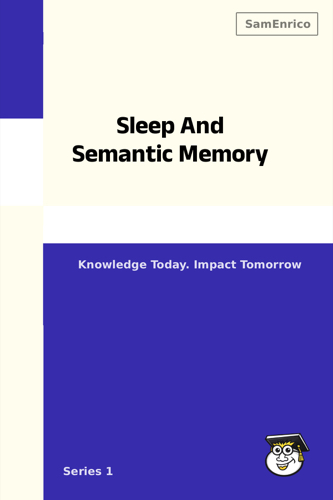
Sleep And Semantic Memory eBook
Remembers facts and knowledge.
Remembers facts and knowledge.
Formats
Free sample
Chapter 1: The Leaky Bucket--–- The fluorescent lights of the university library buzzed softly at 2:00 AM. Sarah, a second-year medical student, had been staring at the same diagram of the Krebs cycle for three hours. Her highlighter had run dry. Her coffee was cold. And when she closed her eyes, she saw carbon atoms dancing in mocking circles.
She had read the paragraph seventeen times. She knew she had read it. She could even remember the shape of the letters on the page. But when she tried to recite the sequence of chemical reactions from memory, her mind offered nothing but a blank, silent void.The next morning, sitting in the examination hall, Sarah stared at Question 12: "Describe the role of succinate dehydrogenase in the citric acid cycle and its inhibition by malonate." She had studied this exact fact for ninety minutes the night before. She had highlighted it.
She had whispered it to herself like a mantra. And yet, the information was gone—not partially faded, not fuzzy around the edges, but utterly absent, as if she had never encountered it at all.Sarah is not lazy. She is not unintelligent. And she is not alone.Every year, millions of students, professionals, and lifelong learners pour thousands of hours into memorizing facts: vocabulary words in a new language, chemical formulas, historical dates, legal precedents, medical terminology, coding syntax, financial regulations. They highlight, they reread, they cram, they sacrifice sleep, they drink stimulants, and then they sit in confusion as the information evaporates from their minds like morning dew.
The tragedy is not that they failed to study. The tragedy is that they studied in a way that guaranteed forgetting.This book exists because of a simple, uncomfortable truth: Most people do not understand how their own memory works. And because they do not understand it, they fight against their brain's natural architecture instead of working with it. They blame themselves for being forgetful when, in fact, they were never taught the rules of the game.This chapter will introduce you to those rules. You will learn why your brain treats a historical date differently than a childhood memory.
You will discover the curve that predicts exactly how quickly you will forget almost everything you learn. And you will begin to understand the single most powerful intervention that transforms fragile, temporary facts into permanent, usable knowledge—an intervention that has nothing to do with studying harder, reading faster, or buying expensive brain-training apps.That intervention is sleep. But before we can understand why sleep is the master key to semantic memory, we must first understand what semantic memory is, why forgetting is not a bug but a feature of your brain, and why the standard advice about "practice makes perfect" is dangerously incomplete.The Two Oceans of Memory Imagine for a moment that your memory is not one thing but two vast, connected oceans. They share a shoreline, they exchange water through underground currents, but they are fundamentally different in composition, depth, and purpose.The first ocean is episodic memory. This is the autobiography you carry in your head—the time-stamped, sensory-rich record of your life's events.
Your first kiss. The smell of your grandmother's kitchen. What you ate for breakfast this morning. The embarrassing moment in third grade when you called the teacher "Mom." Episodic memories are personal, emotional, and tied to a specific context of time and place. They are the stories you tell yourself about who you are.The second ocean is semantic memory.
This is your internal encyclopedia—the vast collection of decontextualized facts and knowledge that you can access without any memory of where or when you learned them. Paris is the capital of France. The mitochondria is the powerhouse of the cell. Water freezes at 32 degrees Fahrenheit. 2 + 2 = 4.
Your mother's birthday. The password to your email account. You know these things without remembering the specific moment you learned them. They have become detached from their origins and integrated into a permanent network of general knowledge.Here is the crucial distinction that most people miss: Your brain consolidates episodic and semantic memories using different mechanisms, at different speeds, and through different sleep processes. This is not a minor technical detail.
It is the difference between studying for a test and remembering the material for years. It is the difference between cramming a list of vocabulary words and actually speaking a new language. It is the difference between recognizing a face and knowing the person's name.Think about the last time you studied for an exam. You likely read your textbook, reviewed your notes, maybe made flashcards. You were trying to build semantic memory—factual knowledge.
But because you were doing it under time pressure, in a specific location (your desk), with specific emotional states (anxiety, boredom, or determination), your brain was also inadvertently encoding episodic information: I read this fact while sitting on my blue chair at 11 PM with classical music playing. That episodic tag can help or hurt your recall depending on whether you are tested in the same environment.But here is the deeper point: You cannot cram semantic memory. You can cram episodic memory. You can temporarily overload your hippocampus with recent experiences, including the experience of reading a textbook. But semantic memory—the kind that allows you to retrieve a fact without context, in any environment, under any emotional state—requires a different process.
It requires consolidation. And consolidation, as we will see throughout this book, happens primarily during sleep.The Forgetting Curve: Why Your Brain Betrays You In 1885, a German psychologist named Hermann Ebbinghaus did something both tedious and brilliant. He invented 2,300 nonsense syllables—meaningless combinations like "WID," "ZOF," and "KAP"—and proceeded to memorize lists of them. Then he tested himself at various intervals to see how quickly he forgot.What Ebbinghaus discovered became one of the most replicated findings in the history of psychology: The Forgetting Curve.The curve is brutally simple and brutally consistent. Within one hour of learning new information, you will forget approximately 50% of it.
Within 24 hours, you will forget 70%. Within one week, unless you have reviewed the material or done something to stop the bleeding, you will forget nearly 90% of what you originally learned.Let that sink in. You can spend an hour memorizing twenty vocabulary words. If you do nothing else—no review, no sleep, no reinforcement—by tomorrow morning, you will remember roughly six of them. By next week, you will remember two.
Not because you are lazy. Not because you have a "bad memory." But because your brain is designed to forget.Why would evolution build a machine that actively deletes information? The answer is that forgetting is not a failure of memory. Forgetting is a feature of an intelligent system.Your brain is bombarded with millions of sensory inputs every second—sights, sounds, smells, textures, temperatures, internal sensations. If your brain tried to remember every single detail of every single moment, it would quickly become paralyzed by noise.
You would walk into a room and be unable to find the door because your brain was still processing the pattern of dust motes in the sunlight from three days ago. Forgetting is…
This is the end of the free sample. Get the eBook to keep going. Buy now
About this book
Details
- Author
- Leclair Jaquelyn
- Publisher
- SamEnrico
- Language
- English
- Genre
- Non-Fiction, Self-Help, Knowledge Retention
- Released
- 2026-06-06
- Pages (approx.)
- 158
- Available as
- eBook, Audiobook

Read better in the ZLOADR app
Your eBooks on your phone or tablet. Sign in with your SamEnrico account and start reading.
More by Leclair Jaquelyn
 Parental Vacation Self Care GuideLeclair Jaquelyn$11.99
 Mayor of a College TownLeclair Jaquelyn$11.99
 Financial Stress for Young AdultsLeclair Jaquelyn$11.99
 Thyroid and HeartLeclair Jaquelyn$11.99
 Design Review VelocityLeclair Jaquelyn$11.99
 Microbiome Skin Health LinkLeclair Jaquelyn$11.99
 Aviation Crisis LeadershipLeclair Jaquelyn$11.99
 Boundary for Introverts GuideLeclair Jaquelyn$11.99
 The Illusionist of the Forbidden City: Wu Xingzhi and the Birth of Chinese Stage MagicLeclair Jaquelyn$11.99
 The Velvet Vault: Inside the Secret Society of the 20th CenturyLeclair Jaquelyn$11.99
 The Purple Porphyry Throne: Splendor of the Byzantine CourtLeclair Jaquelyn$11.99
 Smart Contract Incident ResponseLeclair Jaquelyn$11.99
You may also like
 Hong Kong Handover 1997Dunn Johnnie$11.99
 Zumba For Postnatal Recovery CourseNeal Christian$11.99
 Zumba for BeginnersLadner Nikia$11.99
 YouTube Comment Mining GuideHumes Pandora$12.99
 Worry Box MeditationCarlin Rudy$11.99
 Workplace Stress MeditationNguyen Lynn$11.99
 Workplace Stress and Sleep RepairHawley Ivory$11.99
 Workplace Perfectionism CureDelaney Jeffry$11.99
 Workplace Injustice Anger GuideWallen Isabelle$11.99
 Work Addiction and Burnout LinkGreenwood Ester$11.99
 Women in Yoga and WellnessBeattie Galina$11.99
 Women in Stand Up ComedyChun Evangeline$11.99