
Non-FictionSelf-HelpTrauma Recovery
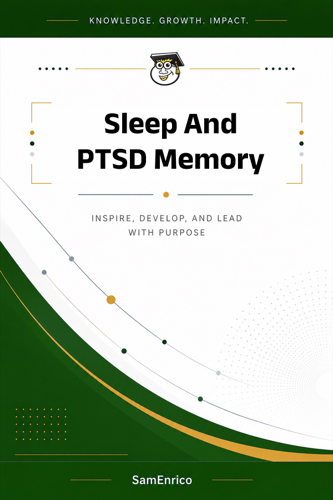
Sleep And PTSD Memory eBook
Processes trauma recall.
Processes trauma recall.
Formats
Free sample
Chapter 1: The Midnight VCR...--–- Every night, while the world sleeps, a war plays out inside the minds of millions of trauma survivors. It is not a war fought with weapons or visible wounds, but with memories that refuse to stay in the past. For someone with post-traumatic stress disorder, closing their eyes does not bring rest—it brings a reckoning. The same terrifying event replays, sometimes in exact detail, sometimes in fragmented bursts, but always with the same visceral intensity as the first time. This is not a failure of will.
It is not a lack of coping skills. It is a fundamental malfunction in how the brain timestamps and files away dangerous experiences. This chapter will explain why traumatic memories feel like they are happening right now, why talking about them before bed can make nightmares worse, and why the brain's natural ability to "extinguish" fear fails precisely when it is needed most.The Ordinary Memory: A Well-Timed Photograph To understand what goes wrong in traumatic memory, we must first understand what goes right in ordinary memory. Think about what you ate for breakfast yesterday. Unless you are reading this while still chewing your morning toast, that memory likely feels distant, slightly fuzzy around the edges, and emotionally neutral.
You can recall it if you try, but it does not jump into your awareness uninvited. More importantly, you know—with absolute certainty—that breakfast happened in the past. You were not sitting at your kitchen table five seconds ago. You are here, now, reading this book.This seemingly simple ability to distinguish past from present is the work of a small, seahorse-shaped structure deep inside your brain called the hippocampus. The hippocampus is the brain's timestamping machine.
Every time you form a new memory, the hippocampus stamps it with a neural tag that says, in effect, "This happened then, not now." It also binds together all the different elements of an experience—the sights, sounds, smells, emotions, and physical sensations—into a coherent, retrievable package.When you recall a normal memory, the hippocampus reactivates that package but simultaneously signals to the rest of your brain that the event is not currently unfolding. This is why you can remember a scary movie without hiding behind the sofa. Your hippocampus is doing its job, telling your amygdala (the brain's fear center) to stand down.The hippocampus also performs another critical function: it gradually transfers memories to the cortex for long-term storage. Over days, weeks, and months, a memory that once felt vivid and immediate becomes more abstract, more generalized, and less emotionally charged. This is called memory consolidation.
It is the reason your first day of high school feels less intense now than it did fifteen years ago. The hippocampus has done its housekeeping.Now hold that picture in your mind: the hippocampus as a calm, efficient librarian, stamping dates on every new acquisition and slowly moving files from the front desk to the archives.Now watch what happens when trauma arrives.The Traumatic Memory: A Broken Timestamp Trauma changes everything about memory formation. When a person experiences a life-threatening event—a car accident, a physical assault, combat, a natural disaster—the brain's survival circuitry takes over with brutal efficiency. The amygdala, which detects threats, screams "DANGER" at maximum volume. In response, the brain floods itself with stress hormones, most notably norepinephrine (also known as noradrenaline).
Norepinephrine is the brain's alarm bell. It sharpens focus, increases heart rate, tenses muscles, and ensures that every detail of the dangerous situation is burned into memory.This makes perfect evolutionary sense. If a saber-toothed tiger attacks you, your brain wants to remember everything: the tiger's stripes, the smell of its breath, the sound of its growl, the exact location of the attack. You need that memory to be vivid, durable, and instantly accessible. The problem is that norepinephrine, in high doses, also impairs hippocampal function.
The same stress response that makes the memory vivid also breaks the timestamping machine.The result is a memory that lacks a clear temporal marker. The hippocampus was too busy trying to survive to do its filing job properly. So the traumatic memory is encoded—stored away—without the neural equivalent of a date stamp. Years later, when that memory is triggered by a sound, a smell, or even just a moment of quiet, it does not feel like a replay of the past. It feels like it is happening right now.This is the first reason why traumatic memories play on a loop.
They are not filed in the "past" folder. They are stuck in the "present danger" folder, constantly demanding attention.But there is a second problem, and it is even more insidious.The Loop: Why "Talking It Out" Fails Imagine a videocassette recorder from the 1980s. (If you are too young to remember VCRs, think of a digital video file that is corrupted and cannot be edited.) Every night, without your permission, that VCR starts playing the same tape. The volume is stuck on maximum. You cannot fast-forward.
You cannot press stop. You can only watch, again and again, as the same terrifying scene unfolds.That is the traumatic memory loop. But here is what most people—including many well-meaning therapists—do not understand: simply replaying the memory does not weaken it. In fact, under the wrong conditions, replaying it makes it stronger.This counterintuitive reality brings us to a concept called extinction learning. Under normal circumstances, when a person repeatedly encounters a fear-provoking stimulus without any bad outcome, their brain gradually learns that the stimulus is no longer dangerous.
For example, if you were bitten by a dog as a child, you might initially fear all dogs. But if you then spend time around friendly, gentle dogs without being bitten, your brain forms a new memory: "Dogs are not inherently dangerous." This new memory does not erase the old one. Instead, it competes with it. Over time, the new safety memory becomes the default, and the old fear memory fades into the background. That is extinction learning.Extinction learning requires a specific neurochemical environment.
The brain needs moderate levels of arousal—enough to pay attention, but not so much that the amygdala hijacks the system. It also requires an active medial prefrontal cortex (m PFC), the brain's "brake pedal" that inhibits fear responses. And crucially, it requires that the fear memory be reactivated while the person is in a safe context.In PTSD, extinction learning fails at every level. The traumatic memory is so intensely encoded that even a partial reminder triggers a full-blown fear response. The person is almost never in a state of moderate arousal—they are either hyperaroused (constantly on guard) or numbed out (dissociating).
And the m PFC, as we will explore in detail in Chapter 3, is functionally suppressed, unable to put the brakes on the amygdala.So when a trauma survivor "talks it out" with a friend or therapist, especially right before bed, they are often doing the opposite of healing. They are reactivating the traumatic memory—bringing it into conscious awareness—without the neurochemical conditions required for extinction learning. The memory plays, the fear response spikes, and then the…
This is the end of the free sample. Get the eBook to keep going. Buy now
About this book
Details
- Author
- Starkey Jacqui
- Publisher
- SamEnrico
- Language
- English
- Genre
- Non-Fiction, Self-Help, Trauma Recovery
- Released
- 2026-06-06
- Pages (approx.)
- 155
- Available as
- eBook, Audiobook

Read better in the ZLOADR app
Your eBooks on your phone or tablet. Sign in with your SamEnrico account and start reading.
More by Starkey Jacqui
 Ticket Resolution TimeStarkey Jacqui$11.99
 The Money Secret Telling GuideStarkey Jacqui$11.99
 Governor's Presidential RunStarkey Jacqui$11.99
 Parent Self Care Emergency KitStarkey Jacqui$11.99
 Thyroid and SkinStarkey Jacqui$11.99
 Microbiome After ColonoscopyStarkey Jacqui$11.99
 Crisis Leadership for HospitalsStarkey Jacqui$11.99
 Boundary Reinforcement GuideStarkey Jacqui$11.99
 Blood and Steel: The Mamluks' Last Stand at Marj DabiqStarkey Jacqui$11.99
 The Opium War: Britain's Gunboat Diplomacy and the Fall of the QingStarkey Jacqui$11.99
 Frozen Shadows: The Mystery of the 1937 Arctic AirshipStarkey Jacqui$11.99
 The Mineral Guide to Hanksite, From Searles Lake.Starkey Jacqui$11.99
You may also like
 Hong Kong Handover 1997Dunn Johnnie$11.99
 Zumba For Postnatal Recovery CourseNeal Christian$11.99
 Zumba for BeginnersLadner Nikia$11.99
 YouTube Comment Mining GuideHumes Pandora$12.99
 Worry Box MeditationCarlin Rudy$11.99
 Workplace Stress MeditationNguyen Lynn$11.99
 Workplace Stress and Sleep RepairHawley Ivory$11.99
 Workplace Perfectionism CureDelaney Jeffry$11.99
 Workplace Injustice Anger GuideWallen Isabelle$11.99
 Work Addiction and Burnout LinkGreenwood Ester$11.99
 Women in Yoga and WellnessBeattie Galina$11.99
 Women in Stand Up ComedyChun Evangeline$11.99