
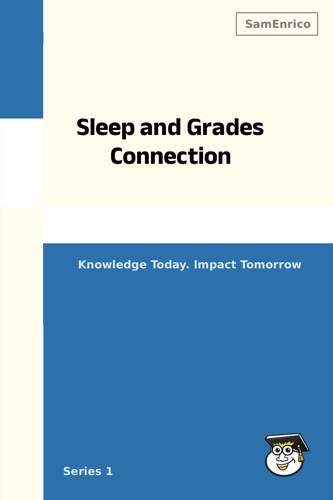
Non-FictionSelf-HelpSleep Hygiene
Sleep and Grades Connection eBook
Improve academic performance by prioritizing rest
Improve academic performance by prioritizing rest over cramming.
Formats
Free sample
Chapter 1: The Midnight Bargain...--–- The glow of a phone screen at 3:47 AM is a peculiar shade of blue—cold, artificial, and desperate. It illuminates a face that has been staring at the same paragraph for forty-five minutes without comprehending a single word. Around that face, on a dorm room desk, sit three empty energy drink cans, a cold cup of coffee from nine hours ago, and a stack of highlighters that have been used so aggressively that entire pages have turned neon yellow. This is the ritual of the all-nighter, repeated millions of times every semester across every college campus, from freshmen orientation to graduate school libraries. And it is, by nearly every measure of cognitive science, a complete and total lie.The lie is seductive because it feels like sacrifice.
The student tells themselves: I am giving up sleep for my grades. I am choosing success over comfort. I am working harder than everyone else. But the data tells a different story. The student at 3:47 AM is not working harder.
They are working against their own biology. They are pouring water into a bucket with no bottom. They have entered what sleep scientists call the twilight zone of diminishing returns, where every additional minute of study actively destroys the retention of the previous minutes.This chapter is not about why sleep is "good for you." You have heard that before. This chapter is about the specific, measurable, brutal neuroscience of why a tired brain cannot learn—and why the most successful students are not the ones who stay up latest, but the ones who understand the midnight bargain for what it really is: a trade of long-term mastery for short-term exhaustion, disguised as virtue.The Glymphatic System: Your Brain’s Overnight Janitor For decades, neuroscientists believed that the brain’s waste management system was a mystery. They knew that every other organ in the body uses the lymphatic system to flush out metabolic debris—dead cells, proteins, toxins—but the brain, protected by the blood-brain barrier, seemed to operate on a different set of rules.
Then, in 2012, a team at the University of Rochester made a discovery that changed everything. They identified the glymphatic system (a portmanteau of "glial" and "lymphatic"), a network of microscopic channels that opens only during deep sleep, flooding the brain with cerebrospinal fluid to wash away toxic waste products that accumulate during waking hours.Here is what that means for a student pulling an all-nighter. Every moment you are awake, your brain’s neurons are firing, metabolizing glucose, and producing waste. The most dangerous of these waste products is beta-amyloid, a protein that forms sticky plaques. In small amounts, beta-amyloid is harmless.
In larger amounts, it slows neural transmission, impairs memory formation, and—over years—contributes to neurodegenerative diseases. But even over a single night, beta-amyloid buildup has measurable effects. A study published in Science in 2018 found that one night of sleep deprivation increases beta-amyloid levels in the brain by 5–10%, an effect that takes two full nights of recovery sleep to reverse.Imagine your brain as a high-performance processor. During the day, it generates heat and metabolic byproducts. At night, the cooling system kicks in.
If you disable the cooling system and keep the processor running, it overheats. It slows down. It starts making errors. This is not a metaphor. Functional MRI scans of sleep-deprived brains show reduced activity in the temporal lobe (responsible for memory encoding) and prefrontal cortex (responsible for decision-making and impulse control), while the amygdala (fear and stress response) becomes hyperactive.
The tired brain is literally a different organ than the rested brain—less efficient, more anxious, and profoundly worse at learning.The practical implication for students is unavoidable. Every hour of sleep lost is an hour of waste accumulation that degrades the next day’s cognitive performance. A student who sleeps six hours instead of eight has not "gained" two hours of study time. They have borrowed two hours from tomorrow’s mental capacity, at an interest rate that compounds. The material they study during those two extra hours will be poorly encoded, quickly forgotten, and emotionally draining to review.
The midnight bargain is not a trade of sleep for productivity. It is a trade of quality for quantity, mastery for minutes, retention for repetition.Emotional Hijacking: Why Tired Students Panic on Tests There is a specific kind of terror that only tired students know. It happens in the first sixty seconds of an exam. The question is one they studied. They know they studied it.
They can even remember the page of the textbook, the color of the highlighter, the exact wording of the professor’s lecture. But the answer is gone. Not fuzzy—gone. The mental space where that information should live is a blank wall. And then the panic begins.This is not a failure of memory.
It is a failure of emotional regulation caused by sleep deprivation. The mechanism is well understood by neuroscientists, and it comes down to the relationship between three brain regions: the prefrontal cortex (PFC), the amygdala, and the hippocampus.The hippocampus is the brain’s memory index. It does not store memories permanently—that happens in the cortex—but it tags each new piece of information with a time, place, and emotional context. When you need to retrieve a memory, your hippocampus sends a search query to the relevant cortical regions. Under normal conditions, this process takes milliseconds.The amygdala is the brain’s alarm system.
When it detects a threat—real or perceived—it floods the body with cortisol and adrenaline, preparing for fight or flight. This is useful if you are being chased by a predator. It is catastrophic if you are taking a multiple-choice exam.The prefrontal cortex is the brain’s CEO. It regulates the amygdala, telling it when a threat is real and when it is not. "Yes, this exam is stressful, but no, it is not a life-or-death emergency.
Stand down."Here is the problem. Sleep deprivation selectively impairs the prefrontal cortex while hyperactivating the amygdala. A study from the University of California, Berkeley, published in Current Biology (2007) put sleep-deprived participants into an f MRI scanner and showed them increasingly negative images. The results were striking. In rested participants, the prefrontal cortex and amygdala worked together—the PFC dampened the amygdala’s response.
In sleep-deprived participants, the amygdala lit up like a fire alarm, and the PFC showed almost no activity. The tired brain could not tell the difference between a difficult exam question and a genuine threat.This is why tired students draw blanks. The stress of the exam activates the amygdala. The amygdala, unregulated by a fatigued PFC, releases cortisol. Cortisol suppresses hippocampal function.
The hippocampus, flooded with stress hormones, cannot retrieve the memory. The student stares at the blank page, feels the panic rise, and concludes that they do not know the material. But they do know it. The memory is there. The retrieval system has been hijacked.The midnight bargain makes this outcome more likely, not less.
A student who sacrifices sleep to study is simultaneously reducing their PFC function, increasing their amygdala reactivity, and suppressing their hippocampus—the…
This is the end of the free sample. Get the eBook to keep going. Buy now
About this book
Details
- Author
- Acosta Winnifred
- Publisher
- SamEnrico
- Language
- English
- Genre
- Non-Fiction, Self-Help, Sleep Hygiene
- Released
- 2026-06-09
- Pages (approx.)
- 150
- Available as
- eBook, Audiobook

Read better in the ZLOADR app
Your eBooks on your phone or tablet. Sign in with your SamEnrico account and start reading.
More by Acosta Winnifred
 Sports Betting Addiction CureAcosta Winnifred$11.99
 Resentment Toward BulliesAcosta Winnifred$11.99
 Relapse Prevention Sleep Hygiene CourseAcosta Winnifred$11.99
 Exercise for Depression GuideAcosta Winnifred$11.99
 Study Burnout Prevention GuideAcosta Winnifred$11.99
 Engine Failure LandingsAcosta Winnifred$11.99
 Resettled After Calais JungleAcosta Winnifred$11.99
 P-51 Mustang Range and Drop TanksAcosta Winnifred$11.99
 The Tongues of the Nile: The Polyglot Scholars of Ancient KemetAcosta Winnifred$11.99
 The Celestial Silk Road: Medieval Astronauts of AngkorAcosta Winnifred$11.99
 Neutrino: The Ghost Particle's Cosmic ChaseAcosta Winnifred$11.99
 How to Start a Polish Business (Beginners Guide)Acosta Winnifred$11.99
You may also like
 Hong Kong Handover 1997Dunn Johnnie$11.99
 Zumba For Postnatal Recovery CourseNeal Christian$11.99
 Zumba for BeginnersLadner Nikia$11.99
 YouTube Comment Mining GuideHumes Pandora$12.99
 Worry Box MeditationCarlin Rudy$11.99
 Workplace Stress MeditationNguyen Lynn$11.99
 Workplace Stress and Sleep RepairHawley Ivory$11.99
 Workplace Perfectionism CureDelaney Jeffry$11.99
 Workplace Injustice Anger GuideWallen Isabelle$11.99
 Work Addiction and Burnout LinkGreenwood Ester$11.99
 Women in Yoga and WellnessBeattie Galina$11.99
 Women in Stand Up ComedyChun Evangeline$11.99