
Non-FictionSelf-HelpSubliminal
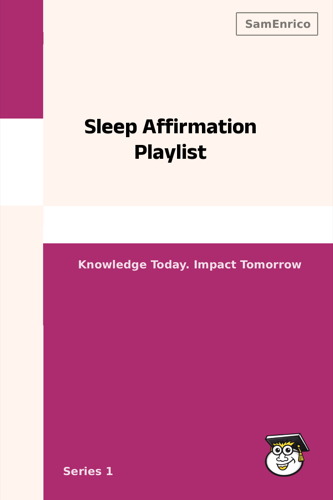
Sleep Affirmation Playlist eBook
Use overnight audio tracks for subconscious belief
Use overnight audio tracks for subconscious belief change.
Formats
Free sample
Chapter 1: The Midnight Listener--–- Close your eyes for a moment and imagine this. You are lying in bed. The lights are off. The house is quiet. Your body is heavy against the mattress, sinking slowly into the blankets.
Your breathing has slowed without you noticing. Your thoughts, which raced an hour ago, have begun to fragment—one moment you are thinking about tomorrow, the next moment you see a flash of a dream that hasn't arrived yet, the next moment nothing at all. You are floating somewhere between awake and asleep, aware but not alert, present but not focused. And in that strange, liminal space, a voice speaks to you. It is soft, barely above a whisper.
It says something simple, something you have heard before but never really believed. I am safe. I am enough. I am changing now. And because you are neither fully awake nor fully asleep, because your usual mental defenses have dropped away, those words slip past every barrier and sink directly into the deepest parts of your mind.
By morning, you do not remember hearing them. But something is different. The familiar knot of anxiety in your chest is looser. The old voice that usually says you can't is quieter. Without knowing why, without any effort at all, you have changed.This is not a fantasy.
This is not wishful thinking dressed up in scientific language. This is the central promise of the Sleep Affirmation method, and it rests on a single, provable fact about the human brain: during the transition from wakefulness to sleep, your mind becomes radically more receptive to suggestion than at any other time of the day or night. Not a little more receptive. Orders of magnitude more receptive. The difference between daytime effort and nighttime listening is the difference between trying to push a river upstream with your bare hands and simply floating with the current.Most people will go their entire lives without knowing that this window exists.
They will struggle and strain and repeat affirmations into the bathroom mirror every morning, wondering why nothing ever sticks. They will blame themselves for being broken, for lacking willpower, for somehow being incapable of the change that seems to come so easily to others. None of that is true. The only thing missing is timing.This chapter is about that timing. It is about the architecture of the sleeping mind, the biological gatekeeper that blocks your efforts during the day, and the astonishing moment each night when that gatekeeper takes a break.
Everything else in this book—the frequencies, the scripts, the playlists, the seven-stage ritual—builds on this foundation. If you miss this, nothing else will work. If you grasp this, you will never struggle to change again.The Hidden Threshold You Cross Every Night Every single night of your life, you cross a threshold that you have probably never noticed. It is not marked by a chime or a flash of light. There is no audible click, no visible sign.
But the threshold is real, and it is one of the most remarkable biological events you will ever experience.That threshold is the boundary between waking consciousness and sleep. Neuroscientists call the approach to that boundary the hypnagogic state, from the Greek words hypnos (sleep) and agogos (leading). It is the period of transition, typically lasting between five and twenty minutes, during which your brain shifts from one mode of operation to another.To understand why this transition matters for personal change, you need to understand something about how your brain produces different states of consciousness. Your brain is an electrical organ. The billions of neurons inside your skull communicate with each other through tiny bursts of electricity, and when you measure that electrical activity with an electroencephalogram, or EEG, you see patterns that change depending on what you are doing and how awake you are.When you are fully awake and actively thinking—reading, working, having a conversation, trying to solve a problem—your brain produces fast, irregular waves called Beta waves.
They cycle at roughly twelve to thirty times per second, or twelve to thirty hertz. Beta is the frequency of effort, of analysis, of the conscious mind doing its job. It is excellent for calculating a tip or remembering where you left your keys. It is terrible for changing deep beliefs.When you close your eyes and relax, your brain slows down to Alpha waves, roughly eight to twelve hertz. This is the calm, meditative state of a person sitting quietly by a window, not thinking about anything in particular.
Alpha is pleasant and restorative, but you are still awake. Your Critical Factor—the psychological gatekeeper we will discuss in a moment—is still on duty.Then, as you drift toward sleep, your brain slows further to Theta waves, roughly four to eight hertz. This is the hypnagogic state. It is dreamlike, floating, deeply relaxed. Your conscious mind is still present—you can still hear sounds, still have thoughts, still notice when your partner shifts in bed—but your usual mental defenses have lowered.
Theta is the frequency of deep meditation, of hypnotic trance, of the moments just before sleep when strange images float across your mind and you are not quite sure if you are awake or dreaming.Finally, when you cross fully into sleep, your brain enters Delta waves, roughly 0.5 to four hertz. This is deep, dreamless sleep. Your conscious mind is offline. Your body is repairing itself. And while your brain is still processing auditory information at this stage—a fact that will become extremely important in later chapters—it is not the ideal time for complex verbal suggestions.The hypnagogic window, that brief period of Theta-dominant transition, is the sweet spot.
It is the moment when your brain is slow enough to be receptive but awake enough to process language. It is the moment when the drawbridge lowers and the gatekeeper looks away.The Gatekeeper You Never Knew You Had There is a reason that positive thinking often feels like an exercise in futility. There is a reason you can repeat an affirmation five hundred times and still feel exactly the same. There is a reason that every New Year's resolution crumbles by February, not because you lack discipline, but because something deeper is blocking you.That something is called the Critical Factor. It is a filter in your brain, located primarily in the prefrontal cortex and associated neural networks, whose job is to compare incoming information against your existing model of reality.
Every second of every waking minute, your Critical Factor is scanning, evaluating, and rejecting or accepting. Its decision rule is brutally simple: does this new information fit with what I already believe to be true? If yes, it is allowed to pass into deeper memory and belief structures. If no, it is blocked, often before you even consciously notice it.Here is why this is devastating for personal change. When you try to install a new belief during the day—I am confident, for example—your Critical Factor immediately searches your entire lifetime of experience for evidence.
If you have decades of memories of feeling anxious, of avoiding eye contact, of your face flushing in social situations…
This is the end of the free sample. Get the eBook to keep going. Buy now
About this book
Details
- Author
- Brownlee Teresia
- Publisher
- SamEnrico
- Language
- English
- Genre
- Non-Fiction, Self-Help, Subliminal
- Released
- 2026-06-10
- Pages (approx.)
- 118
- Available as
- eBook, Audiobook

Read better in the ZLOADR app
Your eBooks on your phone or tablet. Sign in with your SamEnrico account and start reading.
More by Brownlee Teresia
 Gratitude Daily ReviewBrownlee Teresia$11.99
 Net Thirty Vendor Setup GuideBrownlee Teresia$11.99
 Detox to Rehab TransitionBrownlee Teresia$11.99
 The Emotional Regulation for GuiltBrownlee Teresia$11.99
 Humorous Presentation SkillsBrownlee Teresia$11.99
 Sacagawea Expedition GuideBrownlee Teresia$11.99
 Habit Formation for NursesBrownlee Teresia$11.99
 The Last Voyage of the Mary Celeste: Ghosts of the AtlanticBrownlee Teresia$11.99
 The Devil's Tunnels: The Great Escape of the Château d'IfBrownlee Teresia$11.99
 How to Produce LaTeX Ceiling Interior PaintBrownlee Teresia$11.99
 Service Providers Guide to Transplant SurgeryBrownlee Teresia$11.99
 How to Start a Pig Raising and Breeding Business (Beginners Guide)Brownlee Teresia$11.99
You may also like
 Hong Kong Handover 1997Dunn Johnnie$11.99
 Zumba For Postnatal Recovery CourseNeal Christian$11.99
 Zumba for BeginnersLadner Nikia$11.99
 YouTube Comment Mining GuideHumes Pandora$12.99
 Worry Box MeditationCarlin Rudy$11.99
 Workplace Stress MeditationNguyen Lynn$11.99
 Workplace Stress and Sleep RepairHawley Ivory$11.99
 Workplace Perfectionism CureDelaney Jeffry$11.99
 Workplace Injustice Anger GuideWallen Isabelle$11.99
 Work Addiction and Burnout LinkGreenwood Ester$11.99
 Women in Yoga and WellnessBeattie Galina$11.99
 Women in Stand Up ComedyChun Evangeline$11.99