
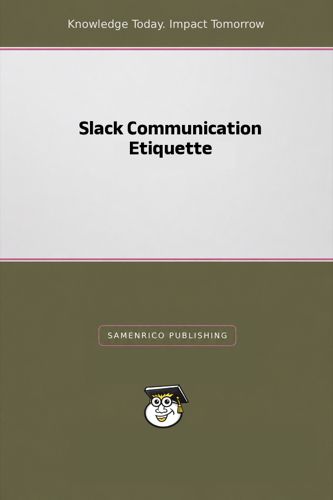
Slack Communication Etiquette eBook
Channels, threads, and status management.
by Marks Gavin
Channels, threads, and status management.
Formats
Free sample
Chapter 1: The Twenty-Three-Minute Theft–- It begins not with a bang, but with a ping.You are sitting at your desk, coffee in hand, finally settled into the morning. The document before you is important—a quarterly strategy, a design spec, a line of code that has been resisting your best efforts for two days. You take a breath. You begin to sink into the work. The world recedes.
This is the state every knowledge worker craves: flow.Then it happens. A notification slides into the corner of your screen. Slack. #general. @here.
Someone has a quick question about the printer. It is not urgent. It is not about you. But the ping arrives nonetheless, and your brain, trained over years of digital conditioning, performs an involuntary act. Your eyes flick to the notification.
Your train of thought derails. The document blurs. The question—does anyone know where the IT team keeps the extra toner?—hangs in the air like a smoke alarm triggered by burnt toast.You ignore it. Good for you. You return your gaze to the document.
But something has changed. The flow is gone. The words on the screen now look foreign. You read the same sentence three times. Your mind, it turns out, is not a light switch.
You cannot simply flip it back to "on." According to research cited by computer scientist Gloria Mark, it takes an average of twenty-three minutes to fully refocus after a single interruption.Twenty-three minutes. For one ping about printer toner.Now multiply that by the number of Slack notifications the average knowledge worker receives in a day. Estimates vary, but studies suggest between fifty and one hundred interruptions per day across email, chat, and other tools. If you are on a particularly active Slack workspace, that number can be higher. Do the math.
Fifty interruptions times twenty-three minutes equals over nineteen hours of context-switching recovery time per day. That is mathematically impossible, of course, which tells us something terrifying: most of us are not recovering at all. We are simply living in a state of perpetual distraction, our deep work sacrificed on the altar of "real-time collaboration."This chapter is about why that happens, why it is not your fault, and—most importantly—how to stop it. Welcome to the asynchronous mindset.The Physics of Focus Before we can fix the problem, we have to understand it. The human brain is not a microprocessor.
It does not handle multiple threads of consciousness with equal efficiency. When you focus on a complex task—writing, coding, analyzing, creating—your brain assembles a temporary neural network dedicated to that specific problem. Relevant memories are activated. Irrelevant ones are suppressed. Patterns are recognized.
This assembly process takes time, typically ten to fifteen minutes of sustained attention.Once assembled, the network operates with remarkable efficiency. This is flow. This is where your best work happens.Then an interruption occurs. Your brain, hardwired to pay attention to novel stimuli (a survival mechanism from when novel stimuli meant predators), performs an attentional switch. The neural network you assembled for the document begins to dissolve.
A new network assembles to evaluate the interruption—is this a threat? is this important? do I need to respond?—and then, usually, another network to respond to the message.When you return to the original task, your brain does not simply pick up where it left off. It must reassemble the original network. Relevant memories must be reactivated.
Irrelevant ones must be suppressed again. This reassembly is what researchers call the "resumption lag." Gloria Mark's research at the University of California, Irvine, found that this lag averages twenty-three minutes and fifteen seconds for complex knowledge work.Let me repeat that, because it is the single most important number in this book: twenty-three minutes.Every Slack notification that pulls you away from deep work costs you, on average, twenty-three minutes of productivity. Not the ten seconds you spend glancing at the message. Not the two minutes you spend typing a reply. Twenty-three minutes of lost focus.This is the hidden math of Slack.
The tool presents itself as a time-saver—why send an email when you can just ping someone?—but its true cost is invisible. You do not see the twenty-three minutes. You only see the ten seconds. And so you tell yourself, "It's fine. I can handle it." But you cannot.
No one can. The physics of the human brain do not care about your willpower.Slack Is the New Office Hallway To understand why Slack is so uniquely disruptive, consider its predecessor: the physical office.Imagine a traditional workspace. You are at your desk, working on that same document. A colleague wants to ask you a question. In the physical world, that colleague must perform a series of actions.
They must stand up. They must walk across the room. They must observe whether you are wearing headphones, whether you are staring intently at your screen, whether you are on the phone. They must decide whether the interruption is worth the social friction of approaching you.If they do approach, the interruption is bounded. They are standing there.
You have eye contact. The conversation happens, and then they walk away. The interruption ends.Slack removes all of this friction. Your colleague does not have to stand up. They do not have to observe your state.
They do not have to weigh social cost. They simply type a message and hit enter. The notification appears on your screen instantly, regardless of whether you are in deep work, regardless of whether you are on a deadline, regardless of whether you have explicitly set your status to "Do Not Disturb."The result is an environment where interruptions are constant, effortless, and decontextualized. Your colleague cannot see that you are in the middle of a complex spreadsheet. They cannot hear the frustration in your voice.
They just ping, and the ping arrives with the same weight as every other ping.I call this phenomenon "the new office hallway." In a physical office, the hallway is where interruptions happen, but they happen at a manageable frequency because walking takes effort. In Slack, the hallway is infinite and everywhere. Every channel is a potential interruption. Every DM is someone tapping your shoulder. And unlike the physical world, Slack does not close at 5 PM.
It follows you home, into your pocket, into your bedroom.This is not collaboration. This is chaos dressed up as teamwork.The Golden Rule of Slack Communication If the problem is constant interruption, the solution is not to abandon Slack. That is unrealistic for most teams. Slack is deeply integrated into modern work, and when used correctly, it can be genuinely useful. The solution is to shift from a synchronous culture to an asynchronous culture with controlled synchronous exceptions.What does that mean?A synchronous culture says: "I need an answer now.
If I send a message, I expect a reply within minutes." This is the default mode for most Slack workspaces, and it is toxic. It assumes that everyone is constantly available, that nothing anyone is doing is more important than answering your message, and that the cost of interruption is…
This is the end of the free sample. Get the eBook to keep going. Buy now
About this book
Details
- Author
- Marks Gavin
- Publisher
- SamEnrico
- Language
- English
- Genre
- Non-Fiction, Self-Help, Slack
- Released
- 2026-06-05
- Pages (approx.)
- 122
- Available as
- eBook, Audiobook

Read better in the ZLOADR app
Your eBooks on your phone or tablet. Sign in with your SamEnrico account and start reading.
More by Marks Gavin
 Dental Triage Mass CasualtyMarks Gavin$11.99
 Collaborative Visualization GuideMarks Gavin$11.99
 Self Hypnosis for TMJ PainMarks Gavin$11.99
 Flow in ParentingMarks Gavin$11.99
 Student VPN DubaiMarks Gavin$11.99
 The Senior Antidepressant GuideMarks Gavin$11.99
 Acupuncture for PCOSMarks Gavin$11.99
 The Purple Parchment Conspiracy: Secrets of the Byzantine CodexMarks Gavin$11.99
 Blood, Sweat, and Octagons: The Birth of the UFC in the UKMarks Gavin$11.99
 How to Produce Pilates MachinesMarks Gavin$11.99
 US Business Credit Number AcquisitionMarks Gavin$12.99
 Solo Marketer Priority MapMarks Gavin$12.99
You may also like
 Hong Kong Handover 1997Dunn Johnnie$11.99
 Zumba For Postnatal Recovery CourseNeal Christian$11.99
 Zumba for BeginnersLadner Nikia$11.99
 YouTube Comment Mining GuideHumes Pandora$12.99
 Worry Box MeditationCarlin Rudy$11.99
 Workplace Stress MeditationNguyen Lynn$11.99
 Workplace Stress and Sleep RepairHawley Ivory$11.99
 Workplace Perfectionism CureDelaney Jeffry$11.99
 Workplace Injustice Anger GuideWallen Isabelle$11.99
 Work Addiction and Burnout LinkGreenwood Ester$11.99
 Women in Yoga and WellnessBeattie Galina$11.99
 Women in Stand Up ComedyChun Evangeline$11.99