
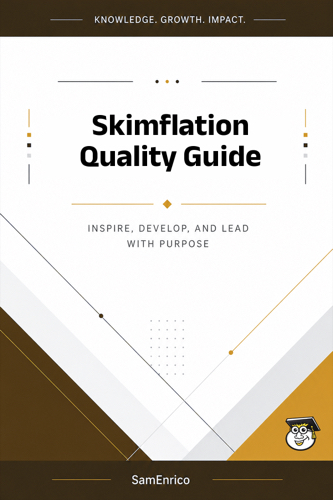
Non-FictionBusiness BriefSkimflation
Skimflation Quality Guide eBook
Use cheaper ingredients while keeping price same.
by Julian Siu
Use cheaper ingredients while keeping price same.
Formats
Free sample
Chapter 1: The $2.99 Illusion--–- You open the jar the same way you have for seven years. Twist the lid counterclockwise, peel away the safety seal, insert a clean knife. But this time, something is wrong. The peanut butter doesn't resist. It doesn't cling to the blade in that thick, stubborn way you remember.
Instead, it slides off. It's runny. Oily. You stir it anyway, thinking maybe it separated. But even after stirring, the texture remains thin.
You spread it on bread, take a bite, and pause. Where is the richness? The nutty depth? You check the expiration date. It's fine.
You check your memory. Did you buy a different brand? No. Same shelf, same label, same price. And yet, it is not the same product.You are not imagining things.
And you are not alone.This is the opening scene of a quiet heist happening right now in your pantry, your refrigerator, your freezer, and even in the hotel room you booked for vacation. The criminals are not masked burglars breaking through windows. They are Fortune 500 food companies, hotel chains, and airlines. The weapon is not a gun but a supply chain spreadsheet. And the victim is not your wallet—at least, not directly.
The victim is your trust, your taste buds, and, as you will learn in later chapters, your long-term health. The crime has a name, though you have probably never heard it. It is called skimflation.Most people have heard of shrinkflation. That is the trick where your bag of chips gets smaller but the price stays the same. You notice that.
The bag feels lighter. The box looks narrower on the shelf. Shrinkflation is visible, and because it is visible, it generates headlines, outrage, and occasionally class-action lawsuits. But skimflation is different. Skimflation is invisible by design.
Instead of giving you less product, manufacturers give you the same amount of a lesser product. They replace expensive ingredients with cheaper ones. They swap real cream for milk solids, cocoa butter for palm oil, and extra virgin olive oil for refined blends. The jar looks the same. The label looks the same.
The price is the same. Only the contents have changed.And that is precisely why skimflation is more dangerous than shrinkflation. Shrinkflation insults your eyes. Skimflation insults your intelligence—and assumes you will never notice.The Three Faces of Inflation To understand skimflation, you must first understand the three ways that companies protect their profit margins when the cost of raw materials rises. Economists call these "hidden inflation tactics." I call them the three faces of the same greedy mask.Face One: Standard Inflation.
This is the honest version. The price goes up. You see it. You grumble. You either pay it or switch brands.
Standard inflation is transparent, which is why companies hate it. Consumers notice price increases immediately, and they remember them.Face Two: Shrinkflation. The price stays the same, but the package gets smaller. Your favorite ice cream carton drops from 16 ounces to 14 ounces. Your cereal box loses two inches of height.
Shrinkflation is harder to notice than a price hike because most people do not memorize package weights. But once you know to look, you can see it. The indented bottom of the jar. The "family size" that is actually smaller than the old regular size.Face Three: Skimflation. The price stays the same.
The package size stays the same. But the ingredients get cheaper. This is the master stroke of corporate cost-cutting because it is almost impossible to detect without forensic effort. You would need to have saved a label from three years ago, side by side with today's label, to see that "cream" became "milk solids" or that "sunflower oil" became "vegetable oil (palm, rapeseed)." Most people do not save labels. Most people do not have the time or the inclination to become amateur food scientists.
And the companies know this.A 2023 study by the Consumer Brands Association found that 73 percent of consumers could not identify a single ingredient change in their pantry staples from the previous year, even when those changes were significant. The same study found that less than 8 percent of shoppers regularly compare ingredient lists across different purchase dates. In other words, the vast majority of us are flying blind.The Tic Tac Wake-Up Call The first time I personally became aware of skimflation was not through peanut butter or mayonnaise. It was through a tiny, minty, plastic box that had sat on my desk for years. Tic Tacs.In 2022, a sharp-eyed Reddit user posted a side-by-side photo of two Tic Tac boxes.
One was from 2019. The other was from 2022. Both were the standard 1-ounce size. Both had the same price at the same drugstore chain. But the 2022 box contained significantly fewer Tic Tacs.
Wait, you say. That sounds like shrinkflation, not skimflation. And you would be right about the size. But here is where the story gets interesting. When consumers complained about the missing mints, the company did not apologize or reverse course.
Instead, they quietly changed the recipe to make each remaining mint taste stronger, so that consumers would use fewer mints per breath-freshening event. They reduced the amount of sugar and added a more concentrated mint oil. The result? You still got the same breath-freshening outcome from fewer mints. The company saved money on packaging, shipping, and ingredients.
And most consumers never noticed the double whammy: shrinkflation and skimflation in the same product.The Tic Tac controversy became a case study in how companies think about consumer perception. An internal email, later leaked during a separate litigation, reportedly said: "Consumers anchor to the price. They do not anchor to the ingredient list. Change the price, and they revolt. Change the recipe, and they adapt." That single sentence is the corporate playbook for skimflation.Why Companies Fear Price Hikes More Than Recipe Changes To understand why skimflation has become the preferred tactic of the modern food industry, you need to understand the psychology of pricing anchors.A price anchor is a mental shortcut.
Once you have paid $2.99 for a jar of peanut butter a dozen times, that price becomes the "correct" price in your mind. When you see it again, you do not re-evaluate the product's value. You just register the price as acceptable. This is why companies spend millions of dollars establishing price anchors through advertising and shelf placement. The anchor is a moat around their market share.If a company raises the price to $3.49, you notice immediately.
The anchor is broken. You might still buy it, but you will feel a twinge of resentment. That resentment makes you more likely to try a competitor's brand. Over time, even a small price increase can erode loyalty.But if the company keeps the price at $2.99 and changes the recipe, you probably will not notice. And if you do notice a change in taste or texture, you are more likely to blame yourself than the company.
"Maybe I bought the wrong kind." "Maybe it's a bad batch." "Maybe my taste buds have changed." Companies count on this self-doubt. They have studied it. They have focus-grouped it. They have optimized their supply chains around it.A 2021 paper…
This is the end of the free sample. Get the eBook to keep going. Buy now
About this book
Details
- Author
- Julian Siu
- Publisher
- SamEnrico
- Language
- English
- Genre
- Non-Fiction, Business Brief, Skimflation
- Released
- 2026-06-07
- Pages (approx.)
- 133
- Available as
- eBook, Audiobook

Read better in the ZLOADR app
Your eBooks on your phone or tablet. Sign in with your SamEnrico account and start reading.
More by Julian Siu
 The Cemetery RestorerJulian Siu$11.99
 Stress In LGBTQ Relationships GuideJulian Siu$11.99
 Fiverr Video Gig IntroductionJulian Siu$11.99
 Telegram Channel OverloadJulian Siu$11.99
 Recovery Nap ProtocolJulian Siu$11.99
 Growth Mindset for ConsultantsJulian Siu$11.99
 Credit Card Detox GuideJulian Siu$11.99
 The Forgotten Palaces: Restoring Persia’s Artistic Legacy in the 19th CenturyJulian Siu$11.99
 The Celestial Scribes: Black Poets Who Charted the CosmosJulian Siu$11.99
 A Collector's Handbook to the Jensen SpJulian Siu$11.99
 Service Providers Guide to Custom FurnitureJulian Siu$11.99
 Validate Digital Product Ideas FastJulian Siu$12.99
You may also like
 Hong Kong Handover 1997Dunn Johnnie$11.99
 Zumba For Postnatal Recovery CourseNeal Christian$11.99
 Zumba for BeginnersLadner Nikia$11.99
 YouTube Comment Mining GuideHumes Pandora$12.99
 Worry Box MeditationCarlin Rudy$11.99
 Workplace Stress MeditationNguyen Lynn$11.99
 Workplace Stress and Sleep RepairHawley Ivory$11.99
 Workplace Perfectionism CureDelaney Jeffry$11.99
 Workplace Injustice Anger GuideWallen Isabelle$11.99
 Work Addiction and Burnout LinkGreenwood Ester$11.99
 Women in Yoga and WellnessBeattie Galina$11.99
 Women in Stand Up ComedyChun Evangeline$11.99