
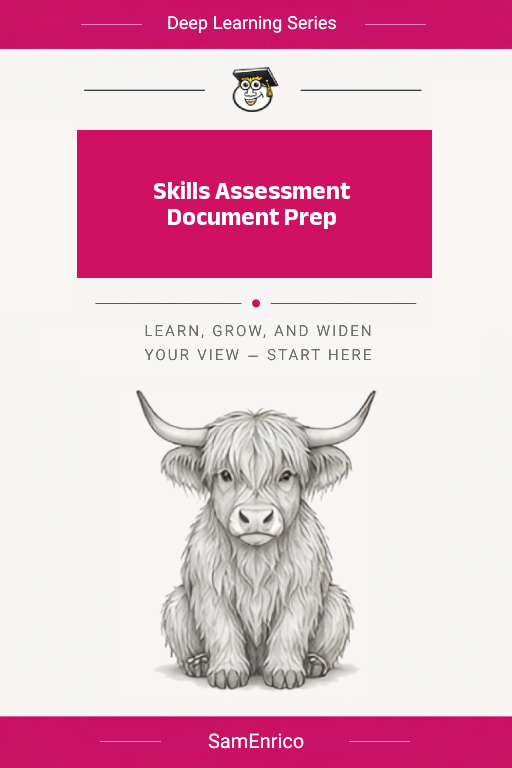
Non-FictionStudent's ShortcutSkills AssessmentDocument Prep
Skills Assessment Document Prep eBook
Prepare degree transcripts, employment evidence, a
Prepare degree transcripts, employment evidence, and English test results for ACS, Engineers Australia, or CPAA verification.
Formats
Free sample
Chapter 1: The Three-Headed Beast--–- You are about to make a very expensive mistake. Not because you are unqualified. Not because your English is poor. Not because your degree is worthless. But because you do not understand who you are dealing with.
And in the world of Australian skills assessments, not knowing your assessor is like walking into a courtroom without knowing which judge is sitting on the bench.Every year, thousands of skilled professionals submit applications to the Australian Computer Society, Engineers Australia, and CPA Australia. Every year, a staggering percentage of those applications are rejected not because the applicant lacked skill or experience, but because they prepared documents for the wrong assessor. They wrote a reference letter that would have worked perfectly for ACS, submitted it to Engineers Australia, and received a cold rejection. They prepared a Competency Demonstration Report that met every EA standard, sent it to CPAA, and were told their degree did not count. They assumed all three bodies wanted the same thing.
They were catastrophically wrong.This chapter is your survival guide to the three-headed beast. By the time you finish reading, you will understand exactly what each assessing body wants, what each body ignores, and where the dangerous overlaps can trick even experienced applicants. You will learn why ACS cares about your project methodology while EA cares about your engineering problem-solving and CPAA cares about your specific course syllabus. You will discover the single question that determines which body you actually need – and it is probably not the one you think.The Three Personalities Think of the three assessing bodies as three different hiring managers at three different companies. They all want skilled professionals.
They all use similar language on their websites. But when you sit down for the interview, their questions could not be more different.ACS is the technical interviewer who wants to see your code, your project documentation, and your ability to work within a structured development methodology. This body does not care about your professional engineering license. It does not care about your membership in any accounting body. It cares about one thing: can you demonstrate, through detailed project reports and employer references, that you have performed ICT work at a professional level?
The ACS skills assessment is fundamentally a test of whether your daily work matches the ANZSCO description for your nominated occupation. If you claim to be a Software Engineer, ACS wants to see evidence that you design, build, and test software systems. If you claim to be an ICT Business Analyst, ACS wants to see requirement gathering, process modeling, and stakeholder management. Nothing more. Nothing less.Engineers Australia is the engineering regulator who wants to see how you think.
This body does not care about your specific programming language or your project management certification. It cares about whether you apply engineering principles to solve problems. The EA Competency Demonstration Report is not a list of your job duties. It is a narrative of how you identified a problem, analyzed it using engineering methods, designed a solution, implemented it, and verified that it worked. EA wants to see the 16 competency elements spread across three groups: knowledge and skill base, engineering application ability, and professional attributes.
A reference letter that says "I managed a team of five developers" means nothing to EA. A Career Episode that says "I analyzed the load-bearing failure in the bridge design and recalculated the stress distribution using finite element analysis" means everything.CPAA is the accreditation auditor who wants to see your transcript. Unlike ACS and EA, CPAA is not primarily assessing your work experience or your projects. CPAA is assessing whether your university degree covers the specific core knowledge areas required for professional accounting accreditation in Australia. This is the most misunderstood assessment of the three.
Thousands of accountants have submitted degrees from prestigious universities outside Australia, only to be told that their education does not meet CPAA standards. Why? Because they did not take a separate course in Australian commercial law. Because their management accounting unit did not cover specific topics that CPAA requires. Because their degree was accredited in their home country but that accreditation does not transfer.
CPAA looks at your transcript first, your syllabus second, and your work experience a distant third.The Universal Baseline: The Australian Qualifications Framework Before you panic, there is good news. All three bodies share one common foundation: the Australian Qualifications Framework. Understanding this framework is the single most important piece of background knowledge you will gain in this book.The AQF is the national policy that defines all qualifications recognized in Australia. It has ten levels, from Certificate I (Level 1) to Doctoral Degree (Level 10). For skills assessment purposes, you care about three levels: Bachelor Degree (Level 7), Graduate Certificate/Graduate Diploma (Level 8), and Master Degree (Level 9).ACS, EA, and CPAA all use the AQF as their baseline for academic qualifications.
This means that if you hold a Bachelor degree from an accredited university in any country, the AQF level is the same. A Bachelor of Engineering from India, a Bachelor of Commerce from Pakistan, and a Bachelor of Information Technology from the Philippines are all considered AQF Level 7 qualifications. The bodies do not rank your university against Australian universities. They do not care if your university is famous or unknown. They care whether your qualification is equivalent to an Australian AQF Level 7, 8, or 9.But here is where the common baseline ends.
While all three bodies accept the same AQF levels, they interpret them differently for different purposes. ACS accepts a Bachelor degree in any discipline as long as you have sufficient ICT content. Engineers Australia requires your Bachelor degree to be in engineering or a closely related field. CPAA requires your Bachelor degree to cover specific accounting core areas – not just any degree will do. You can hold a Ph D in economics from Oxford and still fail the CPAA skills assessment because you never took a course in Australian taxation.Where They Diverge: The Critical Distinctions Let me be brutally specific about what each body requires and what each body ignores.
This is the information that most guides get wrong.ACS requires a detailed employment history with reference letters that map directly to ANZSCO task descriptions. ACS is the only body of the three that publishes a list of acceptable occupations with corresponding ANZSCO codes. You must nominate an occupation from that list. Your reference letters must then demonstrate that you performed the tasks listed under that ANZSCO code. ACS does not require a syllabus for your degree unless you are applying through the Recognition of Prior Learning pathway without an ICT qualification.
ACS does not require you to demonstrate engineering competency. ACS does not care about your membership in any professional body. ACS wants to see project reports, reference letters, and evidence of paid employment.Engineers Australia requires a Competency Demonstration Report with three Career Episodes and a Summary Statement mapping to 16 competency elements. EA is the only body that uses the competency element framework drawn from the Australian Engineering Competency Standards. You do not nominate an ANZSCO code for EA in the same way you do for ACS – you…
This is the end of the free sample. Get the eBook to keep going. Buy now
About this book
Details
- Author
- Parkinson Mathilde
- Publisher
- SamEnrico
- Language
- English
- Genre
- Non-Fiction, Student's Shortcut, Skills Assessment, Document Prep
- Released
- 2026-06-01
- Pages (approx.)
- 155
- Available as
- eBook, Audiobook

Read better in the ZLOADR app
Your eBooks on your phone or tablet. Sign in with your SamEnrico account and start reading.
More by Parkinson Mathilde
 Stress Management Blended FamiliesParkinson Mathilde$11.99
 The Request RejectionParkinson Mathilde$11.99
 Forgiveness Breath MeditationParkinson Mathilde$11.99
 Listening In Project ManagementParkinson Mathilde$11.99
 Dream Character JournalParkinson Mathilde$11.99
 Savoring Technique Mastery GuideParkinson Mathilde$11.99
 CBT in Low Resource SettingsParkinson Mathilde$11.99
 The Quilt of NamesParkinson Mathilde$11.99
 Babe Ruth CalledParkinson Mathilde$11.99
 The Pharaoh's Shadow: How a Forgotten Heist Rocked EgyptologyParkinson Mathilde$11.99
 The Admiral Who Defied the Tides: Togo Heihachiro and the Battle of TsushimaParkinson Mathilde$11.99
 Iron Veins: The Unseen Foundations of Manhattan’s SkylineParkinson Mathilde$11.99
You may also like
 Hong Kong Handover 1997Dunn Johnnie$11.99
 Zumba For Postnatal Recovery CourseNeal Christian$11.99
 Zumba for BeginnersLadner Nikia$11.99
 YouTube Comment Mining GuideHumes Pandora$12.99
 Worry Box MeditationCarlin Rudy$11.99
 Workplace Stress MeditationNguyen Lynn$11.99
 Workplace Stress and Sleep RepairHawley Ivory$11.99
 Workplace Perfectionism CureDelaney Jeffry$11.99
 Workplace Injustice Anger GuideWallen Isabelle$11.99
 Work Addiction and Burnout LinkGreenwood Ester$11.99
 Women in Yoga and WellnessBeattie Galina$11.99
 Women in Stand Up ComedyChun Evangeline$11.99