
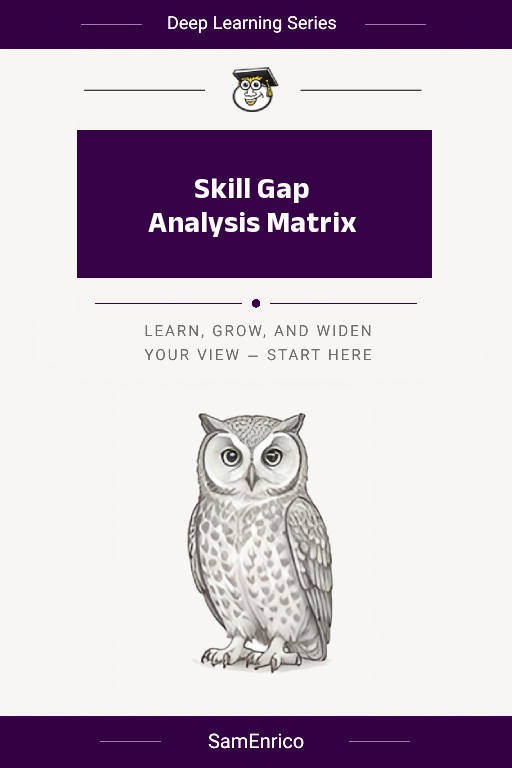
Skill Gap Analysis Matrix eBook
Compare current vs required skills for your target
by Woodard Elin
Compare current vs required skills for your target role in the next 12 months.
Formats
Free sample
Chapter 1: The Half-Life of You--–- The email arrived at 11:47 on a Tuesday. The subject line read: “Update to Role Requirements – Mandatory Review.” Inside, a spreadsheet listed fourteen new competencies. Eleven of them used words Sarah had never seen before. She had been a senior marketing manager for eight years. Three months earlier, her performance review had been glowing.
Now, her manager explained gently that her skills were “no longer aligned with the department’s strategic direction.” She had ninety days to “skill up” or be placed on a performance improvement plan. That night, Sarah sat at her kitchen table with her laptop open to five job postings. Every single one listed requirements that didn’t exist when she graduated. She typed into Google: “Why do I feel obsolete at 37?” Two million results. She was not alone.This is not a book about fear.
It is a book about the mechanism behind that fear and, more importantly, the exact sequence of actions required to dismantle it. The mechanism is called skill obsolescence. Most professionals experience it as a vague sense of falling behind, a low‑grade anxiety that everyone else secretly knows something they do not. But skill obsolescence is not vague at all. It follows predictable patterns, accelerates at measurable rates, and—crucially—responds to a specific kind of intervention.
The first step of that intervention is understanding, with brutal clarity, how fast your current skills are expiring.The Myth of the Permanent Career For most of the twentieth century, a reasonable professional could expect that the skills acquired in their twenties would serve them until their fifties. A nurse learned to take vitals, administer medications, and manage patient records. That knowledge changed slowly, if at all, over decades. A machinist learned to read blueprints, operate a lathe, and measure tolerances. Those skills remained valuable for an entire career.
An accountant learned double‑entry bookkeeping, tax law, and auditing standards. The fundamentals shifted incrementally, not seismically.That world is gone. It is not coming back.The rate of skill obsolescence has been accelerating for forty years, but the past decade has seen a step function change. Automation, artificial intelligence, cloud computing, and globalized talent markets have compressed the useful lifespan of technical skills from decades to months. According to research from IBM’s Institute for Business Value, the half‑life of a learned skill is now less than five years.
For technical roles in software, data science, and digital marketing, the half‑life drops to two and a half years. That means half of what you know today will be obsolete before your next major anniversary.Consider the role of a graphic designer. In 2015, a designer needed proficiency in Adobe Photoshop, Illustrator, and In Design, plus a solid understanding of print production and typography. By 2018, the same designer needed motion graphics (After Effects), basic HTML/CSS for email designs, and familiarity with user interface principles. By 2022, the job postings required Figma, prototyping skills, knowledge of design systems, and—in many cases—experience with AI tools like Midjourney or DALL‑E.
The foundational skills from 2015 remained useful, but they were no longer sufficient. They had become table stakes, not differentiators.The pattern repeats across industries. Data entry specialists have seen their roles transformed by robotic process automation. Mid‑level marketers who once excelled at print campaigns now need Google Analytics, marketing automation platforms, and basic SQL. Project managers who thrived on Gantt charts and status reports now need agile methodology, Jira administration, and data visualization.
In every case, the core argument is the same: the skills that got you into the room will not keep you in the room.The Half‑Life of Skills: A Precise Definition The term “half‑life” comes from physics. It describes the time required for half of a radioactive substance’s atoms to decay into a different state. Applied to skills, the half‑life is the period after which half of a professional’s current competencies have lost significant economic value—meaning they are no longer sufficient to perform the role at the same level without supplementation.This is not an abstract concept. It has measurable consequences. When a skill’s half‑life shortens, three things happen simultaneously.
First, the number of job postings requiring that skill begins to decline. Second, the salary premium associated with that skill erodes. Third, the skill shifts from the “differentiating” column to the “baseline” column—expected of everyone, rewarded by no one.Take the skill of basic spreadsheet manipulation. In 1995, a professional who could build a pivot table in Excel commanded a significant salary premium. Today, that same skill is assumed.
It has not disappeared, but its half‑life has expired. It decayed from a differentiating asset into a background expectation. The same process is currently happening to skills like basic data analysis in SQL, standard social media management, and traditional project management certification. These skills are not useless. They are just no longer enough.The half‑life of a given skill depends on three factors: the rate of technological change in that domain, the velocity of adoption within your industry, and the supply of new entrants who learned the skill more recently.
In high‑tech fields, half‑lives can be as short as eighteen months. In regulated industries like healthcare or law, half‑lives are longer but shrinking. No field is immune.The Skill Trap: Why Hard Work Isn’t Saving You If skill obsolescence were simply a matter of learning new things, the problem would solve itself. Professionals would take a course, read a book, attend a conference, and move on. But that is not what happens.
Instead, most professionals find themselves in a paradox: the harder they work to keep up, the more behind they feel. This is the Skill Trap.The Skill Trap operates through three mechanisms. First, the expansion of required competencies means that each year, your role demands more skills than the year before. What used to be a job requiring five distinct competencies now requires ten. You are not falling behind because you are lazy; you are falling behind because the finish line keeps moving.Second, the compression of learning windows means you have less time to acquire each new skill.
When Excel introduced pivot tables, professionals had years to adopt the feature. When a new marketing automation platform emerges today, your competitors are expected to be proficient within months. The window for learning has shrunk faster than the capacity for learning.Third, the illusion of mastery tricks you into overestimating your current abilities. Research on the Dunning‑Kruger effect shows that people consistently rate themselves above average on skills they have not yet learned to assess accurately. You think you are at a Level 4 (proficient) when objective measures would place you at a Level 2 (advanced beginner).
This gap between perceived and actual proficiency is the most dangerous element of the Skill Trap because it delays action until the gap is too wide to close.Consider a mid‑level data analyst named James. He has been using SQL for six years. He writes complex queries, joins multiple tables, and creates views. He rates himself a 4 out of 5 on SQL proficiency. But the…
This is the end of the free sample. Get the eBook to keep going. Buy now
About this book
Details
- Author
- Woodard Elin
- Publisher
- SamEnrico
- Language
- English
- Genre
- Non-Fiction, Professional's Cheat Sheet, Skill Gaps, Target Role
- Released
- 2026-06-01
- Pages (approx.)
- 134
- Available as
- eBook, Audiobook

Read better in the ZLOADR app
Your eBooks on your phone or tablet. Sign in with your SamEnrico account and start reading.
More by Woodard Elin
 Loneliness Board Game GroupWoodard Elin$11.99
 Widow Self Worth GuideWoodard Elin$11.99
 Technology Failure Recurring DreamsWoodard Elin$11.99
 Boardroom Difficult TalksWoodard Elin$11.99
 The Energy Recovery MethodWoodard Elin$11.99
 The Interruption HourWoodard Elin$11.99
 Test Anxiety TranceWoodard Elin$11.99Test Anxiety TranceWoodard Elin$11.99
 The Bizarre Clothing PileWoodard Elin$11.99
 Antwerp Heist Forensic EvidenceWoodard Elin$11.99
 The Underground Riders: How BMX Smuggled Freedom Across the Iron CurtainWoodard Elin$11.99
 Echoes of the First Dawn: The Indian Ocean's Cosmic ConnectionWoodard Elin$11.99