
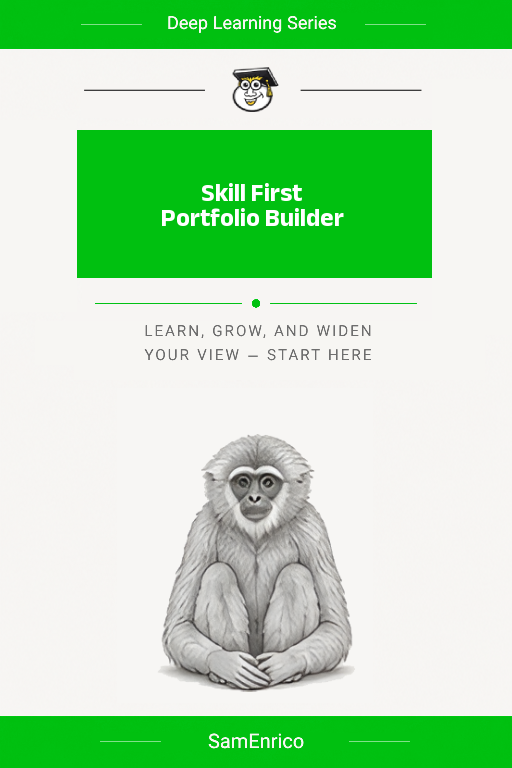
Non-FictionZero-to-One CreatorSkills Focus Guide
Skill First Portfolio Builder eBook
Build your portfolio around demonstrable skills ra
Build your portfolio around demonstrable skills rather than job titles. This guide focuses on skill audits, competency projects, and skill-based portfolio organization.
Formats
Free sample
Chapter 1: Titles Are Lies--–- Your last job title is lying to you. Not exaggerating. Not marketing-speak. Lying. And the longer you believe it, the more money, opportunities, and self-respect you are leaving on the table.Let me prove it to you in the next thirty seconds.Think about your most recent job title.
Maybe it was "Marketing Manager." Or "Senior Analyst." Or "Project Lead." Now answer this question honestly: If I put ten people with that same title in a room, would they all be able to do each other's jobs?Of course not.One "Marketing Manager" spends her days running Facebook ads and writing copy. Another spends his days negotiating vendor contracts and managing budgets. A third spends her days analyzing customer data and presenting to executives. Same title. Completely different skill sets.
One of them is a writer. One is a negotiator. One is a data storyteller. The title told you nothing useful.Now here is the painful part. When you lost that job—or when you leave it—that title becomes worse than useless.
It becomes a cage. Because the next employer looks at "Marketing Manager" and thinks they know what you can do. And they are probably wrong. And you will spend the entire interview trying to correct their assumptions instead of showing them what you can actually do.This book is going to fix that. Not by telling you to ignore titles entirely—you cannot, they exist on background checks and Linked In and resumes—but by teaching you to treat them as what they should be: metadata.
File folder labels. The box, not the contents.Welcome to the skill-first revolution. It is time to build your portfolio around what you can actually do.The Great Unraveling of the Linear Career For most of the twentieth century, the career playbook was simple. You picked a field. You entered at the bottom.
You climbed the ladder year by year. Assistant became manager. Manager became director. Director became vice president. Each title was a step, and each step was a signal.
Employers trusted the signal because the system was stable.That system is dead.It did not die all at once. It died in a thousand small cuts. The rise of job-hopping (the average worker now holds twelve jobs in their lifetime, not three). The explosion of freelance and contract work (thirty-six percent of the US workforce now participates in the gig economy). The collapse of corporate loyalty (the average tenure at a company is now just over four years).
The pandemic, which taught millions of people that their job title could disappear overnight through no fault of their own.And now artificial intelligence, which is doing something even more unsettling. It is not just eliminating jobs. It is redefining them. A "copywriter" today uses AI tools that did not exist two years ago. A "data analyst" today needs prompting skills that were not in any job description five years ago.
A "project manager" today coordinates remote teams across time zones in ways that would have been science fiction a decade ago.Your title is not keeping up. It cannot keep up. Titles are slow. Skills are fast.Cal Newport, in his book So Good They Can't Ignore You, introduced a concept he called "career capital." The idea is simple: the things that matter in your career are not your passion or your title or your connections. They are your rare and valuable skills.
These are the assets you trade for opportunities, money, and autonomy. Without them, you are begging. With them, you are negotiating.Newport was right, but he stopped too soon. He told us why skills matter. He did not tell us how to prove them.
That is what this book is for.The Title Hangover: A Diagnosis Before we go any further, I want you to diagnose yourself. Below is a quick self-assessment. Answer honestly.The Title Hangover Self-Diagnostic Check any of the following that apply to you:You have been passed over for a role you know you could do, and you suspect it was because your title did not match You struggle to explain what you actually do beyond reading your job description aloud You have stayed in a role too long because the title looked good on paper You feel invisible when networking outside your industry because people only understand your title, not your skills You have said "I'm just a [title]" in the last thirty days You have a skill you developed outside work (volunteering, side project, hobby) that you have never figured out how to put on a resume You have been laid off and realized your title meant nothing the moment you walked out the door You look at job postings and feel like you could do the work but you would never get past the title filter Scoring: If you checked three or more of these, you have a severe Title Hangover. If you checked one or two, you have a mild case. If you checked zero, you are either already skill-first or you are not being honest with yourself.The good news is that a Title Hangover is curable.
The cure is not a new title. The cure is a skill-first portfolio.Titles as Metadata, Not Identity Let me introduce a framework that will guide everything in this book. I call it the Skill Trifecta. It has three components:Inventory: What skills do you actually have? (Chapters 1 and 2)Proof: How do you demonstrate those skills with evidence?
(Chapters 3 and 4)Stage: How do you present that evidence to the world? (Chapters 5 through 12)Everything in this book builds on these three pillars. But before we can build, we need to clear away the rubble. And the rubble is your attachment to your job titles.I am not going to tell you to delete your job titles. That would be foolish.
They appear on your Linked In profile. They appear on your resume. They appear on background check forms. You cannot pretend they never existed.But you can change their meaning.Think of a job title like the label on a file folder. The label tells you where the folder belongs.
It helps you find the folder later. But the contents of the folder are what actually matter. The label is metadata—data about data. It is not the data itself.Right now, you have been treating the label as the contents. You have been saying "I am a Marketing Manager" as if that sentence contains information about your abilities.
It does not. It contains information about where you sat and what you were called. That is all.Starting today, you will use titles as metadata. You will keep them on your resume because you have to. You will list them on Linked In because the platform requires it.
But you will stop leading with them. You will stop identifying with them. You will stop letting them define what you believe you can do.The Squiggly Career and the Portfolio Life Helen Tupper and Sarah Ellis, in their book The Squiggly Career, documented something that everyone already felt but few had named: careers no longer move in straight lines.…
This is the end of the free sample. Get the eBook to keep going. Buy now
About this book
Details
- Author
- Charlton Octavia
- Publisher
- SamEnrico
- Language
- English
- Genre
- Non-Fiction, Zero-to-One Creator, Skills Focus Guide
- Released
- 2026-05-30
- Pages (approx.)
- 131
- Available as
- eBook, Audiobook

Read better in the ZLOADR app
Your eBooks on your phone or tablet. Sign in with your SamEnrico account and start reading.
More by Charlton Octavia
 Congo Independence CrisisCharlton Octavia$11.99
 Beta Cryptoxanthin Lung GuideCharlton Octavia$11.99
 From Anger To AssertivenessCharlton Octavia$11.99
 Tension Headache and MeditationCharlton Octavia$11.99
 Focus Habit FormationCharlton Octavia$11.99
 CAR T Cell SurvivorCharlton Octavia$11.99
 Anchoring Effect StrategiesCharlton Octavia$11.99
 Legal Courtroom Body LanguageCharlton Octavia$11.99
 Sandwich Generation Survival GuideCharlton Octavia$11.99
 The Day the Internet Broke: How a Single Bug Shut Down the WorldCharlton Octavia$11.99
 The Last Empress: How One Woman Ruled a Falling EmpireCharlton Octavia$11.99
 Quetzalcoatl’s Celestial Symphony: The Feathered Serpent’s Divine AnthemCharlton Octavia$11.99
You may also like
 Hong Kong Handover 1997Dunn Johnnie$11.99
 Zumba For Postnatal Recovery CourseNeal Christian$11.99
 Zumba for BeginnersLadner Nikia$11.99
 YouTube Comment Mining GuideHumes Pandora$12.99
 Worry Box MeditationCarlin Rudy$11.99
 Workplace Stress MeditationNguyen Lynn$11.99
 Workplace Stress and Sleep RepairHawley Ivory$11.99
 Workplace Perfectionism CureDelaney Jeffry$11.99
 Workplace Injustice Anger GuideWallen Isabelle$11.99
 Work Addiction and Burnout LinkGreenwood Ester$11.99
 Women in Yoga and WellnessBeattie Galina$11.99
 Women in Stand Up ComedyChun Evangeline$11.99