
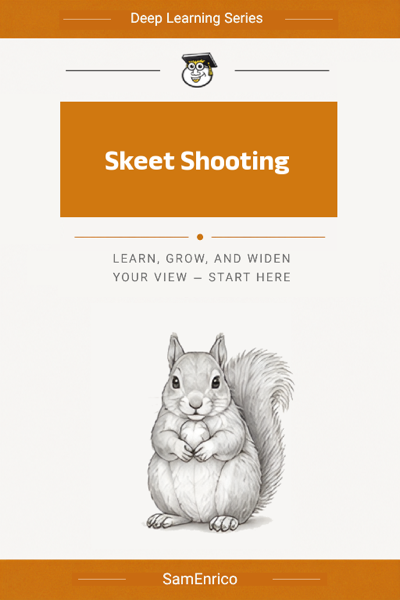
Non-FictionInformativeEducational
Skeet Shooting
A Coursebook on Skeet Shooting
A Coursebook on Skeet Shooting
Formats
About this book
Free sample
Chapter 1: Invisible Geometry...--The clay target that just sailed past your barrel without breaking isn't mocking you—it's teaching you. The problem is that you don't yet speak its language. Skeet shooting is not, despite what your frustrated instincts are telling you, a test of reflexes. It is not a test of how fast you can snap the gun to your shoulder. It is not a game of "seeing the target and shooting it." Skeet shooting is a mathematical sport disguised as a reflexive one, and the mathematics have been hiding in plain sight since the moment you first stepped onto the field.Every miss you have ever experienced can be traced back to a failure of geometry.
You either misjudged an angle, miscalculated a distance, or lost track of your position within the semi-circle. The shooters who break 25 straight are not faster than you. They are not younger, stronger, or gifted with supernatural eyesight. They have simply internalized the invisible geometry of the skeet field until it became as automatic as walking. This chapter is where you begin to do the same.The Accidental Invention of a Sport Before you can master the geometry of the modern skeet field, you need to understand how that geometry came to exist.
The story begins in Andover, Massachusetts, in the 1920s, with a frustrated grouse hunter named William Harnden Foster. Foster loved upland bird hunting, but he hated how few opportunities he had to practice the crossing shots that birds presented in the field. He could shoot at rising targets (trap shooting simulated that well enough), but incoming crossers, quartering angles, and overhead passes required a different kind of practice.Foster's solution was radical for its time: he and his friends at the Andover Gun Club began experimenting with a circular shooting layout. They placed shooters around the circumference of a large circle and launched targets from two trap houses located on opposite sides. The shooter would stand at various "stations" around the circle, engaging targets that crossed from one house to the other.
They called it "Shooting Around the Clock."The original circular field had twelve stations, one for each hour on a clock…
This is the end of the free sample. Get the eBook to keep going. Buy now
Contents
- Chapter 1
- Chapter 2
- Chapter 3
- Chapter 4
- Chapter 5
- Chapter 6
- Chapter 7
- Chapter 8
- Chapter 9
- Chapter 10
- Chapter 11
- Chapter 12
Details
- Author
- Baird Mirella
- Publisher
- SamEnrico
- Language
- English
- Genre
- Non-Fiction, Informative, Educational
- Released
- 2026-05-08
- Pages (approx.)
- 151
- Available as
- eBook, Audiobook

Read better in the ZLOADR app
Your eBooks on your phone or tablet. Sign in with your SamEnrico account and start reading.
More by Baird Mirella
 Omega 3 Fish Oil Memory GuideBaird Mirella$11.99
 Mountain Trail Walking Meditation GuideBaird Mirella$11.99
 Project Kickoff Meeting GuideBaird Mirella$11.99
 Wedding Alcohol Sobriety GuideBaird Mirella$11.99
 Body Scan for Public Speaking NervesBaird Mirella$11.99
 The Siege of Malacca: The Last Stand of the Portuguese East (1641)Baird Mirella$11.99
 Understanding Nystagmus, PeripheralBaird Mirella$17.99
 Celanese ManufacturingBaird Mirella$12.99
 Studienkolleg Preparation GuideBaird Mirella$12.99
 How to Start a Cable-laying Vessel Service Business (Beginners Guide)Baird Mirella$11.99
You may also like
 Hong Kong Handover 1997Dunn Johnnie$11.99
 Zumba For Postnatal Recovery CourseNeal Christian$11.99
 Zumba for BeginnersLadner Nikia$11.99
 YouTube Comment Mining GuideHumes Pandora$12.99
 Worry Box MeditationCarlin Rudy$11.99
 Workplace Stress MeditationNguyen Lynn$11.99
 Workplace Stress and Sleep RepairHawley Ivory$11.99
 Workplace Perfectionism CureDelaney Jeffry$11.99
 Workplace Injustice Anger GuideWallen Isabelle$11.99
 Work Addiction and Burnout LinkGreenwood Ester$11.99
 Women in Yoga and WellnessBeattie Galina$11.99
 Women in Stand Up ComedyChun Evangeline$11.99