
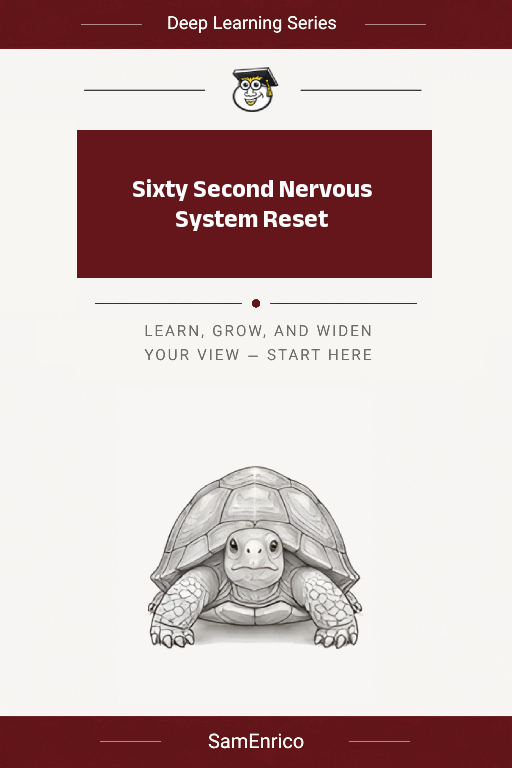
Sixty Second Nervous System Reset eBook
Use five rapid techniques to shift from fight-or-f
by Villa Noelia
Use five rapid techniques to shift from fight-or-flight to rest-and-digest in under one minute.
Formats
Free sample
Chapter 1: The Impossible Command...--–- You are sitting in traffic, already ten minutes late. The car in front of you brakes for no reason. Your jaw tightens. Your shoulders rise toward your ears. Your phone buzzes—another email with a red exclamation mark.
And somewhere in the back of your mind, a voice says, Just calm down. It's fine. Just relax.That voice is lying to you.Not because it means harm. Not because you lack willpower or discipline or spiritual enlightenment. That voice is lying because it is giving you an impossible command.
Telling yourself to "calm down" while your body is flooded with stress chemicals is like telling a sinking ship to stop taking on water—without offering a bucket, a pump, or any way to patch the hull.This chapter will explain why cognitive commands fail during high stress, introduce you to the three distinct states of your nervous system, and reveal the single most important shift you will make in this book: moving from mind-first to body-first resets. By the end of this chapter, you will understand why you are not broken, why your anxiety is not a character flaw, and why the solution has been hiding in plain sight—in your own body, waiting for you to learn a different language.The Paradox of "Just Relax"Let us begin with a simple experiment. Right now, as you read these words, try to force yourself to feel calm. Command your body: Relax. Let go.
Be peaceful.What happened?For most people, the attempt to force calm creates the opposite effect. Your heart may have sped up slightly. Your attention may have narrowed. You might have felt a flicker of frustration or self-judgment—Why can't I just relax? This is not a personal failing.
This is neurology.The prefrontal cortex—the part of your brain responsible for rational commands, self-control, and long-term planning—is exquisitely sensitive to stress. When your nervous system detects a threat (real or imagined), it begins a cascade of chemical and electrical events designed to prioritize survival over everything else. Blood flows away from the prefrontal cortex and toward the limbs (for fighting or fleeing). The thinking brain literally goes offline.Think of it this way: when a house is on fire, you do not sit down to write a thoughtful essay about fire safety. You run.
You grab a hose. You yell for help. The fire itself is not the time for reflection—it is the time for action. The same is true for your nervous system. When your body perceives a threat, the "thinking brain" is deprioritized.
The command "calm down" is processed by the very brain region that has just been asked to step aside.This is why telling an anxious person to "just relax" is not merely unhelpful—it is actively counterproductive. The command creates a secondary stressor: the failure to comply. Now, in addition to the original trigger (traffic, email, argument), you have added a layer of self-judgment. I can't even calm down correctly. What is wrong with me?Nothing is wrong with you.
You have simply been using the wrong tool for the job.The Autonomic Nervous System: Your Body's Hidden Conductor To understand why "calm down" fails, you need to meet the conductor of your internal orchestra: the Autonomic Nervous System (ANS). This system runs silently in the background, regulating your heart rate, breathing, digestion, pupil dilation, sweat glands, and dozens of other functions you never have to think about. It is called "autonomic" because it operates automatically—you do not have to remember to make your heart beat or your lungs breathe.The ANS has three distinct branches, and each one produces a completely different state of body and mind. Think of them as three gears in a car: neutral, drive, and park. Most people spend their entire lives stuck in one gear without realizing they have a gearshift.State One: Ventral Vagal (Safe, Social, Connected)At the top of the ladder is the Ventral Vagal state.
This is the home of safety, connection, and ease. When you are in ventral vagal, your heart rate is steady but flexible, your breathing is calm, your digestion works properly, and your face is soft and expressive. You can make eye contact without discomfort. You can hear someone disagree with you without your heart racing. You can laugh genuinely, cry when sad, and reach out for help when needed.This is not a state of "toxic positivity" or forced happiness.
Ventral vagal includes the full range of human emotion—grief, frustration, boredom, joy, anticipation. The difference is that in ventral vagal, your nervous system has capacity. You can feel difficult emotions without being overwhelmed by them. You can experience stress without being hijacked by it.Most of us spend far less time in ventral vagal than we think. And that is not our fault.State Two: Sympathetic (Fight-or-Flight)The middle rung of the ladder is the Sympathetic state.
This is the famous "fight-or-flight" response, and it is not a bug—it is a feature. Your sympathetic nervous system is designed to save your life. When a car swerves toward you, when a dog lunges, when you hear a crash in the dark, your sympathetic system floods your body with adrenaline and cortisol. Your heart rate spikes. Your pupils dilate.
Blood rushes to your large muscle groups. Your digestion slows or stops. Your hearing sharpens. Your thinking brain downshifts to a narrow, threat-focused mode.This is an exquisitely useful state—for real, physical threats that last seconds or minutes.The problem is that modern life is full of threats that are not physical and do not end quickly. An angry email is not a predator, but your nervous system may treat it like one.
A looming deadline is not a physical threat, but your body may flood with cortisol anyway. A difficult conversation with your partner does not require you to run or fight, but your sympathetic system may activate as if your life depends on it.When you live in a chronic state of sympathetic activation, you experience what many people call "anxiety," "stress," or "being wound up." You may feel:A racing heart or tight chest Shallow, rapid breathing Clenched jaw or fists Inability to sit still Irritability or sudden anger Difficulty concentrating Feeling "on edge" for no clear reason This is not a character flaw. This is a nervous system that has learned to stay in fight-or-flight because it has forgotten how to find the brake pedal.State Three: Dorsal Vagal (Freeze, Shutdown, Numb)The bottom rung of the ladder is the Dorsal Vagal state. This is the oldest evolutionary response, shared with reptiles and other primitive vertebrates. When a threat is overwhelming—when fight-or-flight is impossible or has failed—the dorsal vagal system initiates a shutdown.
Heart rate drops. Blood pressure falls. The body goes into a conservation mode, sometimes described as "playing dead" or "fainting goat" response.In humans, dorsal vagal activation looks very different from sympathetic activation. Instead of racing heart and agitation, you may experience:Feeling "spaced out" or disconnected from your body Numbness or emotional flatness Profound fatigue that sleep does not…
This is the end of the free sample. Get the eBook to keep going. Buy now
About this book
Details
- Author
- Villa Noelia
- Publisher
- SamEnrico
- Language
- English
- Genre
- Non-Fiction, Mental Wealth
- Released
- 2026-06-01
- Pages (approx.)
- 137
- Available as
- eBook, Audiobook

Read better in the ZLOADR app
Your eBooks on your phone or tablet. Sign in with your SamEnrico account and start reading.
More by Villa Noelia
 India FCPA Violation LogVilla Noelia$11.99
 Transcendental Meditation PostureVilla Noelia$11.99
 Therapy Without Borders Access GuideVilla Noelia$11.99
 Party Planning ShortcutVilla Noelia$11.99
 Imposter OCD Doubt LoopVilla Noelia$11.99
 Single Person LTC GuideVilla Noelia$11.99
 The Midnight Couriers: China's Forgotten Underground RailroadVilla Noelia$11.99
 Breath and Mental States ConnectionVilla Noelia$11.99
 Indigenous Grief Rituals ManualVilla Noelia$11.99
 Whispers of the Sky: The Vanishing City of the CloudsVilla Noelia$11.99
 Silent No More: The Unfinished Fight for the 19th AmendmentVilla Noelia$11.99
 Procurement Assistant PathVilla Noelia$12.99
You may also like
 Hong Kong Handover 1997Dunn Johnnie$11.99
 Zumba For Postnatal Recovery CourseNeal Christian$11.99
 Zumba for BeginnersLadner Nikia$11.99
 YouTube Comment Mining GuideHumes Pandora$12.99
 Worry Box MeditationCarlin Rudy$11.99
 Workplace Stress MeditationNguyen Lynn$11.99
 Workplace Stress and Sleep RepairHawley Ivory$11.99
 Workplace Perfectionism CureDelaney Jeffry$11.99
 Workplace Injustice Anger GuideWallen Isabelle$11.99
 Work Addiction and Burnout LinkGreenwood Ester$11.99
 Women in Yoga and WellnessBeattie Galina$11.99
 Women in Stand Up ComedyChun Evangeline$11.99